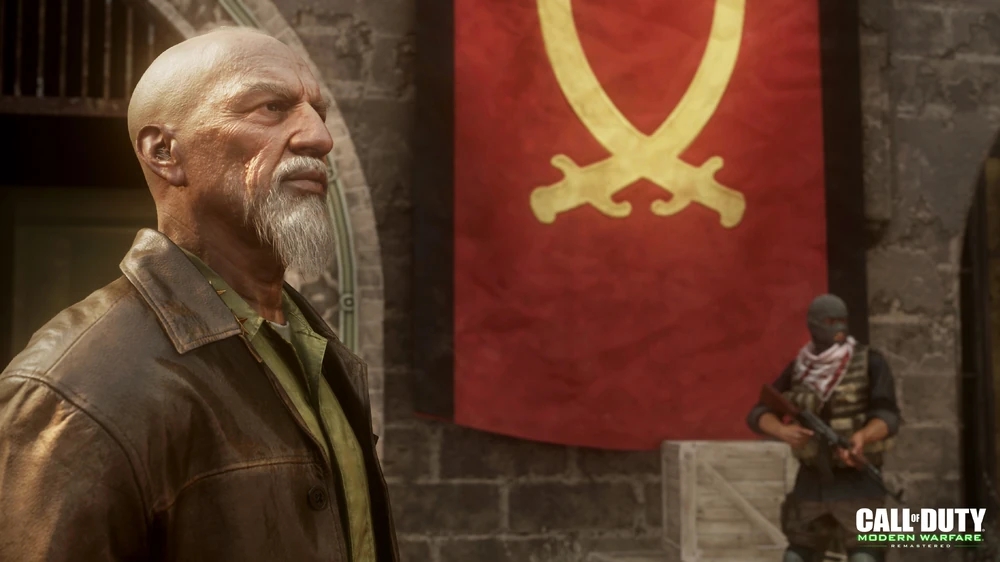
Imran Zakhaev at the Execution of President Al-Fulani (“The Coup”, Call of Duty Modern Warfare Remastered, Activision)
How the original Modern Warfare trilogy took a surprising anti-war stance.
Let’s Summarize A Game from Seventeen Years Ago
To any returning readers from Monday, welcome! I’ll point out here that my plan for this website is to handle serious topics on Mondays, and entertainment topics on Wednesdays. So, if talking about the Call of Duty series of video games in a literary fashion seems to be at odds with Monday’s post about the dangers of allowing AI to take over our writing, it should be.
The genesis of this article came as part of a summary for a much longer piece comparing and contrasting the original and rebooted Modern Warfare subseries of Call of Duty in the context of why people react so negatively to reboots compared to their original source material. Current events and the general state of the world made me revisit some old thoughts regarding the original Modern Warfare trilogy, which led to this offshoot being worthy of an article of its own.
The original Call of Duty Modern Warfare games brutally deconstruct the entire western military mindset. I’ll start this with a brief summary of the events of all three games. We’re going full spoilers here, so if you haven’t played them by now, you’re either not going to or you’ve really got to work through your backlog.
Call of Duty 4: Modern Warfare, set sometime in 2011, begins with Sergeant John ‘Soap’ MacTavish joining Captain John Price’s unit with the 22nd SAS Regiment. Soap, Price, and Price’s Lieutenant only identified as Gaz interdict a cargo ship and discover a nuclear weapon on board, bound for the Middle East, but can only grab the manifest before Russian fast attack aircraft sink the boat. At the same time, a mysterious military figure, Khaled Al-Asad, executes the president of an unnamed country in the Middle East as part of a coup d’etat. The game jumps back and forth between two perspectives as Price’s unit tries to extract their informant within the Russian Ultranationalist group, ‘Nikolai’ from within Russia, which is in the middle of a civil war. Meanwhile, US Marine Sergeant Paul Jackson, under the command of Lieutenant Vasquez and Sergeant Griggs, joins a massive American invasion force of the Middle Eastern nation to find and capture Al-Asad and end his threat once and for all.
The first act of the game ends when 30,000 American servicemembers of the invasion force are wiped out by a nuclear detonation in the Capital City. You play as Jackson when the nuke goes off and get a firsthand look at the proceedings. The second act opens when Nikolai tips Price’s team off about Al-Asad being holed up in a safehouse in Azerbaijan. The team discovers Al-Asad was working with a figure from Price’s past: Imran Zakhaev. Price then tells his team about a mission in Pripyat, Ukraine, to assassinate Zakhaev, who was making arms deals in the post-Soviet age and becoming a threat.
The iconic mission of the game: All Ghillied Up, has then-Lieutenant Price and Captain MacMillian sneak through irradiated Pripyat in the shadow of the Chernobyl Nuclear Power Plant, ten years after the infamous disaster, to assassinate Zakhaev in a flashback. In the present, Griggs, who was not present when the nuke went off, helps extract the team, and they go after Zakhaev’s son, Victor, who commits suicide to avoid being captured. This causes his father to take over a nuclear launch facility in Russia. The joint American-British team is sent to stop him. They succeed, but the final confrontation on a nearby bridge ends with Griggs and Gaz dead, Price seemingly dead, and Soap passing out after killing Zakhaev.
Call of Duty: Modern Warfare 2 picks up five years later, in 2016. Soap, now a Captain, leads Task Force 141, under the control of General Shepherd. Soap and Sergeant Gary ‘Roach’ Sanderson are on a two-man mission to mountain climb to a Russian airbase and infiltrate it to retrieve an American defense satellite module. In the middle of a blizzard. While this is going on, American Joseph Allen infiltrates the organization of terrorist Vladimir Makarov. Makarov was a follower of Zakhaev’s and launches an attack on an airport in Moscow with American weapons, leaving Allen’s body behind to cause Russia to attack the west.
Private James Ramirez is part of the 75th Ranger Regiment and was recently rotated home to Virginia when the Russians attack. Two narratives cover two separate fronts: Task Force 141’s efforts to track down Makarov and end the war, and Ramirez’s unit trying to keep the Russians from taking the East Coast. Task Force 141 find a prisoner in a Russian gulag who is instrumental in their task: Captain Price. The 141 then takes over a Russian naval base on the eastern side of the country and launches a nuclear missile to detonate above Washington DC, breaking the momentum of the invading army and allowing Ramirez and his fellow rangers to fight their way to the White House and retake DC.
Afterwards, Roach investigates Makarov’s safehouse under the command of Ghost, Soap’s Lieutenant who takes the role of Gaz from COD4 with a distinctive skull-patterned balaclava as opposed to a baseball cap. (Ghost shared a voice actor and personality traits with Gaz, since Gaz was killed off). The safehouse team successfully recover intelligence, but are betrayed by General Shepherd, who is trying to cover up his hand in allowing Makarov to start the war. Price and Soap decide to go after and kill Shepherd. They fight their way through his base in Afghanistan occupied by the mercenaries of Shadow Company and take him out.
Call of Duty: Modern Warfare 3 begins right when the previous game leaves off: Price and Soap are on the run, with Nikolai helping them get to India, where many of the Russian loyalists from the first game are in hiding since Makarov’s Ultranationalists have taken over. Shepherd’s death has caused Task Force 141 to be disavowed. Price and Soap, with the help of Nikolai and the Loyalists, work their way across Africa to find Makarov with the help of Yuri, a Loyalist fighter.
Meanwhile, the American Delta Force team Metal helps eject the Russians from New York and back to Europe, before being deployed to Europe themselves when Western Europe falls under a ground invasion from Russia after chemical attacks pave the way. Price, Soap, and Yuri infiltrate occupied Prague to kill Makarov, but are caught in a trap where Soap is killed. Yuri then tells Price that he used to be one of Makarov’s followers before turning on the megalomaniac.
Price and Yuri then team up with Team Metal to rescue the Russian President and his daughter before Makarov can get the nuclear launch codes, leading to the death of Team Metal. The war is over, and Task Force 141’s names have been cleared, but one loose end remains. Price and Yuri assault the hotel in Dubai where Makarov is hiding out, leading to Makarov and Yuri’s deaths, but the end of the conflict with Price and the sole survivor and a shattered world looking to rebuild. The End.
How exactly does a game about how fun World War III would be criticize war?
Now that the summary is finished, let’s read into the details to find this anti-war message, starting with Call of Duty 4: Modern Warfare. On the surface, a video game about socking it to the mighty evil Russians and the quasi-Iraqi generic Middle Easterners sounds about as red-blooded American as you could get. Especially in 2007. And in some factors, you’d be right to make that assessment. A lot of us thought it was really cool to use an AC-130 Gunship to blow the absolute hell out of a small town in Russia and all the evil Russians trying to hunt our allies down, and who didn’t get pumped with the Marines’ bravado going in and kicking the bad guys’ teeth in?
By digging deeper into the narrative of the game, some of the anti-war sentiment is revealed. First, you have political instability in Russia necessitating the investigation of a freighter with suspected contraband on board. Not only are you not told what to be looking for, but you find out it’s a nuclear weapon. As with a lot of war stories, the soldiers on the ground are expendable for the sake of the mission, and it’s only through grit and brotherhood they can survive. You’re also kept in the dark about the nature of the mission. An analytical mind will ask the question: why are we getting directly involved in another country’s internal affairs? Doesn’t that have the possibility of backfiring like it has in real life?
Short answer: Yes.
Long answer: you set in motion the chain of events leading to World War III.
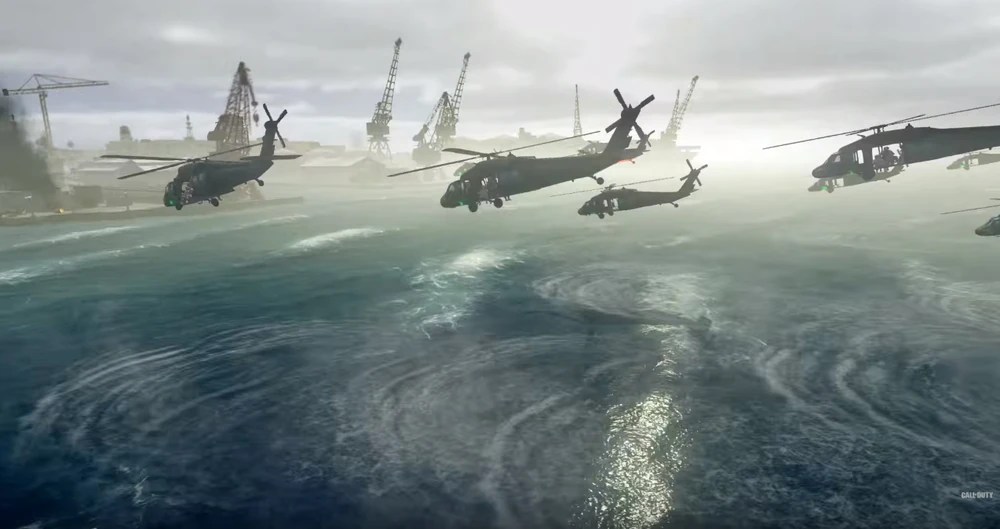
What we get dead wrong about Western Asia
Immediately after the cargo ship mission, a coup in the Middle East occurs. Now, you can launch a fair amount of criticism at the game regarding its depiction of western Asia. And I’m going to.
Khaled Al-Asad is meant to be a thinly veiled depiction of Saddam Hussein. In 2007, America’s invasion of Iraq to topple the dictator was still on the minds of most people in the United States, seeing as the occupation was ongoing. Saddam had only been executed by the Iraqi government about ten months before the game released. Furthermore, development started in 2005, which was only two years into the war in the first place. Middle Eastern dictators with an army of aging Soviet equipment and distinctive facial hair were all the rage in American media as antagonists. Al-Asad’s look was completed with a sweet pair of aviators, a distinctive red beret, and a white and red checkered keffiyeh wrapped around his neck. Even these paint him as a stereotypical Middle Eastern dictator. The aviators remind one of Libya’s Mummar Gaddafi, the keffiyeh calls to mind longtime Palestinian Liberation Organization leader Yasser Arafat, and the facial hair is obviously alluding to Saddam Hussein. The accoutrements of the stereotypical Middle East dictator or bad guy serve to further dehumanize Al-Asad. Between the goatee, the aviators, and the hat, Al-Asad’s face is pretty much shrouded the whole time. He isn’t a person, he’s just an obstacle. On top of all of this, Al-Asad is never directly referenced in either of the sequels
The entirety of the American campaign is predicated on Al-Asad being a bad guy and needing to be removed from power. The country he’s running is never given a name nor a solid location. Missions in this “small but oil rich country” take place in such varied locations as the west coast of Saudi Arabia, the middle of Saudia Arabia, Bahrain on the east coast of the Arabian peninsula, and on the Iran-Iraq border. Those places having a unified government strong enough to hold that territory and weak enough to be overthrown by a Russian Ultranationalist stooge would be a geopolitical improbability the likes of which the world has never seen. Even Al-Asad’s forces are never given a name. In multiplayer, they face off against the US Marines in desert maps and are only given the name “OpFor.” OpFor stands for “Opposing Forces,” which is a military training term meant to refer to the unit portraying the enemy during exercises. Their flag is a red banner with crossed gold scimitars. The iconography could not be more generic if it tried.
Al-Asad gets introduced to us during The Coup, a playable cutscene which serves as the opening credits of the game after the training mission and short but intense operation on the cargo ship. The player, in the role of deposed President Al-Fulani (Translating roughly to “President Somebody”) watches from the backseat of a car as they are driven to an arena for their execution, past stereotypical coup scenes. Tanks roll down city streets, APCs unload loyal soldiers who breach houses, civilians are executed by Al-Asad’s forces, a gunfight against civilian resistance is swiftly won by the soldiers. And then Al-Fulani is dragged to a post in the middle of a crowded arena with television cameras where Imran Zakhaev hands Al-Asad a pistol and he shoots Al-Fulani.
It’s so undeniably generic and represents the worst of American attitudes towards the Middle East. While the 2000s were a vastly different time with different sensitivities, it’s still one of the weakest aspects of the campaign. And while Al-Asad is only the antagonist for the first act and is unceremoniously swept aside after he sends the Americans out with a boom, his plotline only exists to set the Americans up for their hubristic failure.
The only reason the United States gets involved against Al-Asad is because he took over. His speech during The Coup lays out his reasoning which is still incredibly generic. He wants to remove Western influences from his country, and free the people. He calls out Al-Fulani for colluding with the west like the monarchy from before the revolution (also another generic Middle East trait: we overthrew royalty to find a dictator that cozied up to the West, so now we’re going to overthrow him). In the whole speech, there’s no substance, there’s no insight into Al-Asad’s psychology or the history of his country.
Nobody knew about the nuclear weapon that Al-Asad had until they found it during the battle for the capital city. A few minutes before it detonated and killed 30,000 Americans. Modern Warfare 3 would retroactively establish that Makarov was responsible for ordering the detonation and Al-Asad was even more of a patsy than previously believed. Had America not needed to spread freedom and democracy and stop the bad guy, 30,000 American service members would not be radioactive dust and ashes, and would have the focus on the real threat: the Russian Ultranationalist
As horrendous as Al-Asad’s depiction is, I think it serves the narrative of not getting involved in war without a damn good reason quite well. The whole point of Al-Asad from Imran Zakhaev’s point of view is to focus the west on another problem elsewhere in the world so I can win the civil war at home in Russia, and we can become strong again. Classic misdirection. And it works, up until it doesn’t. Al-Asad is a generic bad guy, and America is so quick to take on these generic bad guys in the Middle East that it draws into a situation where we cannot focus on real threats and handle them with restraint and sensible actions.
You are the architects of your own chaos
After the SAS hunts down and captures Al-Asad, Price gives him the good ole Jack Bauer interrogation scheme of repeated punches. Except, it doesn’t work; Al-Asad never gives up any information and Zakhaev’s involvement only gets revealed when he calls Al-Asad in the midst of said percussive interrogation, causing Price to instantly execute Al-Asad with a shot to the head. Finding the man the world thinks responsible for the first detonation of a nuclear weapon in a non-test environment since 1945 is a justifiable action. The rest is not, and most western militaries would have run Price up the flagpole for taking such actions of his own accord. Furthermore, the history between Price and Zakhaev, and Price’s violent tendencies would have meant Price would have been the last person sent against Zakhaev. On top of that, had the British and American forces never stepped foot in Russia and had just tipped off their Loyalist allies about Zakhaev’s role in orchestrating the entire scenario, then Victor’s death never would have been the West’s fault and wouldn’t have inflamed his father to the same degree. There would be no need to nuke the west if Victor was taken out by other Russians. And Imran Zakhaev has just as much reason to hate Price from the botched assassination fifteen years prior, so Price’s involvement in the story serves to increase the tension of the situation and makes the whole point about the game being anti-war. Every action from finding Al-Asad to the end of the story only serves to make the situation worse. The West continues meddling in Russian internal affairs, killing the son of the Ultranationalist leader, convinces said leader to launch a nuke in retaliation. The West fighting their way into the launch facility to abort the strike and kill the guy who launched it, basically gets the whole team killed. And a news report heard over the end credits covers up the entirety of the events in Russia after Al-Asad’s nuclear weapon went off. All of that pain, all of that suffering, and nobody will ever know what truly happened. If the West had never started sticking their nose in places it didn’t belong, the outcome would have been much more of a net positive. Even the ending of the game can’t help but point out that without the timely intervention of Russian Loyalist allies taking Zakhaev’s attention, Soap never would have had the time to get Price’s pistol and kill Zakhaev.
Modern Warfare 2 picks up five years later (but came out in 2009), and all that meddling resulting in all that death still gave rise to the situation they tried to prevent. The Ultranationalists are running Russia, primed for conflict which gets lit off by an overly zealous American General who wants to see America be top dog, and a Russian psychopath who wants to see his nation win the big East vs. West measuring contest once and for all. Neither side are painted as in the right, and the playable characters and their comrades are all caught in the middle: pawns in games with millions of lives at stake. The American General wants an excuse to play hero and raze Moscow to the ground, and the invasion of the United States grants him the unilateral authority and popular support to make it happen. On the American campaign, you fight to take back your homeland, and free the White House from Russian occupation. All good, pro-America stuff, right?
Wrong.
There’s an exchange as you stand on the roof of the White House and look out onto the city in flames which challenges that idea. One of the nameless US Army Ranger NPCs is speaking to the two characters who have been the player’s guide through the American campaign: Corporal Dunn, and Sergeant Foley.
Ranger: So, when are we goin’ to Moscow?
Cpl. Dunn: Not soon enough man. But I know we’re gonna burn it down when we get there.
Ranger: Hooah.
Sgt. Foley: (sighs) When the time is right, Corporal. When the time is right.
“Whiskey Hotel”, Call of Duty: Modern Warfare 2
These soldiers are the victims of an imperialistic mindset, believing that they are serving their country, and seeking vengeance on the wrong nation for the lost lives of their people. Meanwhile their leader who engineered the whole situation is off with his private army making plans to be the big hero, happy to waste American lives in service of that goal. The player knows this information, the American characters do not. Furthermore, on the British side, your multi-national Task Force, set up to stop the bad guy that your actions gave rise to in the first game, was set-up to be scapegoats the whole time. You made the mess, recruited people to clean it up, got them all killed, took out the guy who engineered that situation only to be labeled as criminals and forced to go on the run.
The third game did not explore these themes as closely, and is arguably the weakest of the three campaigns from a story perspective. Shortly after Modern Warfare 2 launched, the entire development studio split in two when many staff members left after the leadership were forced out to start a new studio. As a result, the writing became a bit more cliché, even if the game maintained its fair share of entertaining gameplay and memorable moments (blowing up the Eiffel Tower being one of them). While the game focused more on wrapping up the story in an entertaining fashion, it still touched on those anti-war themes.
The American forces are trying to manage the chaos and bring to account the bad guy’s crew who helped push the situation out of control, while the remainders of Task Force 141 go on a quest for vengeance, ignoring the rules and decency because they’re outlaws anyways. When the heroes manage to do something right: rescue the Russian President that they all put in danger in the first place, it still costs most of their lives. The Task Force’s names are cleared, and they still lose one of their last members in the only sanctioned action they perform all game: killing the psychopath who pulled the strings. Again, a psychopath whom they let off the leash back during the events of the original game in the first place. For an added bonus, the hotel was very much occupied by civilians when Price and Yuri assault the building, and the first enemies aren’t Makarov’s soldiers but hotel security. The epic conclusion to the trilogy is all about bloodthirsty revenge that puts more innocent peoples’ lives in danger, and for an added bonus, the hotel heavily resembles the Burj Al Arab in Dubai, so it’s not like the developers are shying away from reminding people that real people in real places are affected by warfare like this, even far away from the front lines.
War? What is it good for?
After all is said and done, the trilogy leaves a narrative of utter destruction in its wake: the entire Eastern Seaboard of the United States is devastated by the invasion and will take more than a decade to rebuild at minimum. A bloody path was carved through Europe, destroying history on a scale not seen since World War II, and millions of people lie dead on all sides: civilian and military alike. If there was ever a story that showed how inglorious war turned out to be, ironically, it’s the trilogy that started the modern gaming craze of jingoistic, special operations soldiers saving the day with vast amounts of war crimes against the “wrong” people and totally justifiable destruction of anyone who happens to be nearby in service of the “greater good.”
Along the way, moments like the AC-130 mission in Call of Duty 4 were meant to make the players question what they were doing. You see the devastation am AC-130 gunship can bring immediately before taking control of it, and then you’re supposed to hear the guys laughing about raining death from above while you do so. Knowing anything about real conflict, and what a 105mm howitzer round does to a human being standing where it lands can make those chuckles from the AC-130 crew turn your stomach a bit. It provides a sad commentary on the dehumanizing nature of war.
The airport attack during the infamous No Russian mission was a master stroke in pushing an anti-war narrative. Vladimir Makarov’s plan: to attack a Russian airport speaking English with American weapons and leave the body of an American intelligence operative at the scene to make people believe America organized the attack on Russia works because of real history. If America didn’t have a history of subversive actions or lying to justify conflict (See: 1953 Iranian Coup d’Etat, Gulf of Tonkin incident), Makarov’s plan would have failed. However, with a little thinking, Makarov’s plan not only relies on the evidence of the incident, but also on knowledge of real history. In essence, the game is saying: one such incident is enough to spike tensions dramatically because it fits in with an established patterns of the supposed “good guys.” Not only that, but the player is forced to stand in the middle of a gunfire massacre of innocent civilians, complete with blood and screams and the audio of crying children (no children are actually present in game, just on the audio track).
There is no objective reality when it comes to geopolitics, as everyone is serving their own interests. Without exception.
The issues of a shooter critiquing war
In spite of all this, I admit that most people don’t read this far into the obligatory campaign of a game series mostly focused on multiplayer.
I did not come up with these ideas on my own. A few dark corners of the internet talked about Call of Duty 4 as having an anti-war sentiment, and it got me thinking. The more I contemplated the games, the more this interpretation made sense. An FPS series that primarily focuses on how awesome the Allies were against the least sympathetic villains in modern history does not lend itself to such a generous interpretation easily. I get that most audiences are not willing to put in the intellectual labor of a six hour campaign for a first person shooter game where the focus is online multiplayer and all of the bigoted slurs and implied fornication with peoples’ mothers which that entails. Especially in 2007.
If you want to write an anti-war message, an FPS series that has a great deal of Western-centric military idolization is a poor choice of medium to make that point without making it a bit more obvious. I recognize that, on the surface, the game tends to glorify the very things I say it’s trying to critique. However, I don’t think it’s that fair to say that it unilaterally glorifies war and makes the West out to be the undeniable good guys. There’s a strong anti-war interpretation in the original Modern Warfare trilogy that, while indulgent in the “fun” of war at times, shines through on any sort of analysis. While I don’t think that the sole purpose of the narrative was as a trojan horse, to put an anti-war message in front of people who glorify it, it’s impossible to deny that a game series from 2007-2011 tackles the complexity of warfare in the modern age with more nuance than many games of the modern era.




 Ark of the Lost Angels
Leave a comment