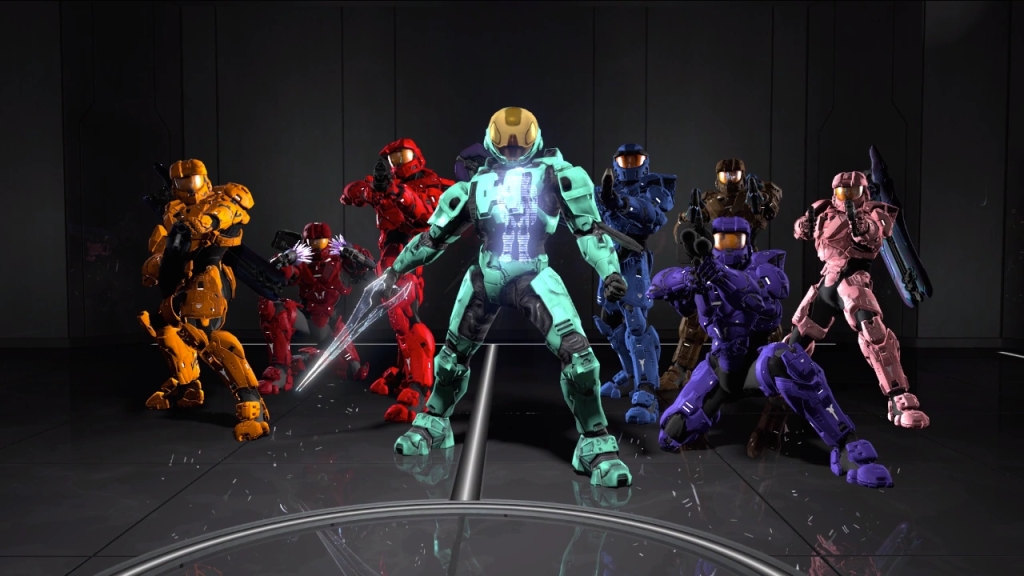
“Hey, uh, I just want you guys to know that, out of everyone I’ve ever met… I hate you all the least.”
Credit: Red vs Blue, Season 13 Episode 20 “The End”
A Look Back at Rooster Teeth’s Time on the Internet
Rooster Teeth began in 2003 with the creation of the long running webseries, Red vs. Blue. RvB was an early example of Machinima, that is to say, movies made inside video games; in this case, the Halo series served as the medium. This Inverse article, written ahead of Red vs. Blue’s Season 15 premiere, talks about some of the challenges faced in the early days of the company. Back then, the internet was a vastly different place, and it’s a remarkable thing that Rooster Teeth was able to navigate the digital landscape which shifted so rapidly and drastically over its 21-year history.
Originally starting as a few short videos made as jokes, Red vs. Blue blossomed into a hilarious, and later on, thought-provoking web series. The series premise is of two opposing armies fighting over a box canyon in the middle of nowhere, both teams made up of the worst of the worst of the Red and Blue armies. As the show goes on, these misfits become heroes in their own right, tackling challenges nobody thought they could, and unraveling the mystery of Project Freelancer. Freelancer was a shadowy program designed to create super soldiers and turn the tide of humanity’s war against the Covenant, tying in with the proper Halo mythos. The project delved into AI research, and the lengths humans will go to in order to reach what they want.
The show was immensely popular throughout Halo’s heyday as one of gaming’s
preeminent series. With the inclusion of CGI fight scenes starting in Season 8: Revelations, Rooster Teeth introduced the larger world to the work of Monty Oum, an animator with a distinctive flair for acrobatic and artistic fight scenes.
Oum’s efforts on Red vs. Blue would lead Rooster Teeth to greenlight his dream series, and the first original and later flagship IP of Rooster Teeth: Rwby. (pronounced Ruby, standing for Red, White, Black, Yellow; the colors of the four main characters). Rwby follows a group of young students at Beacon Academy, where they learn to become Hunters and Huntresses to keep innocent people safe from the dark forces of Grimm at work in the world.
Rwby’s popularity crossed over into more of a mainstream audience, and picked up steam in anime circles, leading to more attention on Rooster Teeth, and greater flexibility and freedom to try new things. Rooster Teeth Animation became an internet production powerhouse, in addition to other ventures like the company’s extensive podcast network and Achievement Hunter.
Achievement Hunter began in 2008 as an endeavor of Geoff Ramsay and Jack Pattillo. Ramsay and Burnie Burns were both fans of the Xbox 360 ‘Achievements’ in games but found there was no one-stop-shop for achievement guides and walkthroughs. Achievement Hunter was meant to fill that niche and grew into a force all its own as the team grew and their exploits became more varied. Of particular note were their long running series of Let’s Plays, especially Minecraft and Grand Theft Auto V. The almost three-hour odyssey, Uno: The Movie chronicling one session of the Xbox version of Uno in its entirety (it has an IMDB page) is also noteworthy.
It’s easy to underestimate what impact a company which started to produce videos in video games could grow into, but Rooster Teeth made it happen. In many ways, they were the prototypical internet production company, even pre-dating YouTube. The company always had a philosophy of prioritizing their own space on the internet over relying on another platform. YouTube is ubiquitous now, but back in its early days, that wasn’t a guarantee. There was a sense of forward thinking at Rooster Teeth that, while didn’t always pan out, was indicative of that hopefulness and optimism that permeated the internet of the early 2000s. Even the old Rooster Teeth website was what they called a “community site” and was in many ways, a prototypical example of what larger social media sites would do. It was a gathering space for fans just as much as it was the release avenue for the creators.
The sense of community was so strong that many longtime community members became company staff. The sense of community was so strong that in 2011, Rooster Teeth hosted a fan event known as RTX which grew over the years into a full convention which celebrated video games, anime, and internet culture, taking place in Austin, Texas each year, and spreading to other cities like Sydney and London. The community’s love was felt as well, routinely raising large sums of money during Rooster Teeth’s annual 24-hour livestream for Extra Life. Even in the midst of the pandemic, Rooster Teeth was able to raise a million dollars for the cause.
Rooster Teeth did eventually suffer from issues. To start with, the company became too ambitious in too many different directions, which did in later years lost a bit of a loss of identity and in trying to grow their audience ended up alienating some members of that audience. There were issues regarding the treatment of staff, a somewhat adversarial relationship with fans at times, horrendous crunch time to finish animation projects, and a few individuals who used their positions to hurt others. Some of these incidents made many of the employees as shocked and angry as fans were. Many hurt the audience’s trust in the company.
That is not to say that all of Rooster Teeth’s history was plagued with controversy and the company should have shuttered a long time ago. It’s a complex thing, as with most things people do.
For many of us into gaming and internet culture, Rooster Teeth was such a prominent entity in that part of society. Places like Rooster Teeth, Machinima (the YouTube channel, named after the filmmaking format), Penny Arcade, and others were important places to visit, with meaningful content to watch. In a time before social media drew so much of the internet into the same location, Rooster Teeth was a place to meet with friends who watched the same shows and found joy in the same type of humor.
It is important to echo the sentiment of so many people in the company and associated with the company: make sure to follow these amazingly creative people. They will continue to make excellent things going forward. It’s important to keep in mind that, above all else, there are over a hundred people who are losing their jobs.
But it’s also okay to lament the end of an era. Rooster Teeth inspired so many people to create themselves. Many of whom ended up joining the company, but just as many others went forth and did their own things. The number of people who were affected by something this company created numbers in the millions. It’s a part of internet history, however small. It was one of the few organizations left standing from its era of internet history, and its closure should be meaningful.
As they say, all good things must come to an end. I’ll always appreciate Rooster Teeth’s long, storied, influential history. I’ll still laugh at jokes from Red vs. Blue, and be enraptured with the fantastical world of Rwby, and relive memories of listening to old episodes of the Rooster Teeth podcast. I’ll take the lessons learned from within, reference running jokes, and continue to take my lead from the example of a company which took on the internet on its own terms and stayed in the ring for twenty-one years.
It’s a little difficult to succinctly summarize Rooster Teeth’s impact, both on the internet and web content at large, and on my own life in general. Suffice it to say that its legacy is important to remember.
After all, “Memory is the key.”






 Ark of the Lost Angels
Leave a comment