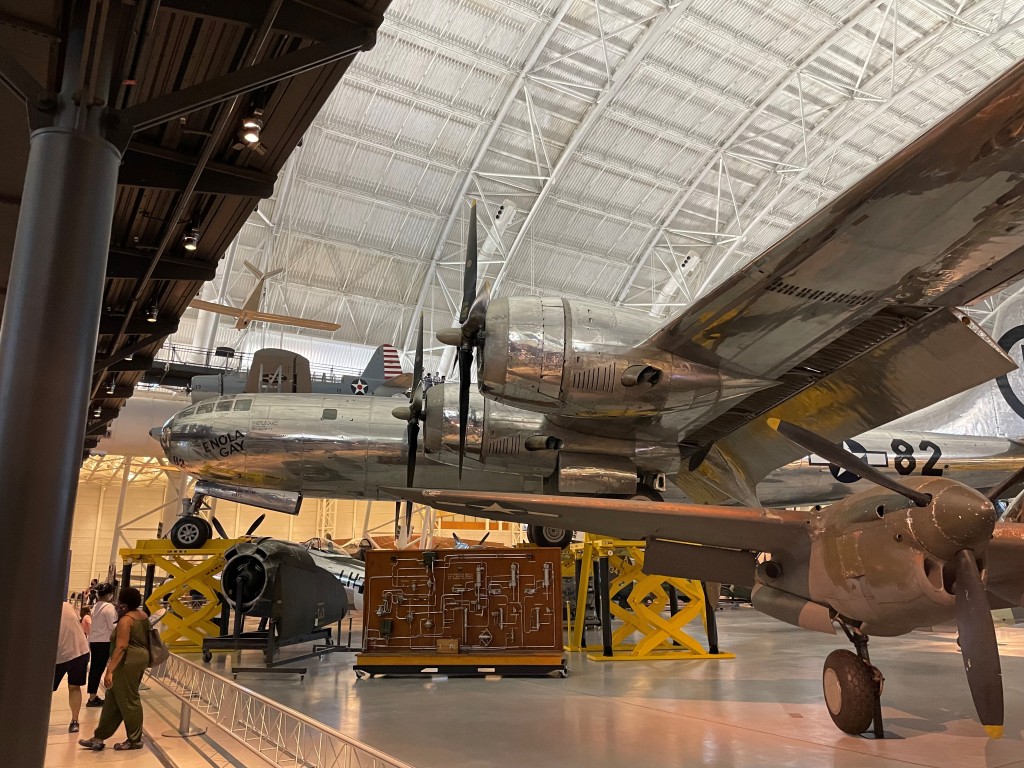
Boeing B-29 Superfortress Enola Gay on display at the Steven F. Udvar-Hazy Center of the National Air and Space Museum Credit: Author
A Dissection of Boeing’s Problems in the Modern Age, and Where They Came From
It’s no secret that Boeing has had a rough couple of months. Ever since the door plug blew off Alaska Airlines Flight 1282, an increasing amount of scrutiny has been given to the company’s practices over its recent history.
Boeing is a storied American company, with a company culture traditionally built around superior engineering, diligent safety, and quality products. Boeing has been at the forefront of aviation innovation and been a factor in America’s national defense for almost its entire existence. The history of Boeing as being so trustworthy and respected has made the display of the company’s inadequacies over the last several years so shocking and concerning to the American people. As the inquiries into Boeing’s failures grow, it seems there are more questions arising than answers.
What does it say when a company which helped win the greatest war the world has ever seen, with a reputation built on its focus toward engineering above all else, and a long storied history of safety standards turn into a comprehensive example of what not to do to manufacture safe airplanes?
More succinctly, how did Boeing, American king of aeronautical manufacturing, become a joke on late night television?
They Who Built An Armada That Blocked The Sun
Boeing has been around for well over a century now. The company was founded in Washington in 1916, a year before America would enter the devastating war in Europe which would later become known as World War I. The period between World Wars would give Boeing its great start, as they built military aircraft in the lead up to the deadliest conflict the world has ever seen. They would acquire companies such as Avion and Pratt & Whtiney, and they began supplying airlines.
Boeing’s fortunes would rise to even greater heights when the Empire of Japan awakened the sleeping giant on December 7th, 1941. With all of its resources behind the war effort, the United States gave Boeing the chance to build the Allies an armada which would block the sun. Boeing rose to the challenge in spectacular fashion. The company produced 98,965 aircraft, which made up roughly 28% of America’s total wartime aircraft production.
Two of the most iconic bombers of the war were manufactured by Boeing. The B-17 Flying Fortress was responsible for an overwhelming majority of the bombing raids over Germany thanks to its range, payload capacity, and ability for self-defense. When too many B-17s were lost to the Luftwaffe’s dedicated pilots, North American Aviation developed an escort fighter, the similarly iconic P-51 Mustang. North American would later merge with Rockwell-Standard to become North American Rockwell, which then became Rockwell International, who would in-turn be acquired by Boeing in December 1996.
The other aircraft Boeing built for the war effort that carved itself into the history books was the B-29 Superfortress. The B-29 was America’s apex of wartime bombers, with the increased range and pressurized cabin necessary to carry out long range bombings in the Pacific theater during the waning months of the war. In August of 1945, the B-29 nicknamed Enola Gay dropped the atomic bomb code named “Little Boy” on Hiroshima, and its sibling, Bockscar, dropped the atomic bomb codenamed “Fat Man” on Nagasaki. They remain the only two aircraft to have ever deployed nuclear weapons in combat.1
Suffice to say, Boeing cemented its place in aviation history with its historic efforts during the Second World War and would continue to make its mark on the defense industry with the Cold War, creating such iconic aircraft as the B-52 Stratofortress, introduced in 1955 and still in use today. The B-52 is expected to, with its latest round of upgrades, continue service into the 2050s.
Boeing’s aircraft were built to last.
After the end of the war, Boeing decided to get back into the commercial aviation game in earnest. One of the great technological leaps of the war was the jet engine, with the British Gloster Meteor and the German Messerschmidt Me 262 becoming operational within months of each other in 1944. Jet aircraft could fly much faster than their conventional counterparts, and despite jets never meeting in combat until the Korean War, they changed the world of aviation forever. In the wake of Japan’s surrender in September 1945, the jet engine now meant it was more feasible to travel long distances by plane than by train. Once aircraft manufacturers could pivot away from wartime manufacturing, the world of travel was forever altered.
Boeing introduced the 707 in 1958, and was the first widely available commercial jetliner, kicking off the jet age. While the first commercial jetliner was the British de Havilland Comet introduced in 1952, issues with its construction led to the Comet being withdrawn from service to be redesigned. The Comet 2 would resume flying passenger flights in 1958, but by that point, Boeing had already delivered several 707s to Pan Am and staked its claim as the premiere jetliner manufacturer.
Boeing redesigned its airplanes throughout the 20th century to be better in all areas: faster, more fuel efficient, longer ranged, more comfortable. Lockheed, who had built commercial airlines up until 1984 when it ended production of the L-1011 TriStar, bowed out of the commercial aviation game. For the American companies, Boeing was the clear winner.
Boeing was on top of the aviation world when the Cold War ended in 1991. Francis Fukuyama called the time period “the end of history.” The phrase reflected the optimistic worldview of the time. Most people believed that the darkest days were behind, and the new era would be one of peace and prosperity. The Soviet republics were now free of the grip of communism, the West had won the cold war, the world was more connected than ever, nuclear war had never happened, and there was a greater need to travel now that there were more places open for business.
If you cut Boeing’s history off with the dissolution of the Soviet Union, it would look pretty good too.
The Trojan Airplane
The optimistic attitude of the 1990s did not extend to the United States defense sector. The idea of open conflict with the Soviet Union was as dead as the USSR itself. The exorbitant defense spending of the Reagan administration was laughed at by the Clinton administration, who was attempting to bring down the national debt. The conflicts of the 1990s were relatively low-stakes in comparison to the possibility of a full-power defense of Europe against a Soviet invasion. The post-collapse Russia could barely feed itself and looked, at the time, as though they were seeking peace with the West. The Gulf War proved American technological superiority. The bombing campaigns in Yugoslavia during its contentious and brutal breakup were successful, and again, proved the superiority of Western military technology.
The United States reaped the benefits of its massive defense spending during the Cold War, but the war was over. The United States Department of Defense believed that they could not maintain Cold War levels of spending which would mean several defense companies would not remain afloat. Not wanting the optics of American companies to shutter so soon after winning the Cold War, the Pentagon urged many of the large defense companies to merge. Their great sin was leaving the terms of those mergers up to the companies themselves. This desire to cut costs led to an unprecedented consolidation, not only of industry but of influence as well. What’s worse is that those measures didn’t work to bring the defense budget down. The top ten defense contractors made up a whopping 74% of the spending on aircraft, ships, and vehicles for the 2022 fiscal year. Most of those companies came about due to the 90s mergers and acquisitions. Bloomberg’s full breakdown of the numbers is a bit staggering. The most important takeaway, however, is that companies cannot grow this large without exerting an undue influence on the government meant to keep them in check, and it’s a little naïve to expect so when said government tacitly encouraged that growth.
The 1990s were rife with American defense company mergers and acquisitions. Raytheon grew to its current size due to several mergers and acquisitions throughout the 80s and 90s. Northrop Corporation purchased Grumman Aerospace in 1994. Lockheed Aircraft Corporation and Martin Marietta merged to form Lockheed Martin in 1995. There were even discussions of a Northrop Grumman merger with Lockheed Martin in 1998. A Northrop Grumman merger with Lockheed Martin merger was shot down because it bore the risk of consolidating too much. The same could not be said of the merger which ushered Boeing down their current track. McDonnell Douglas, itself a product of a merger between McDonnell Aircraft and Douglas Aircraft Company in 1967, merged with Boeing in 1997.
By all accounts, Boeing’s corporate culture prioritized safety first. It was a company built by engineers, run by engineers, and guided by engineers. The corporation’s headquarters was located in Seattle, Washington, right near the manufacturing plants. The company famously did not worry about financials, believing in creating the best products with the highest reliability and safety, which in turn would create a stellar reputation. In essence, Boeing felt that by building the absolute best products, those offerings would sell themselves simply by being Boeing products. That strategy worked well for decades but would tragically change after the merger.
The joke goes that McDonnell Douglas bought Boeing with Boeing’s money.
The joke isn’t very far off from the truth. McDonnell Douglas’ executives were the ones who took over leadership of the new combined entity and opted to continue using Boeing’s name due to its better reputation. McDonnell Douglas essentially gained control of the combined company due to the stock shares held by their executives after the merger was initiated being greater than those held by Boeing’s former executives. As more McDonnell Douglas executives found themselves in senior leadership positions at the new Boeing, the company made several questionable moves. Starting with moving the corporate headquarters from Seattle to Chicago, Boeing moved several of its manufacturing operations out of Seattle to California and the Carolinas, among other places. Many longtime Boeing employees quickly became concerned with the more finance-focused and lax morality of the new bosses in town. Or rather, out of town. The corporate culture which previously elevated and celebrated engineers was now being guided by management focused on financials, who were content to watch all of Boeing’s operations from afar.
The loose morality can be easily exemplified by the time when Boeing’s rocket division was found to be in possession of thousands of pages of stolen Lockheed Martin documentation during a government bid competition in 1999. The merger happened in 1997, and this malfeasance was first uncovered in 2001. Almost immediately after the merger was completed, Boeing’s reputation began to suffer. McDonnell Douglas was not doing well financially when the merger was initiated. Their commercial aircraft operation only accounted for a minute percent of the market share, which is why regulators were happy to approve the sale. McDonnell Douglas executives took their strategies which had reduced their company to a footnote in the commercial aviation industry, and applied them to Boeing’s operations, sullying the once-gleaming Boeing name.
Sure enough, shortly after the merger, the executives in charge of Boeing’s commercial aviation divisions with engineering backgrounds were being replaced with individuals who held MBAs with work experience focused on sales and marketing. The engineers were no longer calling the shots on engineering projects, and as a result, the corporate culture shifted towards the loyal and willing as opposed to those dedicated to building the best airplanes. Boeing’s superior products afforded them the corporate dominance which allowed them to buy McDonnell Douglas for $14 billion in the first place. McDonnell Douglas was worth a fraction of Boeing by the mid-90s, and yet their ideology was the one that came out victorious. McDonnell Douglas managed to rewrite Boeing’s entire way of doing things within a few short years.
It doesn’t take a genius to see that Quality Assurance was impacted by that corporate reorganization.
The Assurance of Quality
Quality Assurance is vital to any effort in any industry. It’s not uncommon to think of QA in a manufacturing context. Most people hear “QA” and think of departments set up to check the quality of manufactured products from steel to airplanes to textiles to children’s toys to guidance systems for cruise missiles. However, QA is also important in, say, the software industry to find bugs, or in the document process of a company with government contracts.
Skimping on the QA process adds risk all over the place. In the document example, for US federal regulations, Section 508 Amendment to the Rehabilitation Act of 1973 necessitates all documents are accessible for the vision impaired. Not making sure those documents meet accessibility standards is in breach of US federal law and could hold harsh penalties for the contractors. For the steel example, a defective product may mean a building collapsing and killing people. It is not difficult to find examples of what a lack of sufficient quality control means for every sector of business.
Another important factor for most companies is their reputation. The world works based off of perception. Wars are started and ended over perception, leaders are elected based on perception, style is all about perception. Perception is the key to winning any battle in the world. Americans were happy to sacrifice on the home front during World War II because they perceived the war as the just thing to do, and they perceived their sacrifices at home making a palpable difference for their countrymen on the frontlines. Americans demanded an end to the Vietnam War because of the perception that America was losing a pointless conflict, and their countrymen were dying for no cause at all. Business is exactly the same. A car company which has the reputation of being unsafe will see fewer of their vehicles on the road. A clothing company which has the perception of being cheap and their products are damaged easily will see fewer sales. An airplane company which has the perception of putting the safety of its passengers at risk will see fewer airlines buying those planes.
With the direct consumer impact on these businesses causing a loss in revenue, and stock prices dropping due to that factor, perception alone has the power to wipe hundreds of millions from the books in short order by further devaluing company stock. Stock markets plummet, investors get scared, projects get cancelled, departments get downsized, people lose their jobs. A brain drain occurs, and the largest competitor gets well-trained staff knowledgeable about their rival’s practices and projects.
Boeing Down
Boeing’s current problems aren’t new. It’s only now that people are paying attention. The Boeing 737 MAX is the latest generation of the 737, which has been in service with airlines across the world since 1968, when the first generation started flying for Lufthansa. The 737 MAX has had trouble before when its autopilot system caused two devastating crashes in October of 2018 and March of 2019, which grounded the aircraft for almost two years.
The corporate culture which took hold after the merger set the stage for both the autopilot crashes, and the more current tales of woe afflicting Boeing. Corner cutting throughout the manufacturing process has caused more problems than it has solved, and cost Boeing more money than it would have taken to avoid. One can only get lucky to avoid catastrophe for so long, and the question becomes “when” disaster strikes, not “if” once an organization knowingly and willingly refuses to take steps to mitigate risk.
The inciting incident of this dramatic tailspin was Alaska Airlines Flight 1282. The plane in question was a Boeing 737 MAX 9, flying from Portland International Airport in Portland, Oregon to Ontario International Airport in Ontario, Canada on January 5th, 2024. During the flight, a door plug, which is a solid piece that replaces an optional emergency exit door, was blown out. This resulted in the cabin suffering an uncontrolled decompression. Subsequent investigation showed the door plug was installed without the proper mounting bolts. Public outcry led to increased attention on Boeing’s shortcomings in the fields of safety and manufacturing. There are verified reports of pilots being concerned about flying Boeing aircraft as they simply cannot trust the processes in place the way they used to.
Former Boeing employees are also concerned about the safety of Boeing aircraft as well, with at least one confirmed instance of a former employee who doesn’t trust his old employer’s products. Ed Pierson, a former Boeing executive, said he got off of a plane before takeoff upon realizing it was a Boeing 737 MAX. Pierson’s flight took place before the blowout of Alaska Airlines Flight 1282. Pierson was one of multiple whistleblowers who have come forth after leaving Boeing to talk about the company’s unsafe practices.
Whistleblower John Barnett laid out a damning series of accusations against Boeing’s manufacturing process and quality control. In the middle of his deposition, he ended up dead, supposedly of a self-inflicted gunshot wound. Overdramatic whispers of conspiracies aside, the optics are more than a bit troublesome for Boeing. Barnett’s accusations go beyond corporate incompetence. He alleges that Boeing knowingly installed sub-par components on production aircraft, including pulling those pieces from scrap bins. Barnett’s list of accusations also includes ignoring a problem with the oxygen system which could cause masks to not work in case of emergency, as well as abysmal tracking of defective parts which results in them getting lost on the factory floor and potentially installed into production aircraft. One such issue on its own may be just the reality of running a large manufacturing operation. However, the pattern of these issues suggests a lack of concern for safety at the core of Boeing’s operational philosophy. Air travel is the safest method of travel in America because of tight manufacturing quality controls, strict regulations, and the high standards which the tens of thousands of airplane manufacturers, airline crews, and federal officials are held to. A massive failure at any one of these points which is not called out by the others will result in flight being much riskier, and the chance of a disaster rising dramatically.
The FAA outright says that Boeing is not manufacturing safe aircraft. The government agency has gone onto criticize Boeing’s response to the Alaska Airlines Flight 1282 investigation due to Boeing being unable to produce requested documentation to comply with said investigation. The issue goes beyond not having the proper paperwork and represents one of the most prevalent cases of institutional failure of an airline manufacturer, perhaps ever. The consequences of this poor Quality Assurance process are hitting the company hard, as Boeing’s stock is in trouble due to the recent series of unfortunate events.
It seems every day that Boeing is hit with another story of a potential disaster on one of its flights. While it may lead to the perception that flying isn’t as safe as it is, Boeing’s recent headline stories are leading to the impression that flying on Boeing airplanes isn’t as safe as it used to be. Now you have passengers, industry professionals, and airline executives calling for something to be done.
Airbus is only too happy to pick up the phone.
Vultures Aren’t The Only Things Which Circle
If it was only the stock price tanking for Boeing, then the current situation would be considered charitable. Instead, this current path will spell disaster for Boeing’s commercial aviation business. This once-mighty American titan of airplane manufacturing is at risk of losing more of their business to Airbus. United Airlines is looking to lease dozens of Airbus planes due to Boeing’s failure to deliver the 737 MAX 10s which have seen consistent delays in delivery. Airbus also stands a chance at taking other airlines’ business, seeing as American Airlines has ordered more planes, the majority of which are coming from Airbus.
Airlines switching plane manufacturers is a significant investment, and a prominent signal that something is wrong. Maintenance crews are trained on certain aircraft, pilots have to be flight certified for their specific aircraft, and contracts in place for parts acquisitions only cover specific aircraft. Most airlines build relationships with airplane manufacturers because it allows them to keep operational overhead down. Airlines have to think longer term when it comes to paying for certification and training for both pilots and support staff. For an airline to pivot away from Boeing towards Airbus is a calculated move that, while it cannot happen overnight, signals a growing lack of confidence regarding Boeing’s quality in the future. It means a company is willing to overhaul their infrastructure on a mass scale because of Boeing’s perceived inadequacies, and a lack of confidence that Boeing will fix those issues.
Furthermore, with all of Boeing’s troubles, they remain a large component of defense manufacturing. Are the American taxpayers footing the bill to build airplanes, train their crews and support staff, and net the company a tidy profit all for products that won’t deliver when taking actions which are vital to national security?
Future Flight Plans
Boeing’s troubles are another example of corporate complacency and a fundamental misunderstanding of what caused the company’s success in the first place to bring about troubled times. It goes without saying that a serious reorganization is in order at Boeing. However, it may also be time to strengthen regulations regarding aircraft maintenance and manufacturing in general. It may be cavalier to talk about how bad all of these incidents look for Boeing, but the autopilot-related crashes of the 737 MAX airplanes back in 2018 and 2019 cost hundreds of lives. Boeing may be a societal punchline, but these problems are no laughing matter. Many of the incidents cropping up within the last several months have come with no fatalities, but if the safety culture at Boeing doesn’t undergo a significant shift in the imminent future, then it is only a matter of time before a much more devastating and impactful incident occurs.
This is also a call to look at the legacy of government contract mergers. Some companies which really should have been allowed to fail have instead become too vital to national interests. Their dissolution is now out of the question because they are too vital to national security. That necessity permits lax standards in other areas. The question now must be raised as to whether or not the plane has left the runway regarding keeping industries competitive, fair, free, and companies small enough to be kept in check by government regulations.
The national security angle cannot be overstated either. If Boeing is letting production defects on civilian airplanes roll out the door in mass quantities, are they cutting corners on their products meant for national defense as well? Is it possible for American aviators in service to their country to refuse to fly in Boeing-manufactured planes? Or will the American taxpayer have to foot the bill for even more extensive maintenance cycles because certain guarantees by the manufacturer cannot be taken at face value any longer?
Boeing, in many ways, is an American tragedy. Its current shortcomings represent failures throughout many industries and is another display of how complacency and disloyalty to the values which have brought success in favor of short term profit can whittle away at a giant until there is nothing left.
It’s a sad day to see the best of American companies fall into such a tragic tailspin.
- Fun Fact #1: Enola Gay is on display at the Steven F. Udvar-Hazy Center of the National Air and Space Museum, located near Dulles Airport in Chantilly, Virginia. Bockscar is on display at the National Museum of the United States Air Force, located in Dayton, Ohio
Fun Fact #2: There are two B-29s still airworthy today, out of a total of twenty-two surviving aircraft. FIFI and Doc routinely tour the country to appear at airshows. Six of the surviving forty-five B-17s are also currently airworthy ↩︎






 Ark of the Lost Angels
Leave a comment