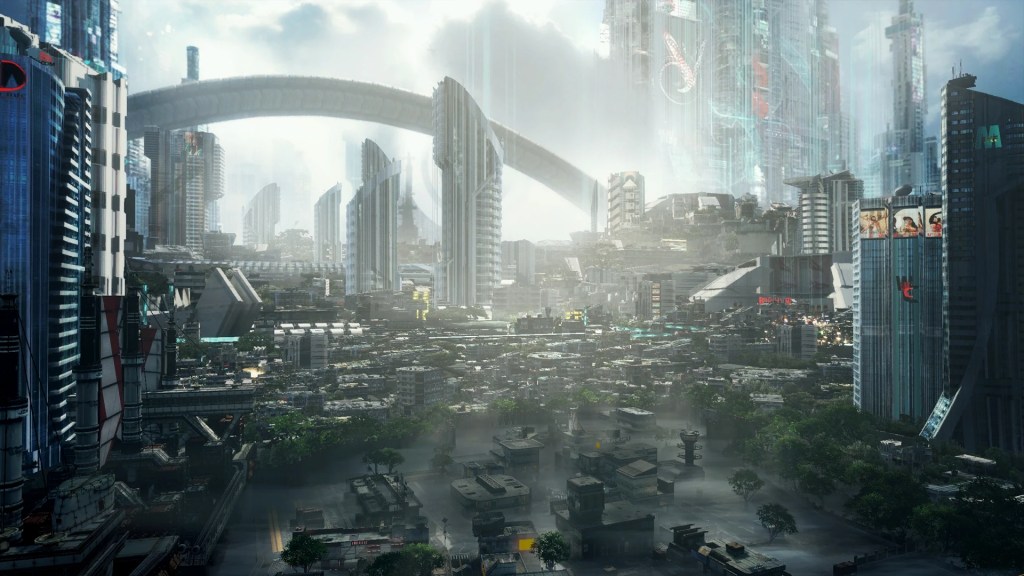
Angel City(Credit: Respawn Entertainment)
An examination of the Titanfall series’ history
Call of Duty has been one of the bestselling video game series of all time, starting when it was originally created in 2003 by Infinity Ward. However, gaming’s trajectory was changed right after 2009’s Modern Warfare 2 launched. In one of gaming’s most infamous cases of corporate screwery, Infinity Ward co-founders Vince Zampella and Jason West were forced out by Activision after renegotiating their contract. This came just after Zampella and West negotiated creative control over the Call of Duty franchise in exchange for Activision retaining the rights to the IP if the founders left Infinity Ward. In response, Zampella and West formed Respawn Entertainment and built a first-person shooter game that could have posed a serious threat to Call of Duty’s arcade shooter dominance.
Respawn answered Call of Duty with Titanfall. Last Monday, March 11th, marked the 10th anniversary of the launch of the first Titanfall game. Launched as an Xbox exclusive title during a period of the year where few if any blockbuster games have the chance to release, Titanfall was poised to reinvent the shooter genre and could have posed a serious threat to Call of Duty’s grasp over the gaming world. Sadly, after the launch of Titanfall 2 in 2016, it failed to happen. Titanfall 2 is regarded as an unparalleled shooter, even several years after its release. Many gamers speak fondly on Titanfall 2’s time in the sun. It’s viewed by many gamers that Respawn chose to pivot towards the free-to-play Battle Royale game Apex Legends set in the Titanfall universe as the company’s main focus, since the main series has so much to offer.
So, what the blazes is Titanfall?
When Two Sides Go To War
The original Titanfall is set in the Frontier, the area of colonized space at the edges of civilization. The game follows conflict between the Interstellar Manufacturing Corporation, a private corporation representing the interests of the core systems close to Earth, and the Frontier Militia, a loose band of privateers, mercenaries, and small militias opposed to the IMC reasserting old claims on planets which were abandoned during struggles in the core systems. The settlers had to fend for themselves for years and are none too pleased when the IMC returns and tries to take the resources of these colonies for themselves.
The well-equipped and highly trained Pilots are crucial components of both militaries. Acting as special forces, Pilots are linked to large mechs known as Titans, which are dropped onto the battlefield from orbit. A Pilot alone is seen as a dangerous force and can turn the tide of any battle with their superior skill over the drones and regular infantry used by both sides. The Titans are a massive force multiplier, and an effective Titan and Pilot can take on entire armies by themselves. Titans sit somewhere between true AI and simple vehicles for Pilots, and there have been cases where it seems Titans take on personality traits of their own.
The original Titanfall was a multiplayer-only game. During gameplay, after a certain amount of time, every player can call in a Titan. The timer is reduced with every kill or action towards completing the match objective. Once a Titan is dropped onto the battlefield, the player can allow the Titan’s AI to guard a location or follow the player or control the machine manually to wreak havoc on the battlefield.
The story of the original game is told through a series of pre-set multiplayer matches with additional voiceovers in the pre-game lobbies and during gameplay. Following an IMC victory at a refueling plant, the Militia stumbles upon a colony of settlers who deserted the IMC over a decade prior, and a former IMC officer. This officer gives the Militia a plan to even the odds against the IMC, by working their way towards the IMC’s main refueling plant at Demeter and destroying it. The refueling facilities allowed IMC forces to reach the Frontier from the Core Worlds in weeks, and with their destruction, it would take years. The plan succeeds, but only with the officer’s sacrifice.
Titanfall 2 picks up five years later, with a proper campaign mode, and the return of many characters from the first game’s shallow story, now able to give these characters more depth. The IMC is still struggling to rebuild the facilities at Demeter, and the Militia having organized themselves into a serious military force intent on liberating the Frontier once and for all. The IMC forces remaining in the Frontier have set up research facilities in hopes of finding any way to give themselves back the advantage. One such facility is found on the planet Typhon, where a massive Militia effort to assault and destroy the IMC weapon is underway.
The player takes the role of Rifleman Jack Cooper, who is being trained to be a pilot by Captain Tai Lastimosa. During the opening assault, Lastimosa is wounded and transfers control over his Titan, BT-7274, to Cooper before dying. Cooper, taking Lastimosa’s equipment, recharges BT, and the two set off to meet up with the Militia forces. Along the way, they uncover the truth about the IMC Fold Weapon and the untold devastation it could unleash on the Frontier, and take on the Apex Predators, a mercenary group under the command of Kuben Blisk that was hired by the IMC to secure the Fold Weapon. Ultimately, the weapon is destroyed, but not without BT’s sacrifice, and the fight to liberate the Frontier continues on.
Titanfall 2 is the last entry into the main series. The Battle Royale spinoff, Apex Legends, takes place roughly two decades after the end of the war, with a deliberately unclear outcome. In the far reaches of the frontier, a competitive combat sport known as the Apex Games has cropped up. The games are believed to have been set up by Blisk, who survived the war. Legacy characters from the Titanfall games are referenced and new characters, some with relations to legacy characters, are playable fighters.
Welcome to the Marauder Corps
The special thing about Titanfall’s gameplay is the similarity to Call of Duty on a base level, with added elements that make the game feel so fresh. The Titans are the biggest, being genuine threats to Pilots on the ground on their own, while the Pilots still have a great deal of maneuverability. Movement is important in the game, with Pilots being able to run on walls, double jump, and take advantage of momentum to whisk themselves across the battlefield in rapid fashion. In addition to the horizontal aspect which Call of Duty is known for, the Titanfall maps were designed with verticality in mind, as well as the Titans. Large open fields for Titans to duke it out are suicide for Pilots trying to cross, but Titans cannot follow Pilots onto rooftops or down narrow alleyways. It creates an interesting push and pull dynamic to the matches and refreshed the gameplay loop.
When the original Titanfall first came out, the contemporary Call of Duty game was Advanced Warfare, which introduced exoskeletons with double jumps and advanced movement to the series. Call of Duty had previously been a boots on the ground franchise with decently realistic settings. The biggest criticism with Advanced Warfare was that the movement didn’t feel like it was far enough out to really change the game, but it still wasn’t quite what Call of Duty previously felt like. Titanfall put them to shame with its movement, and was an actualization of Advance Warfare’s potential as a paradigm-shifting shooter.
Titanfall came along and captivated audiences seeking something new to it. The big criticism of the game was that it was a bit shallow. With no campaign, only three Titan chassis, and a handful of weapons and equipment to choose from, the gameplay loop was solid enough for diehards and fans of the Call of Duty formula wanting something new to get addicted to, but not quite enough to unseat the kings. Throughout the rest of 2014, three paid DLC packs came out with a few maps in each, and later, a Frontier Defense mode which was a wave-based survival against AI enemies was added. By the time the sequel came out, the original Titanfall had a fair amount to offer.
Titanfall launched in as shallow a state as it did due to a tricky development. Geoff Keighley, a prominent gaming journalist, wrote a longform story in his “The Final Hours of…” series chronicling the game’s tricky development. This excerpt gives a good snapshot, but the whole book is worth the read. The game was originally planned to be a launch title for the Xbox One in fall 2013 but was pushed about six months to give more development time. The end result was a fun, genre-challenging game which served as an excellent proof of concept for Titanfall 2.
Effect and Cause
Titanfall’s multiplayer was not for the weak of heart. When facing off against players who had mastered the movement, newer players were easy pickings. However, the game also allowed one to learn quickly, and even the odds. The weapons were pretty fairly balanced. With Titanfall 2, the charms of the original were maintained, and in many cases, enhanced. It was possible to do insane things like use a gravity star to curve a sniper bullet which led to many great stories being shared across social media and inflated the game’s reach. It was hard to explain just how Titanfall changed the landscape, because there was so much care, attention, and love put into the development of the game that it was addicting and fun, and there were always fun things to find in the game.
The gameplay was fun, fast, and refreshing compared to how trite Call of Duty had gotten by that point. The Titanfall 2 campaign, while built on the strength of its core gameplay being solid, had one single mission that is still spoken of with awe, reverence, and fondness all these years later. It’s called “Effect and Cause.” That’s a reversal of the usual phrase, and for good reason: the mission centers around time travel.
Part of the Fold Weapon at the core of the game’s narrative is that it is alien technology that, when used, creates temporal distortion. That technology was utilized in a glove found by a Militia Pilot while he was in search of the Fold Weapon. The gauntlet is used to move the wearer forward and backward in time. Cooper claims it off the Pilot’s body and uses it to traverse through a research facility in search of the Fold Weapon’s location. In the past, the facility is active and preparing for a test firing of the Fold Weapon. In the present, the facility is destroyed and overrun by wildlife.
Part of the genius of this mission is how the gauntlet is used in combat and puzzle solving. In certain sections, the player will have to rapidly flip back between the past and present to progress. One section even necessitated flipping back and forth while mid jump to successfully chain wall runs down a hallway because the ground was inaccessible in both states, and different parts of both walls were unusable in either time as well. The mechanic also had combat implications as well. IMC soldiers covered the facility in the past, but the wildlife and zombie security drones in the present were also quite difficult to handle as well. It added a new dimension to combat, time traveling to reposition and then switching back to get the jump on enemies who thought they had Cooper cornered just a moment ago.
Even the world building is affected by time traveling. There are audio logs throughout the mission, the content of which can be changed by the player acting in the past and listening in the present. One section involves interrupting General Marder, director of the facility, while he is giving a lecture. It’s the only time he physically appears in the game despite being the main antagonist. Blisk and the Apex Predators were just hired guns, despite showing up more often and providing a direct threat. (The General does appear in multiplayer as one of several selectable announcers for the player.)
If there is a level Titanfall 2 is known for, it’s Effect and Cause. The mission’s design is widely praised as bringing an interesting mechanic to an otherwise fantastic shooter that elevates the game as a whole, and leaves players clamoring for more. In fact, there are still people who wish to see an entire game built around the time travel mechanic. It says something about what a fantastic franchise Titanfall is that the sequel to a game known for innovating the fast-paced first person shooter genre introduces a mechanic for a single campaign mission that, years later, still makes people want more.
Trial By Fire
Titanfall didn’t sell as well as it could have, and there are a myriad of potential reasons why.
Titanfall 2’s launch was marred by a few factors that had nothing do with the game itself.
The largest of those was its release date. The game launched on October 28th, 2016. The fall launch window from late September through the middle of November is typically when the biggest game series launch their newest installments. Major blockbuster games typically launch in the final quarter of the year to capitalize on the holiday sales to boost their numbers. In 2016, Titanfall 2 nestled itself in between Battlefield 1 (released on October 21st), and Call of Duty Infinite Warfare (launched on November 4th). Titanfall may still have a place in many gamers’ hearts, but Call of Duty and Battlefield were still the undisputed kings of the FPS genre when it launched. The more established franchises sold more copies, and Titanfall 2 was available at a discount mere months after release.
The big problem with launching in the AAA window is consumers. Most gamers pick up one game during those times to play, as learning multiplayer and progressing is a considerable use of time. Games are typically $60 up front, and in 2016, season passes with access to all DLC were in vogue, and those usually ran $40-50 on top of that initial $60. In addition to launching amongst other, more longstanding franchises, even with a free DLC model, Titanfall 2 just didn’t have enough people with the extra $60 to spare to pick up in that crowded launch window.
The original Titanfall was an Xbox exclusive, while Titanfall 2 was proudly multi-platform. Apparently, people didn’t realize it was no longer an exclusive, and many PlayStation players wrote the game off as a ‘never’ purchase because they thought they couldn’t. Easy to find fault with the marketing there.
Additionally, there are concerns that with Respawn using a free model for its DLC and only charging for microtransactions later into the game’s lifecycle that Titanfall doesn’t lend itself to being monetarily justifiable, especially if it doesn’t sell well at initial launch. The game, however, has stood the test of time, and there are those curious who pick up Titanfall 2 at a discount all the time. The game still, several years after support has ended, is picking up new players.
These arguments, while not wholly without merit, fail to take into account the other factors that impacted Titanfall 2’s sales, as well as ignoring the potential boost of Apex Legends players who never played Titanfall getting a new game set in that world. Perhaps these reasons are enough to convince EA that Titanfall 3 is too big a risk. But Titanfall 2 has withstood the test of time. Players still enjoy it, and it is still held up as a benchmark of what an AAA shooter should aspire to be. A game of that quality deserves a sequel, and if built with the proper care and attention, can easily turn EA a tidy profit.
There’s really no reason not to do it.
Blood and Rust
Titanfall has become another in a long line of gaming franchises tacitly abandoned by their developers, despite an audience hungry for more, with only token references thrown around to placate frustrated fans. (i.e.: Ever notice how Sam Fisher has shown up in a dozen different places when the last Splinter Cell game was over ten years ago?)
There is a great community desire for a new Titanfall game. With that made clear, there is a level of uncertainty about the genre of the game, and the setting. The inability of the series to not reach its third mainline entry has led to an explosion of jokes comparing it to the long awaited Valve properties: Team Fortress, Half-Life, and Left For Dead, which have yet to see their third entries, or the Star Wars Battlefront series, which has been rebooted, but both the original and reboot stopped after their second entries. Many comments across social media represent the community’s desire for Titanfall 3 and find humor in the lack of news about a third entry. Titanfall 3’s release date has been comedically likened to lost information like what happened to Amelia Earhart, the real identity of D.B. Cooper, or the location of the fountain of youth.
The confusion over why Titanfall 3 isn’t coming afflicts a great many people. Titanfall 3 doesn’t need to redefine the shooter genre like its predecessors. Both the Battlefield and Call of Duty franchises have been hit with massive criticism over their latest entries. There is an opening to capitalize on frustrated FPS fans with a game that is simply well-built, balanced, and fun to play. In this environment, the King of Shooters crown is up for the taking, and a Titanfall 3 done well has the chance to take it. The eternal words from Field of Dreams ring true. “If you build it, they will come.”
In the meantime, we’ll have to be content with anticipation for the rumored new game in the universe, the memories of the days of old, and the hope that we’ll one day get to return to the War for the Frontier.
Uphold the Mission
On a personal note, Titanfall is one of my favorite franchises. In a time where I had walked away from Call of Duty, and before Destiny launched (which consumed much of my time for a few years), I had found a new shooter which scratched that Call of Duty-style gameplay itch while being grounded sci-fi, and a blast to play on multiplayer.
The setting of the first game: gritty science fiction about human struggles amongst the stars resonated with me. The art style grabbed me and pulled me into the sci-fi world I had been wanting since I was a kid: human-centric, industrial, about exploration and conflict on the verge between known and unknown. Technology wasn’t too advanced, and the art direction made me look at the worlds I wanted to see. I always thought it was a shame that Titanfall never took off with a bigger multimedia franchise, as an animated series or movie, comics, etc. expanding on this world could have been so interesting. Due to the lack of information available on the Titanfall Wiki, I actually expanded significant sections of multiple articles while I was on my free periods in school, and there are a few paragraphs on those articles which I can still recognize as my own writing that have persisted.
I was in high school when the first game came out. For fun, because I was entranced by this world, I created characters and an overarching story to link the game’s campaign with the other multiplayer maps into a larger narrative as one of my earliest ambitious writing projects. It was never finished as such, but I had created so much original content to flesh out the narrative that years after I abandoned the project, I decided to rework everything I had come up with myself and find a place for it in a science-fiction universe I was building from the ground up.
In the meantime, my tribute to Titanfall will exist in the notes of this story I wish to tell properly, taking what the game inspired me to create and running with it. Many of my ideas ended up overridden by Titanfall 2 once it came out anyways, and so it was harder to justify continue writing something which no longer fit with the canon. I realized as I got older that it’s sometimes difficult to play in someone else’s sandbox, even with your own sand.
Titanfall will always hold a place in my heart, and I hope one day to get back to fighting the war on the Frontier and drop my Titan back into battle once more.




 Ark of the Lost Angels

Leave a comment