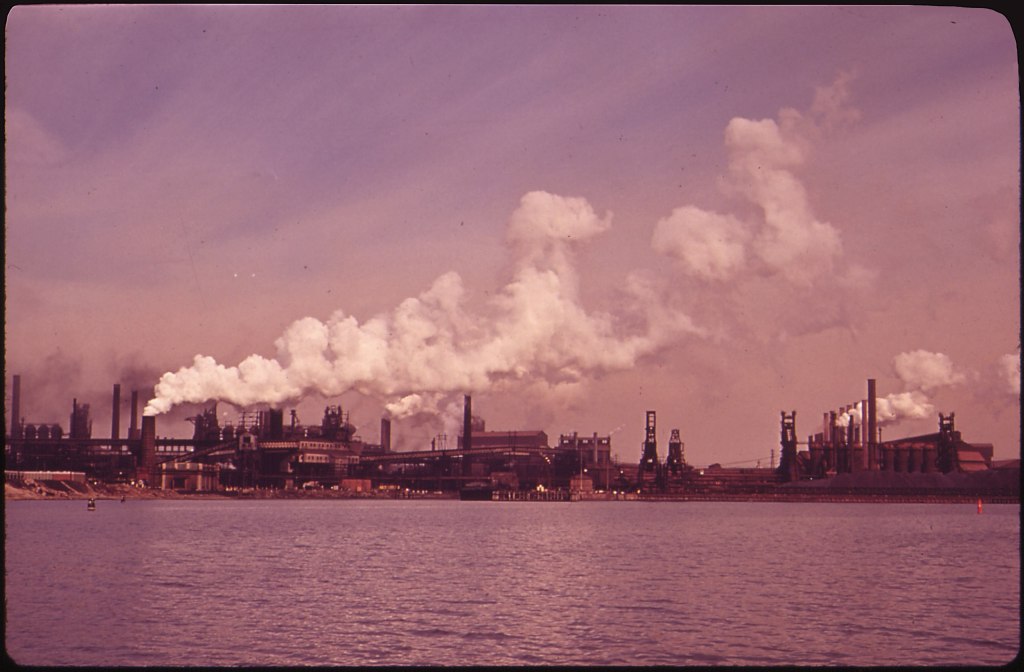
Bethlehem Steel Mill, Sparrows Point, MD. (Credit: NARA)
The Music of the American Working Man
American music has always celebrated the working man. The blue collar laborer built America, and that figure has become legendary in the American cultural canon. Folk music, especially that which was written before 1900, built that idea of the American worker so that by the time the nation entered the modern industrial age, the identity of America was built on the back of the American worker. Since beginning the transition to a post-industrial society, America has been struggling, and a whole new host of works, many of which from overseas, are resonating because they tackle the same thing: what happens when this anchor of society is starting to rust and fade away.
The Good Old Days…Before OSHA
This nation was built off slave labor, and that includes our music. African spirituals brought over on the slave ships turned into Christian spirituals over the years which slaves would sing while working the fields. This became a musical tradition passed down, interwoven with a culture most self-appointed ‘respectable’ (read: white) Americans wouldn’t touch with a ten foot pole. It was vulgar, uncouth. It then turned into the blues as the years went on, which then formed the basis of jazz. Then jazz became more acceptable as it became whiter and thus, more ‘respectable.’ Both the blues and jazz would help foment the formation of rock and roll that became the basis for the format of modern pop music. Rock and roll followed the same pattern, becoming more widely accepted as it became whiter. In essence, American music is black music
Many of the lower class white people, who worked industrial jobs, related to popular music dealing with the struggles of working, the trying nature of hard times, and many of the other themes which rang true with the earlier American folk music. In a sense, the common idea of a working struggle linked both halves of the American musical tradition and only strengthened the sense of a pride that permeated American music as it worked its way towards the modern age.
The Second World War may be the most important turning point in history. On a global scale, the war saw the end to direct warfare between the great powers of the world, the building of the current diplomatic apparatus through bodies like the UN, and the rise of new technologies in communication and transportation that make it easier to share information and move around to bring the world closer together. In America, thanks to the GI Bill, more Americans went to college, owned houses, and had greater economic opportunities after the war ended. Lots of men from poorer areas who went to work in factories before the war could now go to college and get better jobs. The skillset of Americans grew and changed, so the demands of the working world changed with it. For many of the countries ravaged by the war, manufacturing plants were good ways to inject work into devastated areas: everyone needed ships or steel, so places like Japan built the factories and America placed the orders.
However, the important part to this is that many Americans still remembered what it was like to be blue collar workers. And because America was primarily a manufacturing country in the lead up to the war, the idea of the American worker became mythologized. Countless songs and stories were written to honor the American Worker. Songs like the Grateful Dead’s “Cumberland Blues” which were written as late as 1970 harkened back to the American folk music of a century prior and the society which inspired those works. The folk revival of the 1940s, 50s, and 60s told these stories of days gone by as something to be proud of in the current day. The working man was our legacy, our history. The workingman built this country. The workingman needed to be memorialized as the nature of our society started changing.
The honor doesn’t just extend to success stories either. Many folk songs were written after great tragedies to pay tribute to those that made the country move who lost their lives. “The Ballad of Casey Jones” which was written shortly after the tragic train accident that killed Casey Jones. In turn, classic songs as these would inspire new retellings like the Grateful Dead’s “Casey Jones” (the Dead covered “The Ballad of Casey Jones” in concert as well, but the song they wrote was completely different). That songwriting tradition of immortalizing disasters shortly after they happened into the modern era.
On November 10th, 1975, the Great Lakes freighter, the SS Edmund Fitzgerald, was caught in a storm on Lake Superior and sank, killing all 29 of its crew. The song “The Wreck of the Edmund Fitzgerald” by Gordon Lightfoot was what made the Edmund Fitzgerald into a household name. It continued to mind folk tunes chronicling older disasters and immortalized the tragedy of the ship and its crew for all time before.
Those are just two examples of countless songs written about tragedies involving the workers of the country. Yes, Gordon Lightfoot is Canadian, but the Edmund Fitzgerald was an American ship. The close relationship between both countries led to similar feelings on both sides of the border, across multiple generations. In a way, the same struggles led to common feelings across different nations.
This desire to honor the sacrifices of industry dovetailed perfectly into honoring the total loss of industry.
Common Struggles
All art is a reaction to the society in which it is written. If American industry is a major focus of a great deal of our music, then its decline is just as important. America, for so long, viewed itself as a nation of workers and builders. The loss of that sense of identity shows in our art. More than that, the common struggles explored in art from elsewhere still resonate here. America and Britain both had substantial industrial blue collar populations which slowly died away over the course of the 20th century. For America, a young nation, it was not as big of a deal, but there were places in Great Britain which had built ships for hundreds of years. To lose a major industry that became woven into the fabric of the town was traumatic in many cases. It’s only natural that trauma inspired art, which then resonated with people going through the same trauma.
Sparrows Point in Baltimore held one of the biggest steel mills in the world, and the longest lasting of Bethlehem Steel’s shipbuilding operations. Sparrows Point constructed numerous vessels which helped the Allies win the Second World War and rebuild the world in the decades after the war’s end. After years of decline, the yards were sold in 1997, and closed in 2003. The legacy of shipbuilding and the change brought by its exit helped shape the next chapter of Charm City’s history.
Three thousand miles away, the town of Wallsend, Tyne and Wear, England was home to a similar shipyard which closed in 2006. The Swan Hunter yards birthed vessels like the Blue Riband record holder, RMS Mauretania, and the savior of survivors from the Titanic disaster, the RMS Carpathia. During the years it built ships, the town also birthed a man by the name of Gordon Sumner, better known by his stage name, Sting.
In 2013, Sting released his album “The Last Ship” which was recorded during the writing process of the music for the Broadway musical by the same name which premiered in 2014. The musical and album were both about the closure of the shipyards and described by the man himself as a “soul debt” to the place which shaped him that he nevertheless felt the drive to escape.
“So Far From the Clyde” by Mark Knopfler off his 2009 album “Get Lucky” explores the scrapping of a ship far away from its birthplace beside the River Clyde, which was the center of shipbuilding in Scotland for many years.
The stories in these songs, written about places in Northumberland and Scotland resonate in places like Baltimore, because industry used to be everywhere in America. The last fifty years have been characterized by the decline of industry across America, from the automotive industry leaving Detroit, to steel production drying up in Pittsburgh, to shipbuilding leaving Baltimore, to Kodak folding and killing Rochester, to the move away from coal dealing a body blow to most of West Virginia, and so on and so forth. For so much of America’s history, we portrayed ourselves as an industrious society which built things and recent decades have us reckoning with our identity as a post-industrial society.
We’re not the only ones doing that reckoning.
The song “Allentown” by Billy Joel was written about the eponymous city in Pennsylvania near the headquarters of Bethlehem Steel in Bethlehem, Pennsylvania. The sense of pride in their home despite the decline of industry was remarked upon when Joel toured the Soviet Union in 1987. At the concert in Leningrad (now Saint Petersburg) chronicled on the live album Kontsert (rereleased in expanded form as A Matter of Trust: The Bridge to Russia), Joel remarked, “This song is about young people living in the Northeast of America. Their lives are miserable because the steel factories are closing down. They desperately want to leave… but they stay because they were brought up to believe that things were going to get better. Maybe that sounds familiar.”
Indeed, in the Soviet Union, the late 1970s and the early 1980s were filled with a sense of stagnation amongst the people. Mikhail Gorbachev’s ascension to the head of the Soviet Union and the new cultural freedoms he granted meant that these western ideas could be appreciated in the USSR. Unfortunately, its dissolution a few years after Joel’s concerts and the tumultuous times in the 1990s led to the hope of greater days in Russia being continually denied.
Still though, it’s remarkable that the great geopolitical rivalry of the 20th century can bridge the gap through art. It shows how the industrial decline hit much of the world at once. Roger Water wrote the majority of Pink Floyd’s 1983 album The Final Cut. Coupled with his solo outing Radio K.A.O.S., much of his work dealt with the policies of Margaret Thatcher. The Final Cut primarily criticized Thatcher’s war against Argentina over the Falkland Islands, however, the album was subtitled, “Requiem for a Post War Dream,” and touches upon British society years after the war ended. The first song, “The Post War Dream” and the penultimate, “Not Now John” touch on how foreign shipbuilding – explicitly calling out Japanese shipbuilding to fit in with the WWII themes – put many of the shipbuilders in Great Britain out of business. Radio K.A.O.S. was a much more comprehensive critique of the 1980s as a whole, but a significant portion of the album focuses on the 1985 British miners’ strike, and the fallout from that.
The throughline to many of these economic frustrations come from government action or inaction, and the power of free market economies. Logically speaking, the mega corporations like Bethlehem Steel grew complacent with being top dogs. With trade restrictions and import tariffs rolled back in the latter half of the 20th century in an attempt to make everybody who wasn’t communist so reliant on each other that they wouldn’t become communist, the domestic companies ended up outpaced by foreign companies. Eventually, it would become too much, as it was cheaper to import manufactured goods like steel or ships from other nations with less strict labor laws.
A lot of the art written about these is to showcase the pain of watching beloved hometowns wither and die, of expressing frustration with the governments for abdicating their responsibilities or slashing regulations that would have kept companies looking out for their employees. Is it natural for companies to fold if they are being beaten on prices for equivalent products? Absolutely. Is it the nature of industry to change within a country as the country’s priorities shift? Absolutely. Is it the responsibility of the government to take care of their citizens when those seismic shifts occur? 100%. Sure, a fresh 18-22-year-old deciding to go to work in the coal mines as it’s announced they’re closing may seem to be an unwise choice, but when the 45-year-old was that age, and the coal mines were going strong, it leaves them in the lurch when the mines announce they’re closing up shop. There’s no assistance for that 45-year-old, they can’t retire, and it’ll be hard to retrain and get requisite experience in a different industry before they hit retirement age. These shifts can happen rapidly. Oftentimes, there are also no options. A child born to a coal miner might find a college out of state with a solid computer science or biology program and find connections through college and manage to move away that way. Without a job lined up to help relocate and enough savings to facilitate the move away from a dying area and secure a home in an area that’s probably more expensive, that coal miner may not have ever been able to move their family out of their dying hometown, so they’re forced to stay where they are to put food on the table.
The cyclical nature of work also leads to similar plotlines showing up in works across the years. Artists write these because it’s an evergreen concept, and people respond to those works because they are in those situations themselves or they know people who are.
The Generations With New Jobs
While a TV series and not music, as is the focus of this article, the second season of The Wire deserves a mention. The narrative of the show is about a criminal case, but that season dealt with the decline of the docks and the associated dockworker union jobs. The desperation Frank Sobotka holds to resurrect the Port of Baltimore, discussed in Monday’s article, is something that everyone who has lived in a place built of industrial work can relate to.
When one’s home is built off industry that has slowly died away, and the newer generations only know rotting structures and tales of the days of yore, stories like these will resonate with that sense of loss and desperation, even if they live a thousand miles from the shore. Touching on the legacy, and the futility of trying to recreate the past, is why so many of the songs about the industry of days gone by resonate so strongly with people. The songs about the glory days resonate with people who feel as though something has been lost
The idea of the workingman hasn’t completely disappeared from America, and it never will. But the art we create and love, that we pass down from generation to generation, is evolving and helping us come to grips that the country in our mythology doesn’t quite resemble the reality quite so closely.





 Ark of the Lost Angels

Leave a comment