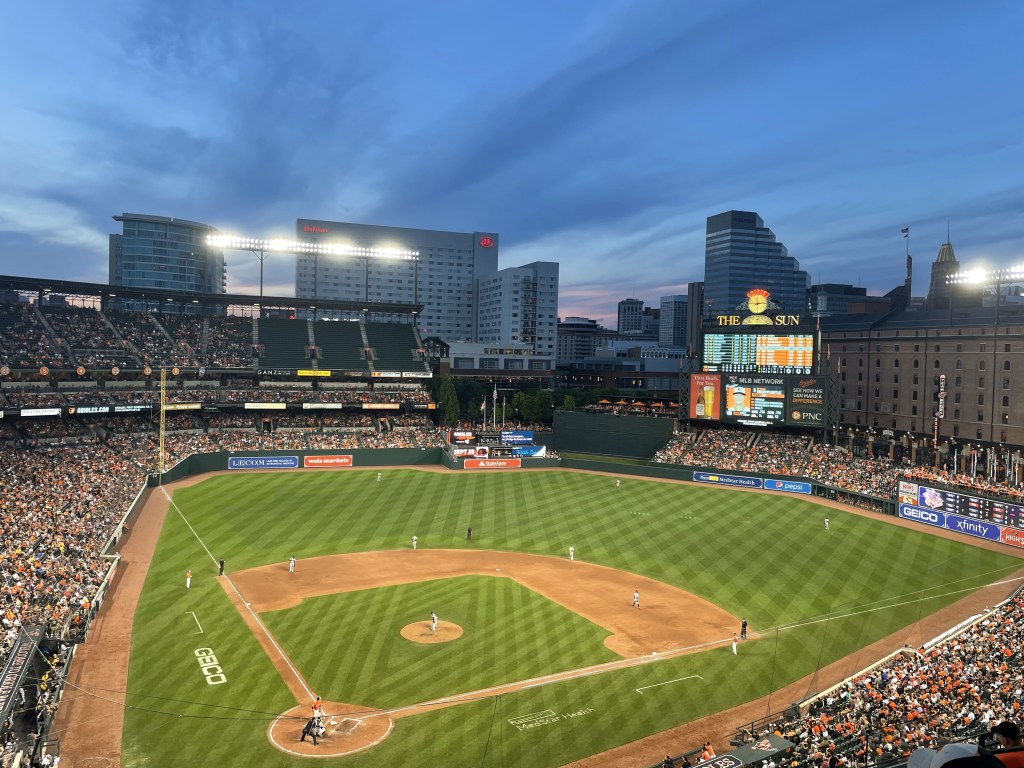
Oriole Park at Camden Yards, August 2022. (Credit: Author)
It’s a new age for Orioles Baseball
In the twenty-four hours before Opening Day of the 2024 MLB Season, the Baltimore Orioles sold to a new ownership group. This begins a new era in the history of a storied baseball team which has meant the world to the City of Baltimore over its time here and brings renewed hope for a team on the upswing after several years of struggles.
Orioles History
The Baltimore Orioles started as the Milwaukee Brewers in 1894, moved to St. Louis to become the Browns in 1902, and then moved to their current home of Baltimore in 1953. The run of 1966 to 1983 is seen as the golden era for the Orioles. The team won three world series in that time frame: 1966, 1970, and 1983. They became the city’s heroes, with baseball greats like Cal Ripken, Jim Palmer, Brooks Robinson, and Frank Robinson (no relation) playing for the team during those years. The team’s longtime manager, Earl Weaver, during this period was known for his success on the baseball diamond, and his expletive-laden tirades directed at MLB umpires. While they had some success after the 1983 World Series win, it began to drop off, accelerated when famed Baltimore lawyer Peter Angelos bought the team in 1993. The team maintained a level of success for a few years, but experienced a change of fortune and entered a dark age by the late 90s. Many losing seasons, a deteriorated farm system, poor management, and an increasingly competitive division with the ascension of the Boston Red Sox and New York Yankees all contributed to the long period in the dark for the Orioles.
The purchase of the Orioles by a new ownership group, led by David Rubenstein, begins a new chapter in Charm City. Up until recent years, the team has been down on its luck. Under General Manager Mike Elias and Manager Brandon Hyde, the team has seen a major resurgence, and is looking to defend its title of AL East Champions this year.
Despite the ups and downs of the team’s successes, the fan base has remained strong like nowhere else.
The Last Game in Town
Part of the reason for the Orioles being so beloved around town is that they were the last game in town for several years. For a period of over ten years, the Baltimore Orioles were the only professional sports team in the city of Baltimore. The NBA’s Baltimore Bullets moved to Washington DC to become the Wizards in 1973, leaving baseball and football as Baltimore’s two athletic anchors. When the Baltimore Colts fled the city under cover of darkness in 1983, the Baltimore Orioles were the sole professional sports team left in Baltimore in the four main American sports leagues (MLB, NFL, NBA, NHL). Additionally, the Orioles were still in their prime in the years leading up to the Colts’ exodus, while the Colts were in a bit of a slump. The fan base, while unforgiving of the Colts secret move to Indianapolis, tripled down on their love for the Orioles.
The Orioles remaining in Baltimore led to many people within the city remaining loyal to the team, even amongst their darkest years. Part of the reason for the departure of the Colts revolved around disagreements over the replacement of Memorial Stadium, Baltimore’s longstanding stadium, which was beginning to show its age. As a result, building a new stadium for the Orioles became a state priority, and the Maryland Stadium Authority was formed with the explicit goal of bringing football back to Baltimore. The efforts to support the Orioles led to the Maryland Stadium Authority taking over the former Camden Station grounds right near the Inner Harbor and building a new sports complex right near downtown. Oriole Park at Camden Yards was opened in 1992 as the first part of the Camden Yards Sports Complex, which grew when Ravens Stadium (now M&T Bank Stadium) opened in 1998, two years after the Cleveland Browns organization moved to Baltimore to become the Ravens. For their first two seasons, the Ravens played in Memorial Stadium, and the stadium was demolished in 2001.
From Memorial to the Yards
The move of the Orioles to the heart of downtown from The Old Grey Lady of 33rd Street helped keep the Orioles in the hearts of Baltimore’s citizens even while the team wasn’t winning games. The Inner Harbor, after the development under Mayor William Donald Schaefer in the 1980s, was boosted by having games throughout the spring, summer, and fall take place mere blocks from bars, restaurants, shops, and attractions. The Orioles showed their loyalty to the City of Baltimore, and the people of Baltimore responded in kind.
Oriole Park at Camden Yards (often referred to with either half of its full name) became an icon across the world of baseball. The stadium’s design harkened back to the baseball stadiums of the classic era in the early 1900s. This retro design with modern amenities created a ripple effect, and for 20 years, every new baseball park followed these trends.
Camden Yards is a special park due to its design, character, and charm. The former Baltimore & Ohio Railroad warehouse adjacent to the stadium remained intact, and it stands behind right field. It was repurposed as offices for the team, resulting in a distinctive backdrop for games at the Yards.
Camden Yards has been remarked upon consistently as the best of the 30 MLB parks, and its effect on ballpark architecture has cemented its place in history.
Birdland
Coming off the heels of the Orioles dominant streak, it’s easy to see why the city embraced the Birds. They maintained a level of popularity even after their fall from grace because games were accessible, the stadium was easy to get to from the heart of the city and pleasant to be in, and legends were still on the roster. Cal Ripken broke Lou Gehrig’s streak of 2,130 consecutive games played on September 6th, 1995, at Camden Yards. That game, an Orioles win over the California Angels at a score of 4-2, still ranks as one of the most watched baseball games of all time.
The Orioles embraced Baltimore and Baltimore embraced the Orioles. Things like loudly shouting “O!” during the singing of the national anthem before games on the line “Oh say can you see” became identified with the city. People everywhere around the area knew the phrases “Ain’t the beer cold!” and “Go to war, Miss Agnes” because of their frequent use by Orioles sportscaster Chuck Thompson, whose play-by-play was universally loved. The phrase “Orioles Magic” is synonymous with Orioles baseball, representing the team’s ability to pull out phenomenal wins from seemingly terrible situations.
The Orioles are intimately woven into the fabric of Baltimore City and are one of the centerpieces of its culture. It’s difficult to explain what life looks like without the Orioles because generations of Baltimoreans have only known life with the Birds. Parents have taken their children to O’s games for ages, making the love of the team a family affair. It’s rare to go anywhere in the area without seeing at least one Orioles shirt or cap or sticker or image. Camden Yards looks more alive than ever thanks to the presence of an incredibly strong roster, with multiple All Stars, Golden Glove winners, and top prospects on the field. The team is poised to make a legitimate run at the World Series again, and it’s been nothing short of electrifying to the city.
There is a time when the magic may have dulled a bit, but it never went out. No matter what happened in recent decades, Orioles Magic is back in Baltimore at its full intensity, and it’s a little like coming home.






 Ark of the Lost Angels
Leave a comment