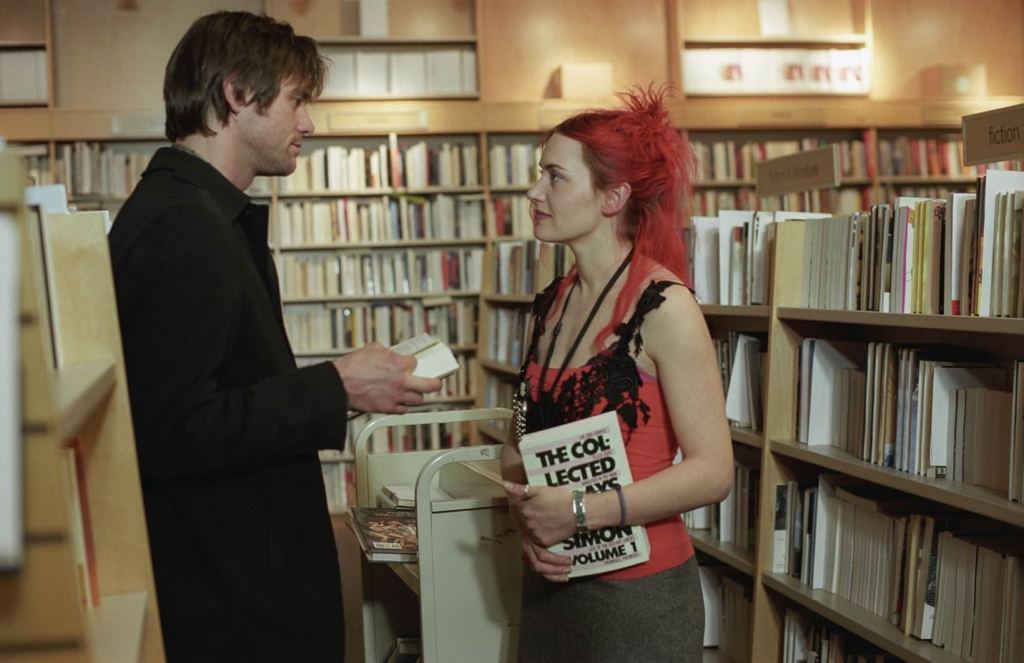
Joel and Clementine (Portrayed by Jim Carrey and Kate Winslet) in Eternal Sunshine of the Spotless Mind (Credit: Focus Pictures)
Eternal Sunshine of the Spotless Mind shows how it is better to love and lose than forget you ever loved at all.
Nostalgia may very well be one of the most powerful forces of nature. Nostalgia is when we dive into our memories, and allow our mind to rewrite them based on our emotions, our desires, our fears, etc. The picture we had drawn before became the subject of thought and contemplation. Time moves forward; our emotions change and affect us differently. Then, during a day of reminiscing, we look back at that picture we painted before and pick up the brush again. Softening the edges, making the colors more vibrant, perhaps creating a more interesting background. Before we realize our hands even moved, suddenly the scene we remember is a lot warmer. We’ve corrected the “mistakes.” And by doing so, we mislead ourselves to remember something which never quite happened as we think it did.
The altering of memories doesn’t always make every one of them better. How many times have you thought about something over and over again: a bad mistake, an embarrassing situation, the moment where you felt you were so out of your usual character and said something horrendous to someone you loved? Then you talk to other people, and it was never as bad as you thought? That’s the same concept as nostalgia, just going the other way.
Life is a collection of experiences we recall differently than they happened. Every single human memory is an imperfect recollection. It’s why witness statements in criminal cases are so difficult and unreliable. Ask ten people to say what happened in a car accident, and you’ll get twelve stories. Yet, the human memory is the most substantial building block of someone’s personality. Memories form who we are. They influence our reactions to certain people based on what we remember about them. They make us want to go back to certain places or avoid them like the plague.
The power and danger of memory can be summed up in one of Jay Gatsby’s most memorable lines, “You can’t repeat the past? Why of course you can!” In The Great Gatsby, the point of the novel is that Jay Gatsby’s memories of Daisy are idealized to the point of stripping her of what makes her the complicated, multi-faceted human which she has become. Furthermore, Gatsby believes Daisy to be the girl he thinks he fell in love with five years prior. He may have overromanticized her in the present which cast those memories into rose-colored glass from their very inception. Gatsby persists because he loves Daisy. At least the Daisy of his memories.
And yet, we see that love and memory are one of the most powerful combinations of factors across the human experience.
How Happy Is The Blameless Vestal’s Lot: A Summary of the Plot
To repeat a section from two weeks ago, Eternal Sunshine of the Spotless Mind may be one of the best films to have ever been produced. It’s a love story facilitated by a little light science fiction about erasing memories, and remains one of the most poignant, quirky, and memorable love stories put to film. The movie will be extensively spoiled in this article, so if you have not watched it, DO NOT PROCEED. This is a movie that deserves to be watched knowing as little as possible going in for your first viewing, so I highly recommend going to watch it. (I stand by this statement even if it means literally nobody comes back to read this article).
If Pulp Fiction is the finest example of a movie told out of order, then Eternal Sunshine has to be the second. The movie opens with the meek, mild-mannered Joel Barish taking a spontaneous trip to Montauk instead of going to work by switching trains at the last minute. While on this trip, he meets Clementine Kruczynski, a free-spirited, mercurial woman with vibrantly dyed hair. Despite having little in common, there is an instant connection between the two.
The movie then flashes back to a few weeks earlier, where Joel discovers this his ex-girlfriend, Clementine, had a procedure performed by Lacuna, Inc. to have her memories of him erased. Joel decides to have the same procedure done to him. The majority of the movie takes place in Joel’s memories as all of his recollections of Clementine are stripped away. Joel relives the worst parts of his relationship with Clementine first and falls back in love with her when reaching the happier, earlier times of their relationship. So much of Joel’s activities throughout the film are fighting to preserve his memories of Clementine, including hiding her in other memories of his so she’s off the ‘map’ which Lacuna is following. Thanks to a subplot following the Lacuna technicians performing the procedure, Joel’s plan fails in the conventional sense. However, in the memory of their first meeting, at a beach party in Montauk, Joel’s memory of Clementine asks him to find her again, whispering, “Meet me in Montauk.”
Having caught back up to the present, one of the Lacuna technicians had found out overnight that she and the lead scientist who created the procedure had an affair and she had the memory erased when she kissed him because she had fallen for him again. In disgust, she mails the files of everyone the company had worked on back to them, where Joel and Clementine discover that they dated previously and had their memories of each other erased. Joel and Clementine initially seem hesitant but end the movie agreeing to try again and see what happens.
The Imperfection of Memory
One of the most effective things about Eternal Sunshine is that it plays into something every person does: remembers bad moments as worse than they were and remembers good moments as better than they were. Think back to a time when you remembered doing something awful for years, then come across someone years later who was also there when they said it wasn’t that bad.
Memories are malleable to a degree. Every time a memory is recalled, it can mix with other memories as the information is stored again, making favored memories shift over time into something less like a faithful recollection of events, and more of something that’s mixed with hopes, fears, desires, and other emotions. Every person remembers things differently, it’s one of the reasons why eyewitness accounts are notoriously unreliable. It also means that every person fills in the blanks differently. Hence why two members of a couple can have vastly different recollections of a fight or their first date.
Memories are also affected by how often we retell them as close to the truth. Every person has, at one time or another, changed a story or left details out or added new details to make themselves look better and others worse. The old adage applies here, “Repeat a lie often enough, and you will start to believe it yourself.”
Everybody’s Got To Learn Sometime
Throughout the movie, we hear Joel’s descriptions of Clementine given right before the procedure, and later at the end, we hear Clementine’s tape doing the same thing about Joel. Both focused on the negative aspects of the other person, which is understandable since both are in the early stages of a breakup, and people tend to overexaggerate the negative qualities of their newly former partner.
Often times, people overrepresent a former partner’s worst qualities in conversations with others shortly after a breakup. People tend to think of their recently separated paramours far better than they let themselves say aloud, because it’s admitting weakness: that they miss their now former significant other. Most people look for a villain other than themselves in a situation, meaning that they will de-emphasize their own actions which led to the breakup and play up their partner’s. Circles back to that aforementioned “repeat a lie often enough” concept.
The memory of love is such a powerful force, both in reality and in the narrative, that it can override all else. The strongest emotions typically coincide with the sharpest memories. Clementine gets disturbed when Patrick, one of the Lacuna technicians, used Joel’s file to start dating her. Clementine, as if subconsciously remembering what Joel said to her, is increasingly disturbed at the similarities to a life she previously lived. Even the inciting events: Joel and Clementine traveling to Montauk seemingly on a whim where they serendipitously meet for the first time again, has its roots in the last words Joel’s memory of Clementine said to him: “Meet me in Montauk.”
You can never truly forget emotions.
And it’s foolish to try.
Clementine and Joel both feel the tug towards each other, despite having tried to forget. Clementine is bothered by Patrick repeating Joel’s words and actions because part of her remembers when Joel said and did those things. Even Mary, the Lacuna technician, falls in love with her boss, Howard, after having done so before and forgotten thanks to the memory-erasing procedure. In all of these cases, forgetting led to a repetition of the same cycle.
The danger of forgetting those memories is forgetting the lessons they taught you. Even if they are warped by our mind’s own differently hued glasses, those memories and the lessons they espouse are still worth remembering. At the basest level, our memories define us. Our experiences shape who we are, how we look at the world, and how we interact with the people around us.
We know not to touch an open flame after we’re burned by it because we remember the pain. In the same way, we know to not make the same mistakes in a relationship through careful contemplation and reflection after or even during a relationship by analyzing the root causes of fights or disagreements. We know what hurts us. We know what we do that leads to us getting hurt. Without those memories, we would end up in a brutal cycle of repetition and pain.
Memory and love are both fickle. They change as we travel through life, never quite consistent, never completely different. Yet, memory and love are two foundational building blocks of human existence. We would not exist as we are without them. Love teaches us lessons, and memory lets us keep them. You never truly get to know someone until you see both the good and bad, and you never truly remember them until you recall both the good and bad.
In its quirky, beautiful way, Eternal Sunshine of the Spotless Mind says the greatest thing about love: that no love, however painful, is ever worth forgetting. Even if a relationship wasn’t healthy. Even if the person wasn’t meant to stay forever. Every love we have teaches us lessons worth learning. Every person we love in this life is worth remembering.
There is no person who is better off forgetting someone they loved.







 Ark of the Lost Angels
Leave a comment