
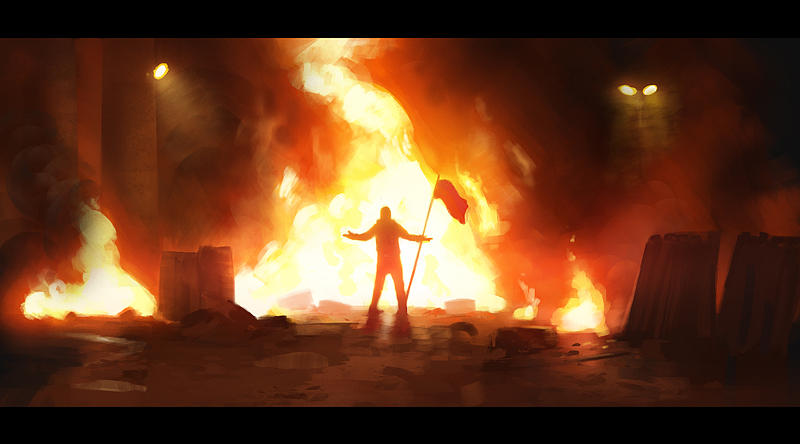
At the End of All Things (Credit: Guillem H. Pongiluppi)
“You were the Chosen One! You were supposed to destroy the Sith, not join them!” – Obi-Wan Kenobi to Anakin Skywalker during the Duel on Mustafar
The Chosen One is a trope which has been known throughout storytelling for millennia. The idea that there is one person who is chosen by the gods or an ancient prophecy or circumstances as the only person who can solve the problem currently facing the world or the village or the nation or so on has existed since storytelling began.
The Chosen One is usually extremely skilled or lucky or both in their endeavors. In many poorly written works, The Chosen One will not face many obstacles they cannot easily overcome, making the trope drift more into Mary Sue territory. However, competently written works can use The Chosen One to explore the theme of destiny, fate, and about humanity’s relationship to those concepts.
A designated hero is appealing to people because in times of crisis, everyone searches for leadership. Knowing that someone is ordained by greater powers to defeat evil and restore peace and justice to the land is a source of comfort. It makes us feel that the storms we face today are not insurmountable because good will triumph over evil, and that there is someone out there to light the path and show us our way. Someone destined to help light triumph over the evil plaguing everyone serves as a form of comfort.
An important distinction about The Chosen One when compared to other forms of hero is a greater power destining this particular hero to being a hero. A character who rises to the occasion with skill and grace and does not face major obstacles they cannot easily overcome may not necessarily be an example of The Chosen One, merely poor writing. In my eyes, the implication of The Chosen One is that they must be truly chosen to be the hero. A hero arising from the masses by circumstance may not necessarily qualify. Others’ perspectives may vary.
Exploring the theme of destiny in a fictional context is a good way to explore and make commentary on people’s feelings about real religions and spiritualities. Fiction is a beautiful lens to view the real world through because the same problems which exist in reality can be explored with a level of disconnection, which ironically allows fiction to be more honest and direct.
In today’s age, Harry Potter or Anakin Skywalker are easy examples to point to, with literal prophecies detailing why they are meant to be the heroes. The concept can be found in much older forms, with King Arthur being a famous example of a prophesized hero, but nowhere near the oldest.
The most dangerous pitfall of The Chosen One is telling a story that is trite or lacks stakes. Focusing on The Chosen One learning how to be the hero the world needs them to be is a frequently-used plot, however, an unwillingness to meet destiny or their reputation conflicting with their very human flaws can make a story very compelling.
Viewing the story from The Chosen One’s best friend can make things even more compelling.
Ordinary People
The Elder Scrolls IV: Oblivion had a refreshing take on the Chosen One trope. With the remaster having released a month ago this week, plenty of newcomers to the franchise or this particular entry are finally playing it. Spoilers will follow, so be warned.
In many of the Elder Scrolls games, you play as The Chosen One. In Oblivion’s more famous successor, Skyrim, the player character is a Dragonborn, the only one who can use the power of the dragons which have returned to Skyrim (the place) and which threaten to destroy the world. Skyrim’s narrative follows standard Chosen One protocol: unknowing hero gets roped into a situation by way of an inciting event, on the path discovers they have great powers, then learn to harness those powers to stop the end of the world. It’s a story everyone has heard a thousand times. Fun, enjoyable, but a pretty safe narrative choice. Especially coming in on the heels of Oblivion.
Oblivion throws a curveball. Sure, the player starts out in prison while the Emperor has to use that prison cell as the entrance to an escape route out of the city once assassins target him and his family. Despite that cell supposed to be remaining empty, the player gets dragged along on the frantic night flight anyways. The Emperor’s line about how perhaps the gods placed the player in that cell so you could meet the Emperor lends itself to a more traditional narrative. At the end of the path, however, the Emperor hands you the Amulet of Kings, which can only be worn by an heir of the Emperor’s bloodline and tells you to find the monk Jauffre.
The whole world is now riding on your shoulders. With the Emperor dead, the magical barriers preventing the realm of Oblivion from interfering with yours are weakened, and the Emperor’s heir must use the Amulet to light the Dragonfires in the Imperial City to restore those barriers. Despite all of them being victims of the assassins, Jauffre tells you that there is another heir: the Emperor’s illegitimate son who is a priest in the nearby city of Kvatch. You travel to the city to collect the heir, only to find it under attack from the forces of Oblivion. The city is ransacked, and while you earn the epithet “Hero of Kvatch” for your role in closing the Oblivion gate and freeing the city, Martin is the truly important figure. Once you save Martin from the forces which ransacked his city and return him to Jauffre before escorting both to safety, you understand your true role in this story.
You’re not The Chosen One. You’re his errand boy.
Throughout the remainder of the main quest, you undertake dangerous missions to find the Amulet of Kings which was taken by the assassins before you reunited with Jauffre, so that Martin can return to the Imperial City, light the dragonfires, and save the day. You travel through dangerous ruins and other dimensions to retrieve the Amulet of Kings and stop the total invasion from Oblivion because Martin is too significant to risk with he adventuring. The grand finale sees Martin sacrifice himself once the invasion is already underway. When the dust settles, Martin is known the land over as the hero who stopped the Oblivion invasion, and you’re the sidekick that helped him do it. While you are still regarded as a great hero, you’re not the one whom everyone talks about glowingly and gratefully once the main quest is completed. You get a set of armor that’s probably worse than what you’re already wearing and a fancy title that some non-playable characters may call you by in their greeting.
In a world of fiction so obsessed with The Chosen One, it’s nice to have the focus on the regular people. Most of us will never be the great hero picked by the forces of destiny, but we can do little acts of good and inspire others on a smaller scale. The heroes need their sidekicks, the inspired masses, and so on. In The Hunger Games, Katniss Everdeen was played up as The Chosen One by propaganda, but the people she inspired were just ordinary people who chose to act. Some of them had been acting before they even knew her name or face, others needed that push, but the tyrannical government she opposed only toppled because ordinary people chose to act. The power of a rallying figure is only as large as the crowd they can rally.
The fact that The Chosen One fills that role in many stories and would never succeed without others is what makes good exploration of The Chosen One so compelling on a macro level, and why poorly executed Chosen One stories feel uninspired and dull. Oblivion is compelling because the player character can become the head of the four main guilds across the country, they can complete historic feats and epic demonstrations of both their good and evil, they can become a paragon or a monster, but they are still not the ones who saved the world. The player’s emotional reaction to the aftermath of the main story is their character experiencing the emotion to being the loyal sidekick of the man who saved the world. Exploring that feeling as a purpose of a work can serve to make The Chosen One feel more human and relatable, by their concern for their friend’s wellbeing while their friend has to deal with the emotions of always being second to their friend’s destined fate. The non-chosen have to deal with seeing their friend as their friend and not the mythical hero of legend they are supposed to be, with all of the requisite emotional stakes that requires.
The stories about the ones who see The Chosen One regularly but are not as special make it easier to connect with those characters. A sympathetic friend will show more of the struggles of The Chosen One grappling with their role in a more human light. In turn, showing stories from the perspectives of The UnChosen Ones can make a story feel like it has more stakes. The other characters operate at a more normal level, and the danger can feel more real for them. Except for deliberate subversions of The Chosen One narratives wherein the destined hero is killed for whatever reason, most stories revolving around The Chosen One mean the protagonist is safe from harm at least until the end of the story if they must give the ultimate sacrifice to defeat the main evil.
Suffice to say, the strengths of The Chosen One in storytelling can lie in the stories of characters who are not chosen themselves.
Destiny is Found on Both Sides of the Divide
The Chosen One works to inspire hope despite also revealing the truth that in reality, there is often no predestined hero coming to save us. The Chosen One is an interesting alternative to reality because the leaders who inspire and encourage great change, hope, and the drive to continue are often born of circumstance. Great leaders and inspirations are made by the situations they find themselves in, not necessarily because they were born to be so.
Star Wars gives so many stories and examples of The Chosen One, those who rise to meet the occasion, and normal people doing their part, which makes it a solidly comprehensive case study for the concept. Stories that focus on the normal people around prophesized heroes, like Oblivion or Star Wars, shake up the typical perspective on The Chosen One, and prove the salient point that even the designated hero will need help from regular everyday people.
The recently concluded Star Wars series Andor is about the lead-up to the film Rogue One which explains how the Death Star plans were stolen prior to the beginning of the original Star Wars, Episode IV: A New Hope. What makes Andor so fascinating is that while exploring the origins of Cassian Andor, the character, it also explores the birth of the Rebel Alliance. The series focuses on the normal people who choose to rebel for many such reasons, to fight back against the tyranny of the Empire. Without their efforts, the Death Star’s existence may never have been uncovered, which in turn would never have allowed the Rebels to steal the plans and propel farm boy Luke Skywalker into Rebel hero by blowing up the Death Star. Without going on his own journey, Luke may not have been able to fulfill his destiny of bringing his father back to the light side so that Anakin Skywalker may be able to fulfill the prophecy as The Chosen One and restore balance to the force. However, Luke never would have been pushed into doing what he did if it wasn’t for Anakin’s former Jedi masters planning on using Luke against his father, nor would the call to adventure found Luke had ordinary people not sacrificed everything to get the Death Star plans. Add to that, Luke ignored what other people said his destiny was in order to facilitate Anakin fulfilling his own. Luke was being prepared to destroy Darth Vader and yet instead, he redeemed Anakin Skywalker. Even heroes don’t have to follow the destinies laid out for them.
I think the fact that Star Wars offers commentary on both sides of the debate around The Chosen One with its variety of stories is what makes it such a compelling universe to study from a meta perspective. That isn’t to say that all of these ideas are original or necessarily done the best by Star Wars. However, the progression of Andor leading into Rogue One leading into the Original Trilogy highlights how these great feats by The Chosen One come to pass: by ordinary people choosing the opportunity to act when and how they can. A hero becomes a hero by virtue of the moment even if there are heroes destined to do great things at the same time.
Today’s world is shaky and uncertain. While there may be a great hero destined to lead or inspire, the darkness which threatens to choke the world can be beaten back by a million small acts of light performed by a million different ordinary people. If there is The Chosen One waiting to lead a specific cause, they still have to have people believing in that cause to help them along their way.
In a way, many of us are looking for The Chosen One to lead us towards our destiny, when that power has been in our own hands all along.




 Ark of the Lost Angels
Leave a comment