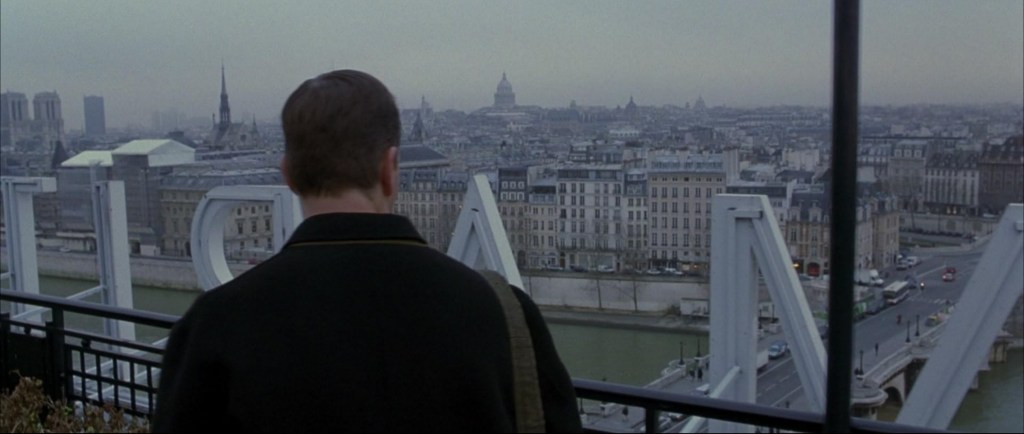
The Bourne Identity (Credit: Universal Pictures)
The Bourne films set the standard for spy action thriller films for years to come.
The Bourne Identity reshaped Hollywood action films for a generation, however, none of them were able to match the Bourne films’ excellence. The best part of Bourne’s appeal remained unsung and unnoticed by most moviegoers: the writing. Tony Gilroy, scribe of the first four Bourne films and the recently concluded Star Wars series Andor, is an expert at bureaucracy. Power struggles in conference rooms seldom make compelling viewing unless they are executed particularly well. Fortunately for moviegoers everywhere, Gilroy excels at making bureaucracy what you want to see on screen, even in an action film.
In the Bourne films, Gilroy interweaves the CIA’s efforts at tracking the titular assassin with Bourne’s efforts to evade them expertly. Multiple scenes of CIA personnel looking at computer screens in a room are just as tense as a brutal hand-to-hand – or rather knife-to-pen – showdown in Bourne’s Paris apartment. The beauty is Bourne constantly being a step ahead of the CIA. Every effort by the American government to kill their best rogue agent is thwarted simply because Bourne is the best among them. Other black ops assassins from the same program as Bourne or its successors are easily dismantled by Jason Bourne himself. The only character in the movies to come close to killing him is an FSB officer on the payroll of a Russian oligarch in the second installment on a lucky break.
Plot Summary
The first Bourne film begins with Bourne washing up in the Mediterranean sea with no idea who he is. He spends most of the film tracking down clues to discover his identity. Meanwhile, the CIA is trying to figure out why the assassination of a displaced African warlord [nation is unnamed in the film, but several pieces of evidence point towards it being Nigeria] who could expose the agency’s dirty secrets in the region failed. It is revealed that Bourne was the assassin tasked with killing this warlord, and he never failed a task before. Privately, Bourne’s handler in the Treadstone program is trying to find out what killed his asset. Once he discovers Bourne is alive, the priority becomes bringing Bourne in or killing him. Bourne responds by taking a sledgehammer to Treadstone’s operations in Europe before slipping away.
The second movie begins with Bourne off the grid in India. A CIA team in Berlin is ambushed in the middle of another operation to uncover information about a Russian oligarch which would implicate a CIA deputy director. Killing the source and framing Bourne, only to then track down and kill Bourne, would ensure the CIA is chasing a ghost and not the real culprits. The information threatened to expose the CIA deputy director who oversaw Treadstone, which is why his focus becomes hunting Bourne down and killing him. A more upstanding member of the CIA uncovers the corruption thanks to Bourne’s help, and Bourne makes it away once more.
The third movie sees Bourne go on the offense against the CIA in an attempt to figure out who he is and his history with the agency. He squares off against Treadstone’s successor, codenamed Blackbriar all over the world, eventually ending in New York City where Bourne helps the sympathetic figure within the CIA from the previous film expose the CIA’s assassination programs.
Taking over for Doug Liman in The Bourne Identity, and Paul Greengrass in The Bourne Supremacy and The Bourne Ultimatum, Tony Gilroy took the director’s chair after having penned the fourth entry starring Jeremy Renner as Aaron Cross. The Bourne Legacy details the fallout of the exposure of the Treadstone and Blackbriar programs by showing the impact on other covert kill units across other US government agencies. Cross is one such agent, forced on the run the same way Bourne was, in a fight for survival when the orders to sanitize every other black ops assassination and intelligence program came down. In this movie, it seems that the hopefulness at the end of Ultimatum was undone by the CIA wriggling free and pinning all the blame on Bourne’s sympathetic opponent turned ally at the CIA, and showing the powers that be quickly and easily replacing the programs they were forced to destroy because of the exposure.
Bourne becomes an unstoppable force which the audience loves rooting for despite his past as a killer for the CIA, simply because watching that prodigious skillset turned against his former masters is incredible to watch. In some fashions, it’s watching the idea of a monster the government created only to lose control of come back to bite them. It provides the audience with the catharsis of seeing a measure of revenge against things they deem against their morals, while Bourne sticks to principles in his crusade to atone for his past and show the CIA that one can play by rules and still win.
In less deft hands, watching a main character escape every situation where he might be captured or killed might be unsatisfying. However, knowing the main character will get out of a situation can still be made compelling by watching how they do so. The films go to great lengths to show not only Bourne’s incredible improvisational skills, but his masterful preparation. Throughout the films, Bourne sets up scenarios to use the CIA’s tactics against them in order to achieve his goals and escape alive. Bourne is also a master of his environment. Between spotting a poster for a demonstration in Berlin during the events of Supremacy before using that demonstration as cover to whisk away his former handler to interrogate her about his past all the way down to fighting off a knife-wielding former colleague with a ballpoint pen and winning, Bourne’s situational awareness and creative thinking allow him to turn the tide on any situation.
What Makes Bourne Work
The protagonist of the movie is a CIA assassin the audience is rooting for simply because they do not know who he is and are compelled by the journey to find out who he is. The antagonists of the movie are terrifyingly competent with massive resources and capabilities. Neither side is stupid, nor do they make errors which people in their field would not make in pursuing their jobs. In many ways, the CIA’s corruption and lack of morals serves as their undoing in the grander scheme of things, either by exposing their unethical assassination programs, or getting several of their own members killed when things go sideways, often as punishment for failure doled out by higher ups. The audience roots for Jason Bourne in his one man mission against the agency simply because anyone diametrically opposed to such an awful group of people is worth rooting for.
Jason Bourne is a superhuman guided by a very human emotion. It’s why he is an incredibly fascinating spectacle to watch on film, while still being invested by the audience. A great character with a great performance built from a great script can make a film which can be boiled down to, “Amnesiac badass fights other badasses across Europe” into one of the best examples in the game. Lesser movies would have had voiceovers or Bourne articulating his own thoughts and emotions around his revelations to other characters. These films, however, take a much more subtle approach.
Matt Damon’s performance as Jason Bourne tells the audience everything they need to know about the man’s emotions. From his frustration in Identity to his lack of knowledge of his identity to the surprise when he realizes he is speaking German to a few Zurich police officers and subsequent greater surprise when he beats the absolute stuffing out of them before leaving the park he was attempting to sleep in, Matt Damon’s subtle expressions and body language explain exactly what Bourne is thinking at every step of the way.
The gritty environments made events feel much more down to earth as well. In a world where spy films often meant glitzy locales, fancy cars, and almost comical gadgets, Bourne goes the other way. Most of the first movie is spent in Paris in the wintertime. The environment was grey, cold, and slightly oppressive. Ugly snow is everywhere, and the people are bundled in coats and merely living their normal lives. Furthermore, the locales visited around Pairs were not the bright, effervescent, fantastical places as in Amélie or Midnight in Paris. The Bourne Identity spent its time in Paris’ grizzled underbelly, amongst normal people, in shady motels and never highlighting the prominent landmarks, allowing them to show up in the background. They served as reminders that the action was taking place in Paris, but never the Paris other films portray. Identity’s car chase was not a highly modified top of the line sports car against enemies in slick black SUVs with automatic weapons, but a decades-old Mini Cooper against the Paris police with their normal patrol vehicles. This pattern of inglorious locales, chases, and activities followed in the subsequent films all over the world, to Goa, Berlin, Moscow, London, Tangier, New York, and so on.
The very real feeling extended to the events that were unfolding as well. Everyone had their skeletons and their own shady motivations, which made the movie feel grounded enough to allow the audience to suspend their disbelief and buy into the idea that one guy could repeatedly take on the entirety of the CIA and win. As more of the CIA was explored by subsequent movie, the idea that the institution itself was rotten to the core was more ingrained in the audience’s mind, willing to justify the destructive fallout of various attempts to kill Jason Bourne across multiple continents in order to keep their secrets. Openly assassinating a journalist, organizing a massacre at a pharmaceutical facility, and assassinating members of foreign governments to keep dirty laundry from being aired were all actions by the CIA taken in the films with no regrets or reservations.
Suddenly having one of their own, who they trained to act without conscience, turn against them, willingly constrain himself with morals to honor the woman he came to love who was killed by the CIA to get to him, and continue winning against the agency is what makes Jason Bourne the best spy in the game. No world ending plots, no hero’s welcome, no fun assignments or glitzy locales were in the cards for a scalpel like Jason Bourne. However, Bourne shows how much damage someone can do with a scalpel if they know where to cut. Bourne is intelligent, the CIA is intelligent, and the movies trust their audiences to be intelligent enough to follow along.
Keeping those core ideas is how the Bourne films could have outlived Bourne himself.
Bourne Without Bourne
It would be a fair criticism to say the audience never gave Legacy a chance. Jeremy Renner played a very different type of assassin than Bourne was, and it felt fresh but that it was still related to the trilogy. The movie’s biggest complaint not related to casting was its weird pacing. In some ways, it felt like the first half of a story that never reached its conclusion, which could have been rectified by a follow up.
The latest movie, Jason Bourne, fell apart thanks to the lack of Gilroy’s slick writing. Even with Matt Damon returning as the titular hero, and Paul Greengrass returning as the director, the film lacked the emotional core (or lack thereof) from the first four movies. As a generic action movie and conspiracy thriller, Jason Bourne works decently well. However, it does not move Bourne’s character forward from the resolution he had at the end of the original movies.
It rehashes several plot points of the original movies and invents new history for Bourne which cheapens the revelations made during The Bourne Ultimatum. The main antagonist having a personal grudge against Bourne dilutes the themes that the American government is willing to take unconscionable actions simply because it can in the name of “security” and anyone who jeopardizes their activities is a threat to be removed. There was a plot based on CIA involvement in a prominent social media site and its CEO which felt written in to feel relevant for the mid-2010s when the movie was made. The originals had this timelessness to them. Despite the dated look of the first film with its obvious late 1990s and early 2000s technology, the plot and the ideas at the core of the storytelling for the original three and Legacy were much more universal.
The only interesting idea brought up by the last movie in the series is the idea that Bourne seeks purpose and could be persuaded to come back. To take a man who gave up so much in order to escape the CIA and give him a reason to come back into the fold could have been an interesting avenue to explore, but there was no solid resolution. The idea of the internet and surveillance being related to intelligence gathering and questioning the relevance of on the ground assets is something many pieces of fiction have explored, but the fifth installment in the Bourne franchise fell short of its reputation in exploring those ideas.
The amnesia mystery is played out at this point. Three whole movies followed a character arc to answer the question of Jason Bourne’s identity. The most recent movie in the series decided to do it again, just ten years later. 2016’s Jason Bourne missed what made the others so great because Tony Gilroy didn’t write it.
Perhaps there is a movie which matches the others’ quality in there somewhere. Jason Bourne was rudderless in Europe for a decade, giving the man a cause big enough to come back would be a good reason for him to struggle with the idea of staying out of it all. If the focus were on bringing Bourne back into the CIA, it could allow an exploration of who he is, why he is driven to do what he does, and battle with the compulsion he felt to serve his country which led him to sign up for Treadstone in the first place against the trials and tribulations he faced to escape from the CIA once he began thinking for himself. It would avoid rehashing the end result of “Bourne totally remembers everything this time!” which was finished in Ultimatum.
Bourne hardly had any agency, and the screenplay was trite. While the action sequences were still top notch, the film’s plot and characters lacked the tight, impersonal thriller aspect that made the first four movies so compelling. Some of that was regained, in a different fashion, with the Treadstone spinoff TV series, but it was in many ways too little too late, which fell too short of the high bar the original movies set. The origin of Treadstone as shown in the show could have worked well as a movie itself. The basic premise of the Cold War pushing the Soviets to develop mental conditioning for sleeper agents, and the Americans trying to copy that which led to the mental conditioning for the original Treadstone worked very well. That could have made for an interesting period-piece action thriller against the backdrop of why the CIA went to the lengths it did.
The Bourne Conclusions
There’s something to be said about the spy genre having glitzy locations, quippy one-liners, fantastic plots, and memorable villains. Even the Bourne-ified Bond films still have some of this, while keeping themselves more grounded. In a way, striking the balance between Bourne and classic Bond could make them more effective at keeping audience interest and makes them better movies overall. The Mission Impossible series is the other game in town, focusing on some more fantastical technology and death-defying stunts. Both series make great popcorn flicks and are quality entertainment in their right.
But the Bourne films feel so much more real because they toss all of what makes other spy films the movies they are. Everyone who speaks of the espionage world talks of a world rife with secrets, danger, and banality, and Bourne has those in droves. The primary conflicts of the original four Bourne movies rest on a simple principle: any potential information on the program-du-jour reaching the public would be disastrous for those involved, and any potential breach needs to be tied off as quickly as possible. The only reason that any of the upper echelons care is to save their own asses. It isn’t personal with Bourne, it isn’t personal with the targets, it isn’t personal with the assets. These are people sent to do a job. It’s a morally reprehensible, indefensible job, and that tracks with a large portion of the CIA’s own sordid history.
Giving the protagonist, a morally gray character in his own right, a compelling mystery makes Jason Bourne the character audiences are rooting for. Unraveling the mystery of ‘Who Is Jason Bourne?’ over the course of three movies was a large arc, and the people Bourne was facing off against, even the ones he had a connection with, were only opposing him for impersonal reasons. It was the perfect summation of the espionage field.
There is a future for the Bourne franchise. The rights to the film adaptations recently went up for sale. Universal may purchase them again and might be prompted to find a writer who could bring the series back to its missing heart with a new entry starring Matt Damon or start over anew.
The original Bourne films had something to say underneath the tight, tense thrills of an amnesiac assassin versus the clandestine agency which created him, and the action, spy, and thriller genres of films are better because of it.






 Ark of the Lost Angels
Leave a comment