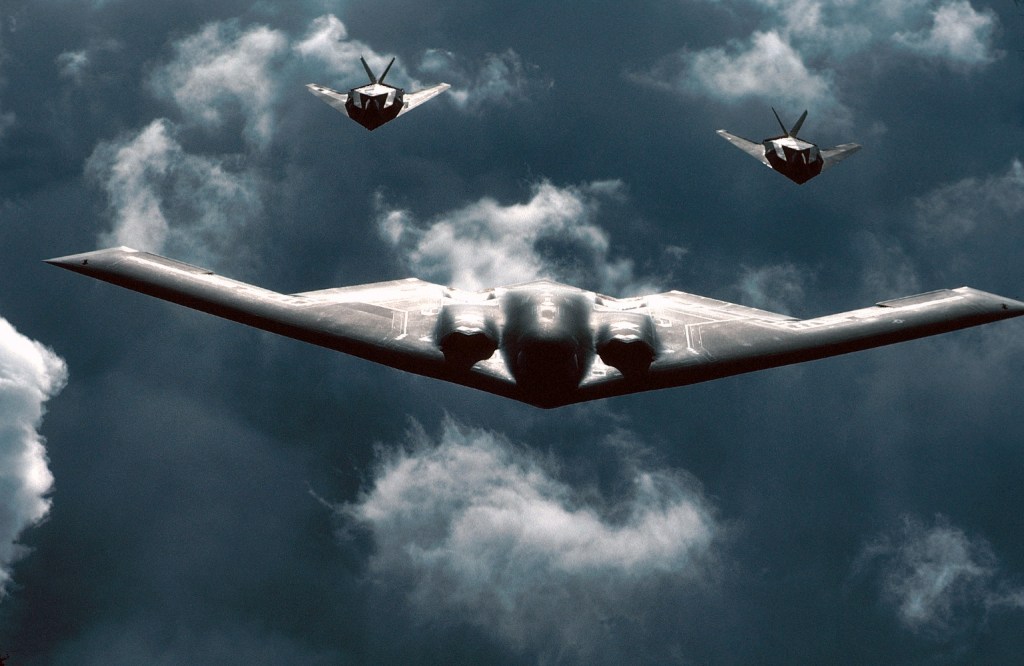
Northrop B-2 Spirit in formation with two Lockheed F-117 Nighthawks (Credit: Wikimedia Commons)
Developments in military aviation led to countless advancements in civilian flight.
If you’re a longtime reader, you’ve probably figured out that I have an affinity for military aviation. War is heinous, and it is a tragedy that these machines have to be used for their intended purpose. However, these airplanes themselves are incredible feats of design and engineering designed to accomplish tasks under intense circumstances operated by only the best of an already exclusive elite group.
My interest in aviation is poetic in nature. It goes beyond the neurodivergent fixation that a love for aircraft is so often dismissed as. Flight is an incredible human achievement and military aviation represents the cutting edge of this indelible facet of human life. These machines are marvels of engineering due to their complexity and capability. More than that, they are an incredible sight to behold in action. Military planes represent the apex of human ingenuity; a stark defiance of nature’s rules simply because humans have a strong distaste being told no, by anyone.
Humanity felt constrained by one of the laws of nature which is responsible for life on earth, so we found a way to defy it. On a beach in North Carolina 122 years ago, two brothers from Ohio stood on the shoulders of all those who came before and took the next step towards the skies. Military aviation is responsible for many of the advancements of aviation in general, as 11 years after the first flight, planes were being used in World War I. Since then, humanity has used military funding to pay for the valiant efforts to better understand how to circumvent the restrictions of this small blue planet. With metal, engineering, and willpower, we broke the sound barrier and learned what we needed to slip gravity and set foot on the moon.
The underlying technologies which have been developed for military aviation have changed the course of human society in positive ways and will continue to do so.
Necessity is the Mother of Innovation
World War II revolutionized flight technology in significant ways. The ideas of large scale air transportation, radar, and propulsion were revolutionized in largest scale conflict the world has ever seen and set the stage for the next steps of development.
The jet engine was a necessary improvement over the piston engines of then-contemporary fighters and now forms the basis of all modern air travel. While the jet engine had its origins before the war, the funding for research and development into making them work had not been allocated until after the outbreak of the war. Nazi Germany believed that a working jet fighter would be a wunderwaffe or wonder weapon, that would help them win the war. The end result was the Messerschmidt Me-262, a terrifying counter to Allied bombing raids that, thanks to fuel, ammo, and pilot shortages, proved to be little else than a last desperate gasp of defiance by a dying regime hated the world over.
However, the jet engine was a design which would persist. Soon after the end of the war, other nations rushed to develop jet fighters of their own thanks to their speed and maneuverability. Jets would finally clash in the skies over a divided Korea in the early 1950s with Soviet Mikoyan-Gurevich MiG-15s fielded by the Chinese and North Koreans squaring off against North American F-86 Sabres fielded by the United States and its allies supporting South Korea.
By the end of the 1950s, civilian aircraft manufacturers had started designing jet airplanes as well, which revolutionized air travel and put the final nail in the coffin of ocean liners. The release of the Boeing 707 kicked off a movement of larger, more luxurious planes which could travel farther distances in less time become the new norm. The Jet Age meant traveling the world was slick, fashionable, and attainable for many people. American airlines such as Pan Am and TWA became known the world over. Flying was seen as a luxury until the 1970s when it became easier to afford with the launch of cheaper airlines, but it connected the world in a way which was inconceivable fifty years prior. As the 20th century wore on, airplanes became faster, larger, longer ranged, easier to fly, and much more affordable for the common people.
Without the pressing need for jet engines in warfare, and the subsequent proof of their effectiveness, the jet age may have taken so much longer to get started. The need for powerful fighter aircraft justified dumping tons of money and resources into creating the most effective form of transportation humanity has seen so far, and the continued requirements of waging war have accelerated the development of aircraft and other technologies.
World War II also saw the development of radar into its modern form. Building on research from the 1880s, radar was developed as a form of early warning system. German bombing raids were occurring nightly over London and other British cities, so any minute of advanced warning was a minute earlier that RAF pilots could get to their planes and get airborne to shoot down German bombers. Soon after, the British would attach small radar units to their own planes to hunt German bombers down at night. The US would quickly follow. Most bombing raids took place at night because daytime raids were more easily spotted and intercepted. Therefore, the development of aircraft designed to find and kill enemy bombers at night became paramount. This would evolve into the radar used by airplanes to track other airplanes in the sky today. Vital for combat, but also easily modifiable to track other things.
After the war, meteorologists found uses of radar for tracking the weather. In searching how the Germans would use precipitation and other methods of fooling the radar to hide, it was discovered how to track weather patterns. With the scientific community able to get their hands on more equipment after the war, they were able to refine the technology to become the cornerstone of modern meteorology it is today. As with the German bombers, every day of tracking an impending hurricane is a day of preparations which can be made in advance. This results in less property loss, fewer destroyed homes, and fewer deaths from large storms. Advanced warning is everything in many of these situations.
What began as a way to give advance notice on air raids now changes the information game in all aspects by keeping a watchful eye on everything in the air. Now, radar helps track every flight across the world and helps predict the weather systems across the planet. It’s easier to know now thanks to radar when a friend’s flight is getting in at the airport to pick them up, and what the weather will be like on the drive there, because traffic always gets worse in the rain.
Perhaps the most significant example of the power of airlifting things came shortly after the war. After World War II ended, the Western Allies and the Soviets split Germany into multiple occupation zones. These would eventually become the nations of East and West Germany. The Nazi German capital of Berlin was split into four sections as well. The Soviet sector was given to East Germany and East Berlin became the capital of the communist German Democratic Republic. While the American, British, and French sectors officially remained under the control of their respective occupying countries, West Berlin was treated as a part of the Federal Republic of Germany, or West Germany. The East Germans and the Soviets did not like a chunk of western territory being in the middle of their own, so in 1948, they instituted a blockade of the access routes to West Berlin through East German territory. The intention was to starve the Allies out and force them to cede the territory back to the GDR.
The response was a massive undertaking of allied aircraft flying food and supplies into West Berlin for almost a year, with one aircraft landing every forty-five seconds at the height of the endeavor. It was a point of pride to not abandon the position in Berlin so soon after it was so sorely won. Colonel Gail Halvorsen would gain fame as the ‘Candy Bomber’ or ‘Uncle Wiggly Wings’ as he dropped candy from his airplane for the children in Berlin when he was flying into Berlin’s Tempelhof Airport with supplies to unload. What began as one pilot’s small effort to bring smiles to children would blossom into an official effort which eventually dropped 23 tons of candy to the citizens of Berlin. The combined efforts of the allied air forces with the biggest humanitarian airborne mission conducted in history would force the Soviets to drop their blockade almost a year later.
This would become known as the Berlin Airlift.
The Berlin Airlift became the first in a long line of using military assets in humanitarian missions. Strategic airlifts turned into a secondary function of militaries around the world, using large transport aircraft to move quantities of items more conventional transportation could not. The Soviet space program even pioneered the largest airplane ever built, the Antonov An-225 Mriya, which is Ukrainian for ‘Dream.’ Designed to transport the Soviet Buran space orbiter – their answer to the American Space Shuttle – it was repurposed as a conventional mass transportation aircraft after the fall of the Soviet Union and cancellation of the Buran program. Sadly, the Mriya was destroyed in February 2022 when Russia invaded Ukraine and attacked the airfield where the An-225 was stationed.
War, as tragic as it is, pushes scientific and engineering development due to the need to constantly gain an advantage over an adversary.
Flying Computers
The world’s first microprocessor was developed for the Grumman F-14 Tomcat. The basis for all modern computing and the entire digital age was designed to move an aircraft’s wings while in flight. The Tomcat had one of the earliest flight computer systems which controlled the sweep angle and degree of the flaps based on a variety of conditions to maintain the optimal lift to drag differential.
In the 1950s and 1960s, governments and militaries were trying to find the best advantages for their aircraft. Variable-sweep wings were one such system they tried. Variable-sweep wings were an early attempt to provide an airplane with enough flexibility to carry out various mission roles before better forms of design and engineering provided superior solutions which cut down on the weight of the swing-wing mechanisms, and the associated maintenance headaches. Less weight means more fuel and armaments, which mean better mission performance. Less maintenance hours means more uptime for every plane in a given unit, and fewer cranky crew chiefs.
To better understand what gives the swing-wings their appeal in their day, a basic understanding of aerodynamics on an airplane is required. Bear in mind that the author of this article majored in English and aviation is only an interest, so the following explanation may not be perfect. The Aircraft Owners and Pilots Association offers a solid overview.
All airplanes need to create significant airflow over their wings in order to create enough lift to leave the ground. The air flowing over and under the wings creates a lower pressure system above the wing to pull the plane upwards. Thrust plays a large part of this, pushing the airframe forward and pushing the air over the wings. Straight wings provide greater lift at slower speeds because they have more surface area. The less thrust you have, the more surface area you need for air to flow over to keep the plane in the air. Drag is the force that acts against thrust, essentially it’s wind resistance. More speed equals more drag which equals more thrust necessary to maintain speed.
Thrust-to-weight ratio determines how much thrust you need to keep the plane in the air. That ratio is affected by the amount of lift the wings can generate. A favorable thrust-to-weight ratio can allow planes like the F-15 to fly with only one wing. The Lockheed Martin F-22 Raptor has engines powerful enough to hit the speed of sound without afterburners, and can hit double that with them. At full throttle with afterburners, the F-22 can actually hold itself aloft when pointed straight up. Most airplanes stall out when their nose is pointed directly up and will start dropping back to the surface until they can get more air flowing over the wings.
Swing wings allow a plane to adjust the sweep of its wings to maintain the best ratio of lift to drag created by the wings. Straight wings help in creating more lift at lower speeds but will cause more drag at higher speeds when the thrust is significant enough to keep the airplane in the air. It is hypothetically to keep an object in the air by generating enough thrust, this is the principle by which rockets leave Earth’s atmosphere. For rockets, this principle is enough but burns fuel quickly to get the object to such a height where it isn’t affected as intensely by the force of gravity. Airplanes operate at much lower altitudes and often need to travel much greater distances across the surface of the earth, in addition to needing to maneuver. This is why airplanes use wings. By sweeping the wings back in flight, the plane can stay airborne while not causing excess drag, maximizing the efficiency of its fuel consumption without compromising lift or speed.
The wings sweep back further with greater thrust to cut down on the drag. That way, the plane isn’t in danger of stalling because it isn’t generating enough lift to counteract the weight of the plane. The less thrust a plane has, the more surface area its wings need for air to flow over to remain airborne. The Tomcat was a heavy plane, and needed to go very fast for its intended purpose: to get high quickly and race to a close enough distance to fire long-range missiles at Soviet bombers before those bombers could launch long-range cruise missiles at the aircraft carriers. Hence the swing wings: sweep back for the race to firing distance, sweep forward for takeoff, landing, dogfighting, and the eventual strike missions it would fly with the upgrades in later models.
This development parlays itself into modern aviation in a few ways. The Tomcat was not the first swing-wing production aircraft, that honor would go to the General Dynamics F-111 Aardvark. Planes on both sides of the Cold War such as the Panavia Tornado, SEPECAT Jaguar, and Rockwell B-1 Lancer from the West and the Soviet Mikoyan MiG-23, Sukhoi Su-22, and Tupolev Tu-160 being produced during the latter half of the 20th century. Only a few models are still in use, the Tu-160 being used by Russia and the B-1 Lancer still in use by the United States being two of the most common and notable examples. The Tomcat’s place in the history books, aside from its starring role in Top Gun, is because it was the first to use computers to control aspects of its flight, namely, the sweep angle of its wings.
The rudimentary computer systems on the Tomcat would adjust the angle of the wing sweep to maximize efficiency based on airspeed, altitude, and other factors throughout the flight. While swing wings would fall out of favor in airplane design as being too heavy and making the plane more difficult to maneuver, the Tomcat’s breakthrough of injecting a computer into the flight control system would be its largest impact to the development of aviation, aside from serving as Maverick’s and Goose’s steed in the sky.
The advancements made for the Tomcat would parlay themselves into the flight computers almost all airplanes use today. The F-14 was the first aircraft to inject a computer in the flight control system. The F-14 used mechanical controls; hydraulics moved its control surfaces based on input from the pilot. This means that there were no built-in safeguards against overstressing the aircraft. Jet engines produce immense amounts of power and controlling such powerful and heavy machines was no easy feat. A pilot could pull too hard on the stick and shear off a wing or damage the airplane in such a way that it cannot be controlled. The advancements made with the F-14 Tomcat and F-15 Eagle laid the groundwork for the modern digital fly-by wire systems which first appeared in a production aircraft with the F-16 Fighting Falcon.
Fly-by-wire is the system around which all modern aircraft are developed, from the smallest and nimblest of fighter jets to the largest and heaviest of cargo and passenger aircraft. In essence, flying-by-wire places a flight computer into the command chain which reads the pilot’s inputs and interprets them to guide the plane in acting to match those wishes without endangering the structural integrity of the plane itself. Pull back on the stick as hard as you can, but this time, the control surfaces won’t respond in a way that rips off a wing.
Flight computers can do more than just make it easier to fly, they can make things which normally shouldn’t fly able to stay airborne. The F-16 Fighting Falcon (colloquially called the Viper) and the F-117 Nighthawk (colloquially misnamed as a Stealth Fighter despite having no air-to-air capabilities) are both inherently unstable airframes. That means without the influence of the flight computer making micro-adjustments on the fly, the airplanes would be unable to maintain steady level flight. In the F-117’s case, this is a by-product of the aircraft being designed to scatter radar. In the F-16’s case, it’s to facilitate a more agile and maneuverable dogfighter for aerial combat. Even with modern air-to-air encounters primarily occurring beyond visual range (BVR), the maneuverability of an aircraft can come in great use during combat exercises, such as Major Emmett Tullia dodging six Iraqi surface-to-air missiles in an F-16 during the Gulf War through maneuvering alone. Tullia’s feat is so impressive because he attempted to use countermeasures but a problem with the dispensers meant that they were not deploying. Tullia didn’t realize his flares and chaff weren’t being released until he landed safely back at base. Without an airplane which could interpret his commands into actions the airplane could take without endangering itself (more than being in a situation where six Iraqi SAMs are screaming towards the aircraft) meant that Tullia had a fighting chance to come home without overextending his aircraft with catastrophic results.
In civilian terms, fly-by-wire technologies allow for smoother flights, landing safely in more dangerous atmospheric conditions, and increased telemetry information which allows investigators to pinpoint failures after disasters and correct them in the future. With more advanced autopilot systems, airline pilots are less fatigued by the end of long flights, which means they are more alert and sharp at critical points of the flight when they have to take manual control, such as takeoffs and landings. These are typically the most dangerous periods in an airplane, and helping the pilots be at their sharpest for these sections or when they have to take manual control during difficult weather help keep air travel the safest method of moving around the planet.
The ground also has a part to play in military aviation’s effect on the civilian world. Ignore the advancements in camera technology which were pioneered to allow the fastest plane ever built, the SR-71 Blackbird, to take incredible images from 80,000 feet. Because of the insane ceiling of the aircraft, the crew had to wear pressurized suits which looked awfully similar to those of astronauts. The SR-71 was capable of Mach 3 and was built for reconnaissance, a massive suite of sensors and other equipment to look at the ground from high up and very fast were installed. Much of its capabilities are still classified, so it’s hard to say what the specifics of the advantages it has given to the civilian world, but the research in building a plane which holds the world speed record for a trip between New York and London at less than two hours undoubtedly has offered much to the world in terms of advancements on air travel. At the very least, valuable information on materials, airframe construction, and propulsion came from the Blackbird’s development. That’s in addition to the information on flight at high speed and altitude gained by NASA when they were loaned a couple Blackbirds for research after the Cold War.
But if the Blackbird made advancements with its ability to look at the ground from very high up, then the Aardvark made advancements with its ability to look at the ground from quite low. The F-111 Aardvark had one of the earliest examples of terrain following radar. The F-111 was designed to fly fast and low, being capable of supersonic speeds as low as 200 feet off the ground. The ‘Vark was able to zip in under enemy radar, drop its payload, and zip back out before the enemy knew what was happening. It’s ability to navigate tricky terrain, like the hills and mountains of Vietnam, was apparently the best way to see the world. And it was all possible thanks to its terrain-following radar. In essence, the F-111 mapped the ground as it flew, and kept the plane stable and headed at a set altitude on a set heading in conjunction with the autopilot. Similar technology has been adapted into other military aircraft, but it’s found civilian uses as well. Aerial firefighting is made easier when the flight computer can keep the plane on track at the optimal altitude for water drops while avoiding hitting the ground, and aerial terrain mapping is made easier when the aircraft remains as stable as possible, with the added bonus of capturing the returns from the radar as data to more accurately map what it’s being sent to map. The technology has even been improved, miniaturized, and built into drones which has applications from engineering to archeology.
The Travel of Yesterday Made Revolutionary Again
Seldom does the future arrive in style the way it did with the Concorde. The supersonic airliner of yesteryear, Concorde was the airplane of tomorrow which ferried passengers across the Atlantic from New York to either Paris or London, and back again between its adoption in 1976 and its retirement in 2003 at around twice the speed of sound. A joint product of Sud Aviation and the British Aircraft Company in a partnership with France and the United Kingdom, and it was flown by both British Airways and Air France. It was the reason Phil Collins could play both Wembley and John F. Kennedy Memorial Stadium during Live Aid in 1985. Before it even ferried passengers, it chased an eclipse across the world, staying in the path of totality for over an hour.
The plane looked like a stylized paper airplane, ripping apart the sky with four engines, which was a sight to behold as it took off. The Concorde relied on afterburners to maintain its speed, which meant the wear on the engines was significantly worse necessitating more maintenance, and the cost of fuel was greatly increased. The Concorde was retired due to rising maintenance costs, the expensive fuel-guzzling design, and the fact that it could only hold a handful of passengers. A fatal crash shortly before September 11th, 2001 which shook fliers’ confidence in the aging airliner, along with the 9/11 terrorist attacks spiking fear of flying entirely, would be the final nails in the coffin for the Concorde. Prohibitive maintenance and fuel costs are a danger to any airliner, and an airplane which uses four engines which are constantly in afterburn becomes a money and time pit for both reasons.
Afterburners inject additional fuel later in the combustion process to produce additional thrust. The downside is that they are so horrifically fuel-inefficient that they are only used for short bursts with military aircraft. Flying without them means much less fuel consumption. For airlines, fuel is the highest cost they incur normally, due to strict aviation maintenance standards pushing for more preventative maintenance to ensure passenger safety and societal confidence in the industry.
Modern military aviation may have part of the solution to the supersonic airliner problem.
The Lockheed Martin F-22 Raptor has the capability to reach supersonic speeds without the use of afterburners, called ‘supercruise.’ This immense feat of engineering allows the engines to be strained less while maintaining performance, and the nature of the engines in the F-22 assist it with its stealth and maneuverability. While those factors are vital for combat aircraft in the modern age, such factors are not a concern in civilian aviation. The cutting edge air superiority fighter at the top of the pile worldwide may hold the key to making air travel even faster and making the world more accessible. If the technology for supercruising engines can be scaled up to work on a passenger plane, the world could see the return of the supersonic airliner.
Supercruising engines in conjunction with an airliner design that dramatically reduces the sonic boom would give the world of air travel its latest revolution in just over a century. The biggest hurdle to using supersonic air travel over land is the effect sonic booms have on the people and structures on the ground below. Sonic booms, even from planes flying high up, can shatter windows and burst eardrums. Currently, NASA and several aerospace companies are researching the most optimal way to fly supersonic without creating a sonic boom.
Essentially, a sonic boom occurs when an object is moving faster than the speed sound travels the airwaves. A byproduct of this is that going fast enough to do so compressed the soundwaves in front of the aircraft that they stack up. Instead of the roar typically associated with jet engines, what sounds like a mighty crash follows the object, as with this F/A-18 Super Hornet. Sonic booms are part of the reason why all personnel working on the flight deck of an aircraft carrier wear ear protection.
By shaping the aircraft to more gently part the air, and flying high enough, sonic booms can be mitigated enough to facilitate regular travel over land without disturbing the people below. Engines which can go supersonic without afterburners coupled with a lack of sonic booms would mean supersonic airliners can make their return to the skies and now travel over continents in a way that’s economically beneficial. For example, traveling from New York to Los Angeles could be accomplished in a fraction of the time it does using today’s airliners. Faster flights alongside lower fuel and maintenance costs equal more flights per day, which would be an economic boon to domestic travelers and the airlines could make even more money with the increased number of flights per day.
Of course, a supercruising supersonic airliner is all hypothetical at this point. However, by looking at the results of research and development designed to make warbirds the potent killers that they are, the path towards the next generation of civilian aviation reveals more of itself for those who understand how to look. There is an old saying that be summarized as, “Whatever the military lets you see, know it has something three generations better.”
Conclusions
Nations spend on their militaries more than they spend on other aspects of their societies. For many, the philosophy that without the capability to resoundingly defend the homeland, the rest of society is pointless. That idea does come with serious moral and philosophical flaws, but it is still the way of thinking practiced by the majority of nations across the world. It means that there can be pragmatic upsides to insane levels of military spending.
These airplanes were made possible by the brightest aerospace engineers of their times. Competing companies, especially in America, all brought different aspects to the table which then dovetailed into civilian aviation in exciting ways and advanced the field of aeronautics by leaps and bounds. These people tackled engineering challenges for the thrill of breaking new ground, out of a feeling of service to their country, simply because they were good at it, a combination of all of them, or various other factors. What remains is that the machines they built changed the world and will continue to change the world. It is a privilege that most of the combat aircraft built in the latter half of the twentieth century never saw the large-scale war for which they were designed. However, their contributions to the field of aviation should not be overlooked or minimized simply because of their origin.
Aviation has been a crucial part of warfare since its inception, and the military applications of airplanes will always walk hand-in-hand with the civilian ones.






 Ark of the Lost Angels

Leave a comment