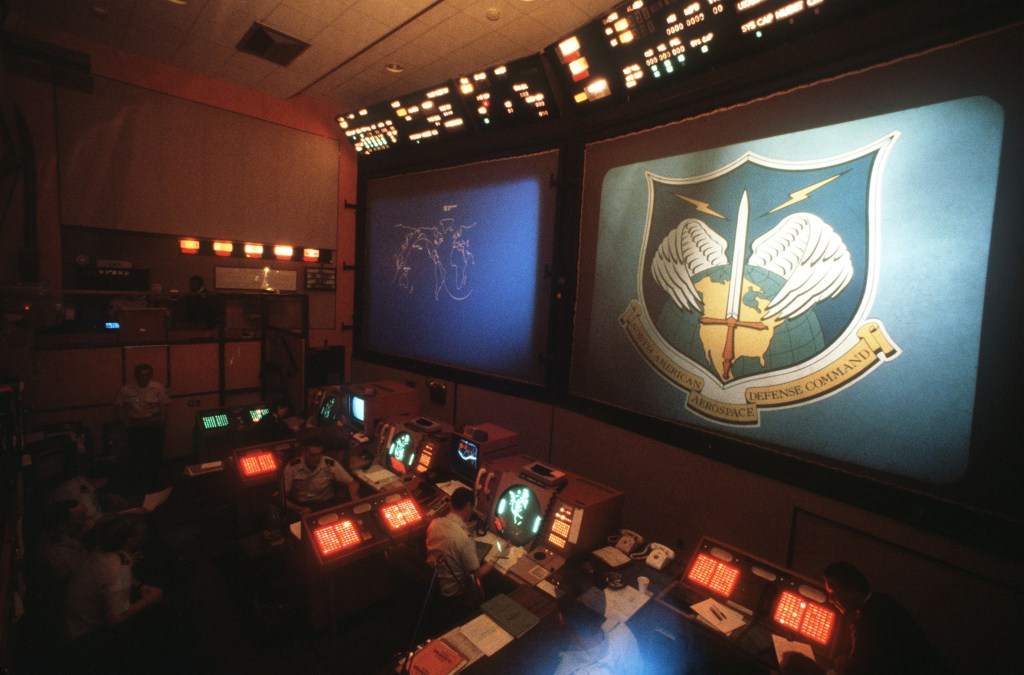
Command Post of the North American Air Defense Command (NORAD) at the Cheyenne Mountain Complex, April 1st, 1984. (Credit: Wikimedia Commons)
The nuclear fuse was almost lit in 1983 thanks to escalation, paranoia, and stubbornness.
Everybody remembers the tense thirteen days of the Cuban Missile Crisis as the closest the world ever came to nuclear war. When the Soviet Union set up intermediate range ballistic missiles in Cuba in response to the American Jupiter missiles in Turkey. In response, the United States blockaded Cuban waters and ordered any ships carrying Soviet missiles to turn around and be fired upon. The gambit worked, and the world inched back from a nuclear hellstorm and into a period of relative warming of relations between the United States and the Soviet Union.
As all good things must come to an end, the superpowers would chill their relationship again just twenty years later. 1983 saw the closest the world would come to nuclear war since the Cuban Missile Crisis, courtesy of fear and paranoia.
Morning in America, Twilight in the USSR
Ronald Reagan’s 1980 presidential campaign was marked by sharp rhetoric against the Soviet Union. With the Iran Hostage Crisis and the Soviet invasion of Afghanistan both beginning in 1979 and stretching into the 1980 election cycle, President Jimmy Carter was seen as weak by the American people. Regan positioned himself as a strong bulwark against communism and a proud defender of America against an almost certain Soviet nuclear first strike.
The Soviet Union was marked, at the time, by stagnant leadership. Leonid Brezhnev was seventy-four years old and in ill health when Reagan was sworn in as President in January 1981. Despite Reagan’s own advanced age, he appeared energetic, confident, and resolute. Reagan understood that optics was everything during his time in show business, and he felt the Presidency was no different. Brezhnev had been delegating the majority of his responsibilities since 1975 due to his health struggles.
Brezhnev had been responsible for the détente with the United States in the late sixties through the seventies. He had agreed with Presidents Nixon, Ford, and Carter that the two superpowers needed to relax their stances towards nuclear warfare as the annihilation of humankind served nobody’s interests. By the time of his debilitation in 1975, Brezhnev’s inner circle consisted of KGB hardliners led by the agency’s head, Yuri Andropov. The KGB was paranoid about losing Soviet influence across the world and believed that the United States was engaging in an elaborate game of misdirection so they could launch a nuclear first strike when the Soviets least expected. When Brezhnev passed in November 1982, Andropov became the head of the country and KGB paranoia became Soviet policy.
Andropov’s influence had been felt before he officially took over. The aforementioned invasion of Afghanistan caused the USA to take a harsher stance towards the Soviet Union and boycott the 1980 Olympic Games in Moscow. The break in relations correlated with the Soviets believing that the United States was playing an elaborate game of resuming hostilities before annihilating the USSR.
Ronald Reagan’s election on an anti-communist platform only served to reinforce that sentiment.
World Gone MAD
While Reagan had given other anti-Soviet speeches before, the Evil Empire speech given in early March 1983 marked a sharp increase in the American rhetoric against the Soviet Union. Instead of framing the conflict as peer adversaries seeking geopolitical advantages, Reagan opted to describe it as a battle between good and evil, casting the USA as the valiant and the USSR as the villain.
Reagan’s Strategic Defense Initiative program (nicknamed “Star Wars”) was built around various novel concepts to defend the United States against Soviet nuclear missiles. One of which was a space-based laser which would track and eliminate Soviet ICBMs before they could reach their targets. The massive financial resources poured into this program served only to convince the Soviets that they were falling behind in the arms race. The SDI was ultimately another Washington boondoggle and never came close to being operational.
The paranoia it bred turned out to be much more effective.
The problem with the SDI was that it was a pie in the sky idea, as reality would bear out by the time the program was shuttered. However, when it was announced about two weeks after the Evil Empire speech, it forced the Soviets to consider the idea that the United States wasn’t constrained by Mutually Assured Destruction. The concept of MAD was what kept the peace between the USA and USSR throughout the Cold War. In essence, it can be summarized as, “If you send enough to destroy us, we can send enough to destroy you in return. We may not win, but you also lose.” Both nations possessed enough nuclear firepower, early warning systems, and methods of delivery to annihilate each other in case one shot first. Since nobody wanted to be the one to fire the first shot to end the world, both countries kept their nuclear weapons from going off. However, to the Soviets, if the United States didn’t have to play by the old rules, they could strike first and wipe their enemy out without losing any sleep.
At that point, you start to unholster your weapon. Suddenly, shooting first before the other guy knows you’ve pulled seems like the only option if the other guy can stop your bullet the moment he knows you fired it.
Much of the Cold War was brinkmanship, elaborate attempts at misdirection, and the manipulation of global sentiment through any means necessary. The USA had announced the capability to stop nuclear missiles before they reached their targets and were stepping up their smack talk within a few weeks. With the benefit of hindsight, everyone knows it was Reagan putting on a show for the domestic audience and announcing another hopeful government program which would only serve to pay contractors high salaries for several years. At the time, however, the Soviets were fearful it was a signal that the fire was about to consume everything from East Berlin to Petropavlovsk.
As is a recurring theme throughout Russian history, then things got worse.
A Series of Provocations
1983 was a tense year in geopolitics. The United States deployed Pershing II nuclear missiles to its allies in Europe, particularly West Germany, which made the Soviets feel like there was a western attack brewing. The Pershing II missiles were deployed in West Germany in November 1983 but had been announced years earlier. The impending deployment of intermediate-range nuclear missiles to territory bordering the Eastern Bloc was viewed as a major provocation by the Soviets. While the missiles would not come until the end of the year, they were a dark cloud on the horizon which had been moving steadily closer and it weighed on everyone’s minds.
There were numerous protests in the months leading up to their eventual deployment. Many people in both the east and the west believed that the presence of the missiles in western Europe was indicative of the United States’ desire to launch a first strike. The Pershing II’s proximity to the USSR, and their large numbers meant that the Soviets had virtually no defense against a NATO first strike using these intermediate-range weapons. To Moscow, it made no sense why anyone would deploy such weapons unless they had every intention of using them. Matters weren’t helped by the CIA deploying psychological operations designed to scare the Soviets with the nuclear capabilities of the American armed forces.
The provocations would occur on the other side of the world as well. The United States Navy is the most powerful force on the water anywhere in the world and is responsible for a large part of American military supremacy because American military logistics are second-to-none. FleetEx ‘83 was a massive US Naval exercise in the Pacific. In fact, it remains the largest naval exercise ever conducted in the North Pacific to this date. It was designed to show off the Navy’s ability to bring an immense amount of power to bear on the Soviet’s eastern flank and control a contested ocean. During that exercise, US Navy aircraft overflew the Kuril Islands, which were occupied by the Soviets after World War II when they were controlled by the Empire of Japan and remained in Soviet control since. The archipelago forms the connecting barrier between the Pacific Ocean and Sea of Okhotsk, drawing a line between the Kamchatka Peninsula in Russia’s far east, and the Japanese mainland. The Soviet Air Defense on Sakhalin, an island in the Sea of Okhotsk, did not scramble a response to those flyovers, which resulted in the commanding officers being removed from their posts.
This response to the lack of response from Sakhalin would put the Soviet Air Defense forces in the Pacific on hair triggers for the next several months and cause a greater tragedy down the line.
Korean Air Lines Flight 007
During the height of the Cold War, the United States and the Soviet Union were on hair triggers with each other. The Soviets routinely probed American airspace with bombers flying near Alaska, and the United States routinely conducted stealthy reconnaissance flights over Soviet territory. In September of 1983, the General Secretary of the Communist Party of the Soviet Union at the time was still Yuri Andropov. The Soviet Union was still on edge. And in Anchorage, Alaska, an aircrew in a Boeing 747 didn’t realize that they would be about to take their final flight. On September 1st, 1983, Korean Air Lines Flight 007 would be shot down by Soviet Air Defense aircraft in a tragic case of late-night mistaken identity.
Recall FleetEx’83, when US Navy aircraft overflew the Kuril Islands and the Soviet Air Defense on Sakhalin did not respond. Daily drills and tense expectations were the norms for the Soviet far east air defenses. Andropov’s concerns of a western first strike created a culture of paranoia in the Soviet military and intelligence communities which meant that an airliner slightly off course and flying over Soviet territory would be shot down quickly, to avoid the wrath of Moscow for another lackluster response to territorial incursions. Furthermore, at the time of KAL Flight 007, the Soviets were on heightened alert due to a missile test they were conducting on the Kamchatka peninsula, which was being monitored by an American reconnaissance aircraft.
KAL 007 departed New York without incident and made it to Anchorage, Alaska with little problem. While in Anchorage for a refueling stop, KAL 007 discovered issues with their radio navigation equipment. They switched to the backup Inertial Navigation System, however, the INS was not properly aligned. They deviated from their scheduled course which took them over the Bering Strait over the Pacific before turning back to cross over Japan before landing in Seoul. KAL 007 actually flew over the Kamchatka Peninsula in far eastern Russia before returning to neutral airspace. This brief overflight got the Soviets into a state of heightened alert. Fearing an American attack or reconnaissance flight, the orders were given to find and destroy the offending aircraft.
The Soviet station on the peninsula had their radar knocked out by storms before this incident, which meant finding the offending aircraft was more difficult. Concerned about letting unidentified aircraft travel over Soviet airspace, the Commander of the Soviet Far East District Air Defense Forces, General Valeri Kamensky, ordered that the aircraft be shot down over neutral airspace after verifying it was not a civilian airliner. The lack of Kamchatka’s radar meant finding the plane was more difficult, and it showed up again over Sakhalin, the location of another Soviet air base at the time. The Soviet fighters found the aircraft, but in the darkness, they could not discern whether it was civilian or military. They fired warning shots, but the pilot believes the airliner may not have even seen them. Then, the Airliner contacted Tokyo Area Control Center to request permission to ascend to a higher altitude to save fuel, which was granted. The ascension was seen by the Soviet fighters as an evasive maneuver, and the order to shoot down Flight 007 was given to the Soviet fighters before the plane returned to international airspace.
Soviet fighters took the shot with missiles and sealed the fate of KAL 007. The missiles did not destroy the airplane outright, instead damaging control surfaces and causing a struggle for the flight crew. Flight 007 stayed in the air for several minutes, with the crew trying to reassert control over the aircraft with some success before they lost all control, and the aircraft spiraled downwards before breaking apart in the air. Everyone on board was killed, including US Congressman Larry McDonald. The Soviets did not acknowledge the incident until five days later and would impede search and recovery efforts by elements of the US Navy in spite of both nations being signatories to the 1972 Incidents at Sea agreement. After the dissolution of the Soviet Union, the Russian government would reveal later that they had recovered the black box from the wreckage and hid it because it disproved their accounts.
The aftermath was a sobering reminder about what military aircraft are meant to do, and why the use of force must be applied judiciously and as a last resort. In response to this incident, President Reagan announced that the Global Positioning System (GPS) which had been developed for the US military would be open for consumer businesses to utilize as well. Reagan also began to beat the war drums once more. Before understanding the full details of what had happened (which would not truly come out until the 1990s after the USSR dissolved), Reagan labeled the attack as a deliberate and barbaric massacre of innocent civilians. There was reason for the United States to suspect it was a mistake. The Soviets knew for certain that it was a mistake. They also believed the Americans to have so thoroughly penetrated their information apparatus that the Americans would also have confirmation that the shoot down of KAL 007 was a mistake. Therefore, to the Soviets, Ronald Reagan was making a deliberate call for war.
Now, it’s simple to track any flight in the world, making it easy to time picking your friends up from the airport. Back then, many people in the west feared that most of the flights that would be soon taking off would be carrying nuclear weapons with them.
The Soviets thought so too.
Stanislav Petrov
Mere weeks after KAL 007 was shot down by errant Soviet Air Defense fighters, Stanislav Petrov rode into history by not calling his bosses. Petrov was a lieutenant colonel in the Soviet Missile Defense forces. It was his responsibility to relay information about incoming attacks up the chain of command so that the proper authorities can respond. However, at his distant early warning post, Petrov thought something was amiss.
Nuclear early warning systems are a complex set of mechanisms to register incoming nuclear missiles and bombers. With only minutes to decide on a response, every second of advanced warning counts in order to give the proper orders to strike back in the case of a nuclear attack. Ground-based radar stations, monitoring satellites, intelligence assets on the ground, atmospheric sensors, and airborne aircraft with powerful radar arrays are all components of large nuclear warning defense systems. Early warning radars were designed to spot missiles as they crossed the horizon, however newer systems can bounce the signals off the ionosphere to detect them over the horizon. At the time, the early warning satellites were the best bet because they were pointed to detect the launches, which would give as many precious few minutes as possible before impact.
On September 26th, 1983, Stanislav Petrov was at work at the Serpukhov-15 bunker outside of Moscow. The bunker was a command center for the Soviet early warning satellite system codenamed Oko. Shortly after midnight, his warning screen lit up with warnings about one, then two, followed by three, four, and five missile launches. Petrov’s duty was to call the higher ups as soon as he could to inform them that the Americans had launched. He refused to pick up the phone.
His gut instinct was that a total nuclear attack by the United States would consist of more than five missiles. The idea of a first strike was to eliminate the other side’s ability to respond. With hundreds of nuclear sites spread across the largest country on earth by landmass, all built with the awareness that they’d be the prime targets in case of such an attack, five missiles didn’t make any sense. He told his team that it was a false alarm and logged it as such.
It turned out that one man’s gut instinct saved the world from almost certain annihilation. Minutes after calling the false alarm, the Soviet ground-radars would confirm his instinct: they detected no missiles coming into Soviet territory. Had Petrov not waited, Soviet leadership at the time would have undoubtedly launched a full-scale ‘second strike’ against the United States which would have prompted a full scale true second strike and plunged the world into total global thermonuclear war.
As it turned out, the satellites gave a false report due to a rare ‘glitch.’ The Soviet (now Russian) early warning satellites travel in Molniya orbit around the Earth. At the time, the satellite aligned with the sun and the area it was surveilling which bounced the sun’s rays off high altitude clouds and registered as a nuclear missile launch. Because Oko was a new system, these rare circumstances hadn’t always been known, and Oko’s alerts would always be checked with geostationary satellites before any decisions were made.
Petrov died in Moscow in 2017 at the age of 77, but the world’s continued existence serves as his legacy. He lived most of his life afterwards in complete obscurity. After the incident, he was questioned by his superiors and ended up a pensioner living outside Moscow. It was only long afterwards, once the Cold War had ended and the USSR broken up, did people hear of his story when his former commanding officer, Colonel General Yury Votintsev, told reporters what Petrov had done early that September morning. Petrov received an award from Association of World Citizens, which read ‘To the man who averted nuclear war’ in 2006, and the Dresden Peace Prize in 2013.
He is known as ‘The Man Who Saved The World.’
Able Archer ‘83
Paranoia over the start of nuclear war engulfed both American and Soviet decision making circles, from the lowest of intelligence officers to the chief executives. Operation RYAN was the Soviet Union’s massive intelligence gathering operation designed to determine whether NATO would launch a nuclear first strike by monitoring nuclear facilities and other personnel involved in making those decisions. Due to the heightened tensions of the Cold War, the intelligence services of the other Warsaw Pact countries would be roped in soon thereafter.
Andropov was a hardliner who was formerly head of the KGB, and as his power grew over the years, so too did his influence. The upper echelons of the Soviet government were majority picked by Andropov by the time he became Premier, and they reflected his suspicions that the United States was preparing a nuclear first strike. Even when RYAN was passing up intelligence that the West was not intending on striking first at all, it was dismissed as being incorrect. The Soviet leadership believed that the United States and its allies were so good at hiding their true intentions that it rendered the mighty KGB practically useless in gathering foreign intelligence. The truth was that Ronald Reagan was a President who liked to play for the cameras as a tough guy and the USSR was a convenient punching bag, especially for a man who testified to Congress as a friendly witness before the House Un-American Activities Committee the year he became SAG President.
The Soviets believed that the United States under Ronald Reagan was preparing a first strike, fears which would only be heightened by the American response to KAL 007 and their own jumpiness after Stanislav Petrov narrowly averted the apocalypse, amongst all of the other problems cropping up over the course of the year. The proverbial straw which could have broken the camel’s back was the Able Archer ’83 exercises which occurred in November.
Able Archer ’83 was a NATO wargame. Designed to test NATO nuclear forces’ readiness, the exercise was a massive command and control simulation of what ordering a full scale nuclear attack would look like. It began on November 7th, 1983, and ended on November 11th. The irony of ending the exercise which almost started nuclear war on Armistice Day has been remarked upon by historians and scholars the world over.
The Soviets, jumpy after all of the close calls from earlier in the year and hopped up on their own domestic supply of fear and paranoia, believed that Able Archer was the cover for an actual nuclear launch. Why else would the aggressive rhetoric be dialed up so dramatically, followed by several steps to nullify the USSR’s ability to respond, provoke a military response to study how they acted, and then blaming the Soviets for purposefully killing people in what they honestly believed everyone knew to be an accident? To the Soviet military, intelligence, and political worlds, NATO was ready to hit first, justifiably or not.
Able Archer 83 was a massive, carefully coordinated effort to simulate total nuclear war. Aircraft with simulated nuclear weapons and their crews were put on alert status at NATO airbases all over the world. The command and control centers saw the most activity they had probably ever seen. Leaders were being secured. The DEFCON level was set to 1. The Defense Readiness Condition (DEFCON) is the state of alert for the United States military. DEFCON 1 means nuclear war is about to start or has started, and has never been used (other than exercises such as Able Archer). The military has only been at DEFCON 2 once, during the Cuban Missile Crisis. Some forces reached DEFCON 3 at the outbreak of the Yom Kippur War but was only reached by all US forces worldwide on 9/11.
Thus, all of the pomp, circumstance, bomber crews getting airborne, and missile silos getting their hackles up, the Soviets became extremely nervous. This caused them to ready their military forces stationed in Poland and East Germany and prepare their own nuclear bomber aircraft. NATO caught wind of the Soviets’ fears and declined to respond to the Soviets’ increasing readiness upon the exercise’s conclusion as a way to ease Moscow’s mind. However, it wouldn’t be until years later that members of NATO and the United States military and intelligence communities would understand the extent of the danger posed by the Soviets’ reaction to the exercises.
Ultimately, while Able Archer ’83 did not result in nuclear war, the fears of such devastation would pave the way for peace as cooler heads prevailed in its aftermath.
The Sum of All Fears
Nuclear war would not come to pass. The Americans were shocked to realize how many close calls they had with the Soviets during 1983. When Andropov died in February 1984, Konstantin Chernenko took over for thirteen months, most of which he spent in the hospital. Wanting to avoid another in a series of old men croaking in office, the Politburo would elect a young reformer to the highest office in the Soviet Union, a man with a distinctive port wine stain birthmark named Mikhail Gorbachev.
Gorbachev was the only leader of the Soviet Union who was born after the Soviet Union was formed. He was young, charismatic, and recognized the need for both peace and reform to Soviet society. He developed a strong relationship with Ronald Reagan, who was inaugurated for his second term on January 20th, 1985, a mere nine days after Gorbachev became General Secretary. The two men presided over the gradual disarmament of their respective militaries, and the cultural exchange which had so long been denied to the citizens of both nations. With new bridges being built and old weapons being scrapped, Reagan and Gorbachev made once-bitter enemies into ambivalent cohabitators, only for communism to fall across Europe in 1989 and the Soviet Union itself to dissolve by the end of 1991.
The lessons of 1983 should be that diplomacy and restraint must always be practiced in international settings. That most people want to live in peace with their neighbors, and special responsibility must be taken by those who posses the power to destroy the world ten times over. The human factor is still absolutely vital to decision making in the face of powerful new technology. The open sharing of information and refusal to let fear and paranoia dictate decision making result in fewer tragedies. That a world which exists on the foundation of cooperation and communication and a refusal to create bitter and brutal enemies is the kind of world of which everyone should dream.
With dignity, humility, patience, prudence, honesty, earnestness, and a little luck, we will continue to get by on this special little blue planet.



 Ark of the Lost Angels

Leave a comment