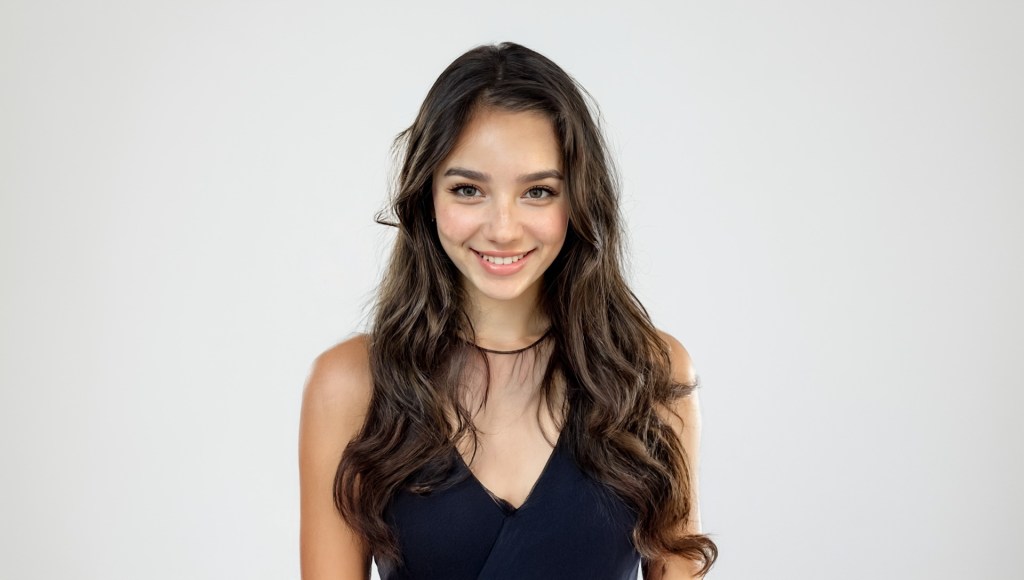
(Credit: “Tilly Norwood” on Facebook)
To start on a personal note, I am breaking my usual rule about not using AI generated imagery with this article. I do not do so lightly. However, because the subject of this article is an AI creation means that I would rather use an image of it to accompany this article, rather than falsely imply any of the normal art or photography I’d use is AI generated. This is a special exception to discuss this topic. I remain committed to promoting content created by humans in all avenues and want to reaffirm my commitment to never use AI to write a single word I produce here on this website.
The recent announcement of an AI “actress” has brought to light more fears about the use of AI in entertainment.
The overreliance on AI in the sphere of public concern chips away at humanity’s ability to engage with critical thinking, discernment, and understanding fact from fiction. Social media runs rampant with AI generated images or stories of events which never happened, designed to influence opinions one way or another. People who understand what to look for (or are at least skeptical enough to research what they see before believing it) are able to recognize AI generated content for what it is. As these models get better and better, the ability to discern reality from construct will be challenged. This is a massive threat to society’s cohesion, for whoever controls the flow of information controls the world. AI will allow groups to destroy trust in objective facts and guide large amounts of the populations with outright lies which look perfectly true. The world’s population needs to put tight restrictions on the use of AI now before it is too late. Overreliance on AI is already being normalized in far more innocuous ways, such as the games we play, the music we listen to, and the movies and television we watch.
The entertainment industry is atrophying and zombifying at a frightening rate. The power of technology to completely warp reality has never been more potent than it is now, and the problem will only continue getting worse. At the Zurich Film Festival last month, the CEO of AI production studio Particle6 revealed that they are attempting to have the first AI generated actress signed by a Hollywood agency. The forced injection of AI into the creative fields is dangerous, damaging, and frankly exhausting. In a world where disinformation on social media runs rampant, the quote from the Marx Brothers’ Duck Soup feels all too familiar: “Well, who ya gonna believe me or your own eyes?”
To say that we are through the looking glass is an insult to Alice in Wonderland, Lewis Carroll, Walt Disney, and quite frankly anyone who has ever put a pencil or pen to paper, or whoever typed so much as a three sentence short story.
“Generating” the Future?
Assistive AI has many pragmatic uses. From identifying pieces of information or sequencing genomes for scientific experiments or analyzing medical data, there are countless ways which AI provides benefits to humanity. The arts aren’t one of them. As established previously, generative AI presents a clear and present danger to the current societal order. In addition to the massive ecological cost of using it and maintaining the data centers responsible for processing the millions of requests given to it every minute, generative AI has no safeguards as it currently is, and takes the human element out of the decision making process.
However, there are deeper reasons why AI doesn’t work in the creative fields. In summary, it isn’t creative.
Generative AI works by studying works and then synthesizing something based on those works using the parameters given to it by the prompt. It’s an impressive feat of engineering if it wasn’t so wrong all the damn time. In fact-based works, AI hallucinates nonexistent sources or draws incorrect and illogical conclusions from data because it is not capable of analysis. It synthesizes information based on all of what it has been fed, but there is nothing to say the information it was trained on is correct, up-to-date, or even relevant. Often times, AI scrapes all sources equally, meaning as much misinformation and disinformation is on alternative news sites or social media makes it into the pool of available information with the same weight as carefully researched, peer-reviewed scientific journals. It’s the equivalent of someone listening to multiple hours of astrophysics lectures and attempting to explain what happens when stars die without having any certified knowledge of astrophysics or even if the lectures they watched were from scientists, let alone scientists esteemed in the field.
In the creative realm, the same concepts apply. AI may be able to write a poem using the same types of words as Walt Whitman or Robert Frost or Gwendolyn Brooks, but it will not be able to capture the same message. The end product will be superficially similar but lack the heart and soul which characterize an author’s work. AI cannot make specific determinations about using certain words in a stanza, or playing with the meaning of words, or even creating coherent thoughts. It is only trained on the text rather than the meaning, and the philosophy behind creation is impossible for AI to replicate.
Now apply the same standards to video. Sure, AI can produce some scenes that look cinematic, but there is no clear direction, no understanding of cinematography or visual storytelling, and no message or intention behind the shot. It apes what the established directors do but without the pathos behind it, rendering AI generated video a cheap copy of actual art without the human sensibilities which emotionally move people when they watch.
In addition to not getting people quite right, with awkward movement, inconsistent body proportions, and unnatural textures, AI cannot replicate the thought process behind actors. The joy of acting is the ability to create a character which inhabits the story. Actors bring their own ideas, experiences, and feelings to roles all of the time. It is their input, both pre-planned and improvised, that make so many movies what they are. Even something as seemingly insignificant as where one actor makes eye contact with another during a dialogue can change the meaning and impact of a scene. Without actors to make those decisions in real time, the soul of moviemaking or television production is completely lost.
AI robs the most human aspects of creativity of their humanity. Its insidiousness is in its dullness.
Follow the Money…and the Lawyers
On a much more pragmatic business level, studios using AI actors open themselves up to other serious problems. This reddit comment outlines a scenario in which studios open themselves up to a massive war of litigation if somebody should use the same AI actor to do porn. Deepfakes can spark legal action because they are using the likeness of a real person without their permission. To give the same protections to an AI actor, that entity would have to be legally recognized as a person, or at least the property of the company, which creates more legal problems. The licensing costs based on expected box office returns, for example, may become close to what paying a bona fide human movie star for the production. So, as a result of legal precedent which may have to be paid, including foisting the cost of operating the data centers for processing onto the movie studios, it may be cheaper to use real actors.
Another sinister part of AI as it relates to show business is that real actors are already being used and seeing no compensation for it. Tilly Norwood and her ilk are not wholly original creations. As with all generative AI, they are created by synthesizing a human face and voice from hundreds of thousands of individuals’ performances, without paying them a dime in residuals or royalties. An actor has the right to be paid for the use of their likeness, which was one of the major points of the SAG-AFTRA strike in 2023. The AI industry is built off of copyright infringement as it currently works, by training the various models on material under copyright without any protections for the artists which created them. There is legislation currently on the floor of the House of Commons in the United Kingdom to force companies to disclose which works they use to train their AI models. In response, Nick Clegg, former UK Deputy Prime Minister and Meta Executive said it would be “implausible” to ask permission for every work used to train these AI models “because these systems train on vast amounts of data.” That mentality hits the nail on the head for the motivation of these AI companies.
This is a way for technology corporations to shaft all areas of the creative avenues to hopefully drive them out of business while offering a replacement and positioning themselves as the only options. If actors cannot feed themselves by acting, they will find other careers outside of the creative arts. Without actors to be in visual media, production companies will turn to AI in order to maintain their output. The studios will have no problem replacing actors with AI because it will mean greater profit margins. No more stunt workers, no more safety personnel, no more costly insurance policies, no more need to rent studio space, no more need for the artisans who build sets, no need for craft services and production assistants, there will be no cameras to maintain and operate, nor will there be a need for sound technicians and all the equipment they operate. Quite simply, studios are salivating at the opportunity to replace all of the humans on their productions with AI because it means eliminating all of those costs from the budget of every production.
This would be a tragedy for filmmaking even if it’s smart business. Yes. these are all salaries which production studios will no longer have to pay, but these are also all humans being removed from the extremely human aspect of making art. Star Wars would never have become the cultural phenomenon it is today if Ben Burtt hadn’t created the sounds of the galaxy far far away, or the visual effects team at Industrial Light and Magic had not given physical form to the imaginings of George Lucas in 1977. Replacing actors with AI, especially after already openly trying to replace writers, is the next step in Hollywood’s plan to remove humanity from art. By replacing the presences on screen with cheap AI generated copies, both the tech companies and productions studios are priming audiences to accept when the entire filmmaking industry becomes a handful of studio executives prompting AI models to make movies.
An assault on actors is an assault on the entire film industry.
The Human Face
The use of AI actors is an assault on actors, make no mistake, in more ways than one. AI actors, because of their freedom to do anything without having a say in the proceedings because they cannot themselves think means they will have no value in a film or television production. Tom Cruise, for example, is a huge box office draw because of the quality of his movies and his star power. Tom Cruise is very particular about which projects he takes on in order to maintain that image.
And that touches on another sad reflection of our society today. An AI generated actress cannot say no. And it is mildly concerning that the first AI generated actress garnering this amount of publicity is an attractive young woman. It opens the idea up as an avenue for continuing to normalize the exploitation of women by depicting these behaviors on the screen without reservations. More than that, young actresses will find themselves more easily exploited in the casting process. It won’t be unconceivable for a director to demand that a young woman degrade herself on camera in a way that makes her feel uncomfortable with the explicit threat that, “Unless you do this, you will be replaced by an AI who will.” And as AI technology continues to improve, the idea that the real actress can be replaced with AI for those degrading scenes comes as a wicked double edged sword. On one hand, if she consents so it’s not technically her body on display, that’s a constructive use of AI. On the other hand, without her consent, it opens the world up to a new level of cyberpunk dystopia manifest in reality. With Hollywood’s long history of exploiting women, which led to the Me Too movement, this is a serious concern which should not be dismissed in any conversation about the use of AI in Hollywood.
This dovetails into the other problem with society at large: the desire of control over women. Tilly Norwood was designed to look young while still being ostensibly an adult. It reinforces unrealistic beauty and age standards already attached to women in Hollywood. It reinforces the sexualization of barely legal women as a cover for the sexualization of teenagers and young girls. And it reinforces the exploitation of these women that the young actresses whose performances were ripped off to create Tilly Norwood in the first place did not receive compensation only to be replaced by AI actresses like Tilly Norwood. It’s a double violation in many senses.
Hollywood stars have already begun to launch their criticism of this move. Just as the writers did in their concerns over being replaced by AI which led to the WGA strike in 2023, actors have a vested interest in keeping AI out of visual media. With good reason. Humans have acted in front of audiences for tens of thousands of years, it is one of the oldest human art forms to have existed. The mediums through which these performances are conveyed have changed and evolved as technology has advanced, but the heart of all of these performances has been that a human has written them, a human has performed them, and humans have supported all of those pieces. The use of synthetic performers literally steals what makes these performances so memorable, emotional, and real by stealing the humanity from them. The actors’ union, SAG-AFTRA, has already released a statement condemning the use of AI actors.
The Tilly Norwood controversy drummed up in recent weeks has the potential to be a tipping point in the conversation about AI. While the conversation may be artificially driven to normalize the idea of AI performers in the future, the concerns it has forced people to think about what AI actors would look like. More importantly, it forces people to think about what a future Hollywood without real performers would look like. Movies will become bland, soulless, corporate, data-driven slop rather than daring to do something which breaks conventions, inspires controversy, or touches the soul. Movies are meant to make us laugh, cry, cheer, think, and feel. They are meant to make us feel at home, inspire discomfort, contemplate ourselves and the world around us, and take us away from our lives for a few hours to experience something else. By removing the essential human elements from movies, we open ourselves up to losing our humanity itself. Pale binary imitations of art can never replace the real thing, and we owe it to our creatives to remind the business world of that fact.
Art and commerce will always be at odds, but commerce only wins if we let it.

 Ark of the Lost Angels
Leave a comment