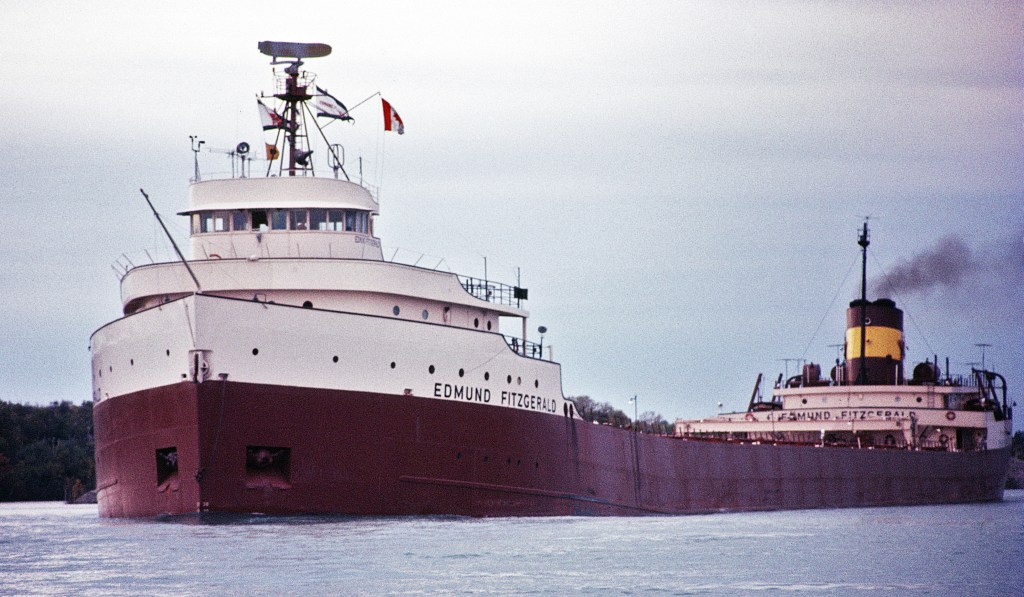
The Edmund Fitzgerald, 1971 (Credit: Wikimedia Commons)
Fifty years after its sinking, the Edmund Fitzgerald lives eternal.
Sailing has been one of the most dangerous professions in human history. The earth’s seas and oceans have claimed millions of lives over the millennia of human existence. The danger of seafaring and the sacrifice of sailors have been reflected in poem, song, and story for tens of thousands of years. The dangers of seafaring in the ages of exploration are why pioneers are held in such high esteem. Advances in technology mean that most shipwrecks of the modern age are by human error or not following safety regulations, such as 2012’s Costa Concordia disaster or in 1989 when the Exxon Valdez hit Bligh Reef and spilled 10 million gallons of crude oil over the Alaskan coastline.
Sometimes, however, even in the modern age of miracles, a disaster is caused by forces beyond human control. November 10th of this year will mark the 50th Anniversary of the wreck of the Edmund Fitzgerald, with several events planned to commemorate this anniversary. Like many of its fellow fallen vessels, the story of the Edmund Fitzgerald was told in song. Unlike many other sunken ships, the Edmund Fitzgerald was immortalized in a song written shortly after it disappeared beneath the waves rather than years later.
Perhaps it was the immediacy which laid the Edmund Fitzgerald to rest in hearts across the world, where it is still remembered and honored today.
The Lake, It Is Said, Never Gives Up Her Dead
The Great Lakes are a bit misnamed. Their characteristics make them out to be more inland seas. They are five massive, interconnected bodies of fresh water with heavy currents, depths, waves, and massive dimensions. Of the five lakes: Michigan, Huron, Superior, Ontario and Erie, only Lake Michigan is contained within the United States. The other four sit in between the United States and Canada and have shorelines in both nations.
As a result of their location and characteristics, they became invaluable for commerce both interiorly to both nations as well as between the two countries. Thus, shipping became the region’s major economic lifeline since civilization took hold on its shores, even long before the United States or Canada existed. With the industrial boom hitting in the United States, and the completion of the Saint Lawrence Seaway in the aftermath of World War II, waterborne trade in the Great Lakes maintained its importance into the modern day.
Shipping on the Great Lakes comes with a unique set of challenges and advantages. The Edmund Fitzgerald was one of a special kind of ship known as a lake freighter or a ‘laker.’ The lakers typically work for most of the year, going into winter layup when ice makes the Great Lakes impassable by ship. The fact that they work only in freshwater means there is much less corrosion from the saltwater found on ocean-going cargo vessels. Indeed, some lakers such as the Arthur M. Anderson, which was the last vessel to have contact with the Edmund Fitzgerald before it sank, are still in use despite entering service in the 1950s. Despite their width being restricted by the Saint Lawrence Seaway, most of the lakers don’t venture out to the ocean where their narrow design represents a greater danger with the bigger waves of the ocean.
Lakers are often designed to carry one specific cargo. The Edmund Fitzgerald carried taconite, which is a type of iron ore. They are also designed to be self-unloading, in that they have the equipment to unload their cargo without any outside assistance and can often do so in a matter of a few hours. Lakers developed into a vital family of designs which took up the mantle of centuries of trade and transport across the Great Lakes. With so much commerce crossing these fearsome bodies of water, there were many ships which were lost to their fury over the centuries.
However, none of them ever hoped to match the fame of the Edmund Fitzgerald.
The Pride of the American Side
The Edmund Fitzgerald is the most famous and mysterious ship which worked the Great Lakes. She was laid down on August 7th, 1957, and would be launched in June the following year. On September 24th, 1958, the Edmund Fitzgerald undertook its maiden voyage. With a deadweight tonnage of 26,000 long tons, the Edmund Fitzgerald was the first ship of its kind to be built to maximum size allowed by the Saint Lawrence Seaway, and remains the largest vessel lost in the Great Lakes to this day.
The Edmund Fitzgerald was named for the president and chair of the board of the Northwestern Mutual Life Insurance Company at the time of its construction. Northwestern Mutual, headquartered in Milwaukee, was invested in the iron industry on the Great Lakes and so contracted Great Lakes Engineering Works (GLEW) to build the vessel. Edmund Fitzgerald did not want the ship named after himself, but the board insisted, voting unanimously (with Fitzgerald abstaining) to honor their chairman and president whose grandfather and great uncles had all been lake captains, and whose father owned the Milwaukee Drydock Company.
Its launch was an auspicious occasion, one which would herald its fate. The champagne bottle failed to break, which is a bad omen for a vessel. In addition, a man died of a heart attack during the ceremony. After a half-hour delay when the keel blocks got stuck preventing its launch, the ship created a wave which drenched the attendees when it finally entered the water before it slammed into a pier.
Despite this rough beginning, the Edmund Fitzgerald would have a storied career and would become the most famous vessel on the Great Lakes. It set and broke several speed records. Captain Peter Pulcer became known as the “DJ Captain” because he would play music over the PA systems when the ship was traversing the St. Clair and Detroit Rivers. He would also entertain onlookers with facts about the ship delivered by a bullhorn while passing through the Soo Locks.
The last hours of the Edmund Fitzgerald remain somewhat of a mystery to this day.
The Captain Wired in He Had Water Comin’ In
For its final voyage, the Edmund Fitzgerald was under the command of Captain Ernest McSorely. She left Superior, Wisconsin on November 9th, 1975, around 2:30 PM, bound for Zug Island, Michigan with 26,211 long tons of taconite ore pellets. On the way, she crossed paths with the Arthur M. Anderson, which was under the command of Captain Bernie Cooper. The Arthur M. Anderson was sailing out of Two Harbors, Minnesota, bound for Gary, Indiana. The two ships were in radio contact as they traveled together, though the Edmund Fitzgerald was faster and stayed 10 to 15 miles ahead of the Arthur M. Anderson.
The weather would dictate the course of both ships. The two captains were made aware of a storm headed their way and decided to take a northern route across Lake Superior where the highlands on the Canadian shore offered some protection. They passed between Isle Royale and the Keweenaw Peninsula and turn southeast bound for Whitefish Point, Michigan.
The weather conditions worsened over the course of the day. Gale warnings were issued at 7:00 PM on November 9th. They would be upgraded to storm warnings in early morning the next day. Winds gusted to 50 knots and seas 12 to 16 feet. In the early afternoon of November 10, the Edmund Fitzgerald was approaching Caribou Island afterhaving passed Michipicoten Island. The Arthur M. Anderson approached Michipicoten, located about three miles off the West End Light.
At 3:30 PM, McSorely radioed Cooper to ask if the Arthur M. Anderson would stay close to the Edmund Fitzgerald as they made for Whitefish Point because his ship was listing and taking on water. A little over half an hour later, the Edmund Fitzgerald called the Arthur M. Anderston to report that they had lost their radar and asked the Arthur M. Anderson to keep track of them. As the afternoon turned to evening, the intense winds caused rough sailing and the large waves caused the Arthur M. Anderson to frequently lose sight of the Edmund Fitzgerald on radar.
Minutes before it vanished, McSorely was on the radio to the Arthur M. Anderson. At 7:10 PM, the McSorely stated “We are holding our own.” Five minute later, the Edmund Fitzgerald vanished from the Arthur M. Anderson’s radar for the last time. The Arthur M. Anderson called the Edmund Fitzgerald again at 7:22 PM but received no response.
No mayday or other distress signal was sent. The storm cleared soon thereafter but the seas were still rough, and the Arthur M. Anderson could not see the Edmund Fitzgerald despite the fact that the Edmund Fitzgerald should have been in visual range. By 8:00 PM, the Arthur M. Anderson had contacted the Coast Guard with concern for the Edmund Fitzgerald, and despite the conditions, turned back to try and search for the vanished laker, to no avail. While two of the Edmund Fitzgerald’s lifeboats and some other debris showed up, there were no signs of survivors.
The Coast Guard launched aircraft and dispatched two cutters to assist in the search later that evening, the first arriving shortly before 1:00 AM on November 11th, and the second arriving on the 14th. Also on the 14th, a US Navy aircraft with underwater detection equipment received a strong response north-northwest of Whitefish Point. The Coast Guard picked up two pieces of wreckage on sonar over the next few days. There was another sonar scan launched the following May, which prompted the Navy to send a deepwater submersible in, which recorded video tape and photographs of the wreckage including confirmation that it was the Edmund Fitzgerald.
The official cause of her sinking is still unknown. The most prevailing theory found in both federal reports (one prepared by the National Transportation Safety Board and the other by the U.S. Coast Guard’s Marine Board of Investigation) is that there was intense flooding of the cargo hold due to the size of the waves overwhelming faulty hatch covers. This flooded the cargo hold and despite the crew being able to manage, the size of the waves meant that once the ship was overwhelmed, it was swallowed by the sea too quickly for the crew to react. Other theories include the ship bottoming out on a shoal, or that the ship had problems with its keel and a rogue wave caused the ship’s ‘backbone’ to break in dramatic fashion, dooming it and its crew.
This cuts to part of the fascination and fixation with the Edmund Fitzgerald. Its final moments seemingly confident in its ability to weather the storm, and declaring defiantly that it would remain, the sudden disappearance leaves mystery in its wake. People are naturally attracted to puzzles, and in the absence of fact, people will fill the void with fiction. The Edmund Fitzgerald became a modern mystery in an industry where disasters tend to have much more solid answers. Even her hull sitting at the bottom of Lake Superior offers no solid answers to its final few minutes afloat following its last transmission.
The Arthur M. Anderson is still in active service but has not sailed since the 2024 season. She needs a five-year inspection, and while it is possible that the last ship to have seen and talked to the Edmund Fitzgerald may have also sailed its last voyage across the Great Lakes, it has a history of returning to open waters after long periods in layup. Even if it never carries cargo again, there is an effort to retire the Arthur M. Anderson as a museum ship where it would carry on to tell its part in the story of the Edmund Fitzgerald.
Though the story of the Edmund Fitzgerald would have languished in obscurity had Gordon Lightfoot not told it to the world.
The Legend Lives On
Gordon Lightfoot was a Canadian singer-songwriter who was known as one of Canada’s greatest musical artists and prolific the world over. In the aftermath of the sinking of the Edmund Fitzgerald, Lightfoot became fascinated by the disaster and drew inspiration from news articles when writing the song, most notably the Newsweek piece published two weeks after the loss of the Edmund Fitzgerald, entitled “The Cruelest Month.”
Recording the track was another matter entirely, a legend befitting its subject matter. Lightfoot agonized over ensuring the lyrics were as accurate as possible until his guitarist told him to just tell the story. At the time of its writing, the wreck had not been found, much less explored, and the details of the Edmund Fitzgerald’s final moments were even murkier than they are now. Legend has it that Lightfoot recorded the vocals in one take, reading them from a sheet of paper by candlelight. The track was recorded a month after the Edmund Fitzgerald was lost to Lake Superior.
While Gordon Lightfoot is credited for enshrining the ship into legend, there are some creative liberties taken in his famous song. The most enduring tribute remained unfinished by Lightfoot until his own death, as he updated the lyrics of the song for live performances as new information became known. He felt a responsibility to tell this story and indeed he continued telling it until the end of his life. More importantly, he felt the responsibility to tell it truthfully, to honor those who died and for their families left behind. Such changes include changing lines implying the crew made mistakes around the hatchways and correcting his description of the “maritime sailors’ cathedral” (actually the Mariner’s Church of Detroit) when in fact a parishioner objected to Lightfoot’s description of the church as a, “musty old hall.”
In the years since its release, Lightfoot’s song became a cultural phenomenon. Much in the same way that James Cameron’s 1997 epic Titanic renewed interest in the world’s most famous shipwreck, Lightfoot’s tune chronicling the last hours of the Edmund Fitzgerald helped bring the story of an utter tragedy home for people. In turn, this sparked, and continues sparking, renewed interest in the treatment of wrecks. Many of the ships which rest on the bottom of the seas, lakes, and oceans across the world are graves, and while salvage of lost relics is a tantalizing idea, these sites are better left undisturbed. The hull of the Edmund Fitzgerald serves as a headstone for the 29 souls which were lost when it slipped beneath Superior’s surface.
More than that, the families of the sailors who perished lived on. The cultural debt owed to them to ensure that maritime safety regulations are updated remains present in all of our minds. It is up to regulators, lawmakers, and the electorate to ensure that the right people are positioned to make the laws and regulations to keep another memorial service from being held in that rustic old hall in Detroit.
Going beyond the pragmatic responsibilities, the continued recognition and appreciation of the sacrifices made by people who put themselves in danger on the world’s seas and oceans to deliver cargo which is so vitally needed to maintain society as it exists. Ships are still the most common method of transporting cargo, and while technology has advanced to keep the world’s sailors safer, the simple fact is that nature is still stronger than any steel man can forge. Every time a sailor travels the open waters, there is a chance they will never make port again.
The Edmund Fitzgerald is remarkable through being unremarkable. She was one of many vessels claimed by the waters of the Great Lakes. Though she is the largest and the most recent of the lost lakers, she may have faded into history without much mention. Without Gordon Lightfoot writing his iconic song, the Edmund Fitzgerald may have easily become a historical footnote as just the biggest vessel to be lost on the Great Lakes. By being immortalized in such an iconic fashion, the Edmund Fitzgerald’s name is known across the world, far outstripping the fame the ship would have had if it had completed its natural service life and became a museum ship or headed to the scrapyard.
Fifty years after it sank, the Edmund Fitzgerald lives on.





 Ark of the Lost Angels
.jpg)
Leave a comment