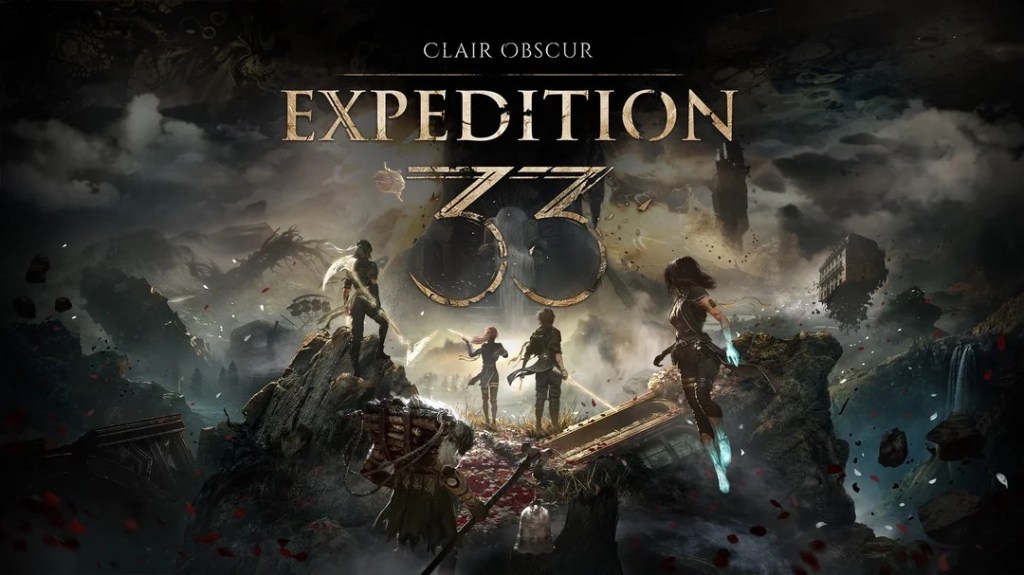
Key art for Clair Obscur: Expedition 33 (Credit: Sandfall Interactive)
Last week, Clair Obscur: Expedition 33 made gaming history by setting a record for awards at The Game Awards by winning nine out of thirteen nominations, including Game of the Year. French developer Sandfall Interactive released their first title in April of this year, and it took the gaming world by storm. Expedition 33 went from a promising indie title to an absolute phenomenon after its release and has left an indelible mark on the gaming landscape. Personally, it became one of my favorite games of all time, alongside Cyberpunk 2077 and The Elder Scrolls IV: Oblivion.
I first heard of Expedition 33 in summer 2024, during its reveal at the Xbox Games Showcase. I was intrigued by the premise and the story looked interesting. I was never a huge fan of turn-based RPGs. The last one I played was Sonic Chronicles: The Dark Brotherhood for the Nintendo DS, which first released in 2008. Suffice to say it’s been a while. I thought nothing of this game and didn’t even realize it had been released until a friend of mine recommended it to me. It was that friend’s recommendations that got my brother to play it, and both of them finally got me to try it.
The game sold me on the main menu. The music was the first thing I noticed, and the title track “Alicia” was this haunting piano and vocal tune that burrowed deep into my soul and sat there in melancholy perfection. By the time I got through the prologue, I was locked in. What followed was almost a hundred hours of me getting lost in this fantastic world with an incredible story following captivating characters set to one of the greatest soundtracks I have ever come across. I went out and purchased the music before I had even finished the first act, and it’s been a regular listen for me for the last seven months. I spent a significant amount of time learning the combat system, and honing my reaction times, taking after my brother’s school of trying to parry everything. He’s much better at that than I am.
I’d like to talk about the game in-depth. There will be spoilers now. If you have not played the game, do not read past this point.
I think the most resonant theme of the game to me was the various ways grief can manifest itself. Escapism is a frequent vice of mine. I write stories and poems to get away or process my real life. I read, watch movies, and play games to drop out of this world for a little while to focus on something else. Often it’s because life threatens to become so overbearingly oppressive that something different is warranted. However, the threat of escapism being so overpowering is a temptation which could lead to ruin.
I think one of the best things about Expedition 33 is how open the game is about its major plot twists and the depths of its story in such a way that the audience has no clue about it. Most of the songs when properly translated unravel crucial details quite plainly. However, the majority of the vocal tracks in many songs are written in French, archaic French, with Latin and other pieces mixed in to create something that is all real but doesn’t give everything away without some legwork. See what I mean about being open in a way where the audience has no clue?
The game’s writing is a high point, both in its storytelling and in its characters. In the world of Expedition 33, the citizens of a city called Lumière are struggling to survive. The Fracture saw Lumière cast adrift from the Continent on its own island, and creatures called Nevrons appear to attack the city. Each year, the Paintress paints a number on a monolith far away counting down. Everyone that age disappears in an event known as the Gommage. Every year, an expedition sets out for the Continent to defeat the Paintress and stop her from painting death for another generation. Every expedition lays the trail “for those who come after” by exploring the Continent, leaving journals, and leaving tools behind for the ones who come later.
The main cast of expeditioners are Gustave (played by Charlie Cox), Lune (played by Kirsty Rider), Sciel (played by Shala Nyx), and Maelle (played by Jennifer English). They enlist the help of Esquie (played by Maxence Cazorla), a legendary figure of great power who helps them navigate the Continent. They also come across the Gestrals, a silly race of being who enjoying fighting but aren’t always the brightest. After their landing goes awry and the majority of the expedition is killed, Gustave, Lune, Sciel, and Maelle become the last four expeditioners making their way towards the Paintress.
During their journey, Gustave is killed by the mysterious Renoir (played by Andy Serkis), while the rest of the expedition is saved by the timely intervention of the mysterious and charming Verso (played by Ben Starr). Verso explains that he and Renoir were members of Expedition 00, the first Expedition to set out for the continent to look for survivors in the aftermath of the Fracture. Verso states that they gained immortality when they reached the Continent (explaining Renoir’s advanced age in a time when everyone older than 33 should be gone) and that Renoir was their commander who had joined in with the Paintress. Verso agrees to help them stop the Paintress and joins their expedition. They recruit Verso’s Gestral friend, Monoco (played by Rich Keeble), and the rest of the expedition discovers in the ruins of Old Lumière that Renoir is Verso’s father, and the mysterious young woman often accompanying Renoir is Verso’s sister, Alicia. After much trial and tribulation, the Expedition makes their way through the Monolith and defeats both Renoir and the Paintress.
Upon their victorious return to Lumière, Verso reads a letter from Alicia meant for Maelle which explains the truth: that Maelle is the real Alicia from the outside world. Maelle was the youngest child of a family of painters with the ability to enter their canvases. When the real Verso died saving his sister Alicia from the fire, their mother, Aline, entered the only canvas Verso had painted and created the city of Lumière and its inhabitants. To escape her grief, Aline painted a version of her family so she could live as though Verso was still alive. The real Renoir entered the canvas to try and save his wife from dying by staying in the canvas too long, and their conflict caused the Fracture. Maelle was the real Alicia who entered the canvas at the bidding of her older sister Clea to try and help get Aline to leave, only to lose her memory when she was reborn as a child of Lumière. Aline, the Paintress, was actually holding back the real Renoir from erasing everything in the canvas. Renoir, in a desperate attempt to save his wife and daughter from being destroyed, intends on forcing both from the canvas and destroying it so that Aline won’t die from avoiding her grief. Renoir, now with more strength thanks to Aline being ejected from the canvas, Gommages everyone still left in Lumière.
Alicia, now having her memories of her real life restored, is able to use her powers as a Painter to save Lune and Sciel. The expedition regroups and agrees to help eject Renoir from the canvas so Alicia can restore everyone lost to Lumière. The expedition also confronts Verso over his falsehoods, and he admits to being depressed over knowing he is the painted copy of a dead man created by his mother’s grief. Unable to die, but dramatically unsatisfied with life, Verso wanted to help Renoir destroy the canvas to both save his family and give himself rest. After exploring the continent, gathering strength, the expedition returns to Lumière to face Renoir and they banish him from the canvas.
It is at this point that Verso realizes Alicia has no intention of leaving the canvas and that Alicia is intending on living out the same avoidance of her grief that Aline was trying to, even when it kills her. The two duel, and the ending is chosen based on who the player chooses to play as in that final duel. In Alicia’s ending, Lumière is restored, but Verso sees the toll that it is taking on Alicia. In Verso’s ending, Alicia is ejected from the canvas, and the canvas is destroyed, and Alicia stands with her family at a memorial for the real Verso as she imagines her friends waving goodbye before disappearing.
What makes the game’s narrative so effective to me is that the world is incredible to experience, and every answer only makes that world more intriguing. The characters all feel incredible human, with messy flaws and inconsistencies, competing motivations, and a very gray morality throughout. There are no true villains, because every antagonist has very valid reasons for doing what they do. The game’s narrative talks about the dangers of escapism, of grief and depression threatening to take over, and the importance of finding reasons to live and move on. A key tagline was “Tomorrow comes.”
The performance of every cast member brought these characters to life. Jennifer English won Best Performance at The Game Awards for her work as Maelle(/Alicia) and deserved it from the incredible way she brought Maelle to live and the subtle shifts she brought to her performance when Maelle was Gommaged and Alicia returned. Ben Starr and Charlie Cox were both nominated in the same category. Charlie Cox took one day’s work to flesh out a character with a rather basic part in the narrative and made him memorable and endearing. The audience quickly became attached to Gustave which made his death that much more gut wrenching. And Ben Starr’s turn as Verso was phenomenal. A man who lives halfway between truth and lies, always trying to arrange the pieces to get his ideal outcome without being soulless or heartless requires a delicate balance which Ben Starr nailed in dramatic fashion. Kirsty Rider, Shala Nyx, and Rich Keeble also deserve their flowers for making Lune and Sciel and Monoco dynamic and engaging members of the expedition, and especially helping Monoco be some comedic relief without being a completely comedic character.
The world is another high point. Lumière feels like it has history and its own traditions despite its people only appearing in the prologue. The world has so many elements which hint at its painted nature without overtly giving it away before the reveal. It feels lived in and alive all at the same time, even as the layers are peeled back throughout the story. The art direction sells this incredibly well. I was enthralled when I first took control of Gustave on the Continent, and exploring incredible environments like the gorgeous, coral coloring of Flying Waters or the picturesque forest which led to the Gestral’s Ancient Sanctuary made me fall in love with the game. By far my favorite environment was Sirène’s Island. From the moment I entered the enormous desert arena with a giant dancing figure in the middle singing an enchanting song, I was enthralled. Never have I encountered an environment in a video game which drew me in so wholeheartedly and left me spellbound. Every area was memorable, the enemies fit their environments, and every place was so different than the others without feeling incongruent.
Again, I cannot give enough flowers to the music. Composers Lorien Testard and Alice Dupont-Percier crafted an engaging score with so many memorable tracks that work outside of the context of the game. The raw emotion would not have been as effective without their musical contributions, and helped make each area feel distinct while guiding the audience’s intended emotions in the dramatic moments. The runaway success of the soundtrack has already seen a concert tour across Europe be scheduled after a few live performances in France sold out incredibly quick.
Sandfall Interactive began during the covid pandemic, and recruited people in interesting ways. For example, lead writer Jennifer Svedberg-Yen originally auditioned as a voice actor, and game director Guillaume Broche found lead composer Lorien Testard on an obscure message board about video games. The core team of 33 had a clear vision they wanted to execute on, and with help from the others they brought in such as the animation team based in Korea, were able to deliver an incredible experience. I look forward to seeing what Sandfall does next, and will be there day one.
I think the significance of Expedition 33 is that it proves not only can AA titles still sell, and that there is a hunger for turn-based RPGs, but people respond to games created with vision and character. New IPs are risky for companies because there is no established name to trade off of, but I think that’s what makes it amazing. This game blazed a trail, and people responded to something which took well-known ideas and placed them together in a fresh and unique way. People respond to the risk takers, and gamers want to see games with heart and soul created with care and attention to detail. There are some complaints about the game: Act III is a little awkwardly paced story-wise, Lune and Sciel have very little to do story-wise when the nature of the world is revealed, and the combat balance can make encounters in the endgame a bit of a joke. However, the game was so engaging and engrossing that these complaints fall short when compared to the end product as a whole.
I am not a challenge player. I have never been a fan of the From Software titles such as Dark Souls or Elden Ring. The idea of learning an enemy’s attack patterns through attrition never resonated with me. I enjoy games for the unique advantages that interactive storytelling offers. That being said, Expedition 33 makes me want to accomplish everything in the game. Even if it means I sit down and fight the same challenge boss for six hours straight until I learn how to kill him (Simon). I want to experience everything this game has to offer, and I want to support the developers which is why I bought the soundtrack in multiple formats, why I plan to order the art book when the English version becomes available. This resonates with me.
I am not the only one. The game sold 400,000 copies between its nomination for Game of the Year and last week alone. Its wins at the game awards netted a congratulations from French President Emmanuel Macron. The music, in addition to the concert tour, led to Alice Dupont-Percier becoming one of France’s most-streamed artists. People responded to the game, as it sold 3.3 million copies within 33 days after it released, and swept at The Game Awards exactly 33 weeks after it released. There are countless cosplayers and convention appearances since the game came out. People have responded to Expedition 33 in a tremendous way, both as players and within the gaming industry. Sandfall intends to continue making stories the same way. There’s something special about this game, a real lightning in a bottle moment, and I’m glad I’ve got to be part of it. The developers know and appreciate the attention and love from the fans. It takes a special kind of company to develop free downloadable content billed as a Thank You to fans (literally called the ‘Thank You Update’) and it was insanely cool to hear in the middle of the acceptance speech for Game of the Year that it’s available now (and indeed, within twenty minutes, my game had an update ready).
This game was something special to me. I felt the emotions throughout the story and we tend to create the strongest emotional ties with things that move us. Good art should move us, should make us think, should make us reflect. Good art should affect who we are because it is meaningful. I can say that I am profoundly changed thanks to Expedition 33, and that I will always love this game. I could delve into so many things, so many discussions, but for now I will say that I will cherish my time as part of the greatest expedition in history, and I look forward to seeing what Sandfall does next.
For those who come after.




 Ark of the Lost Angels
Leave a comment