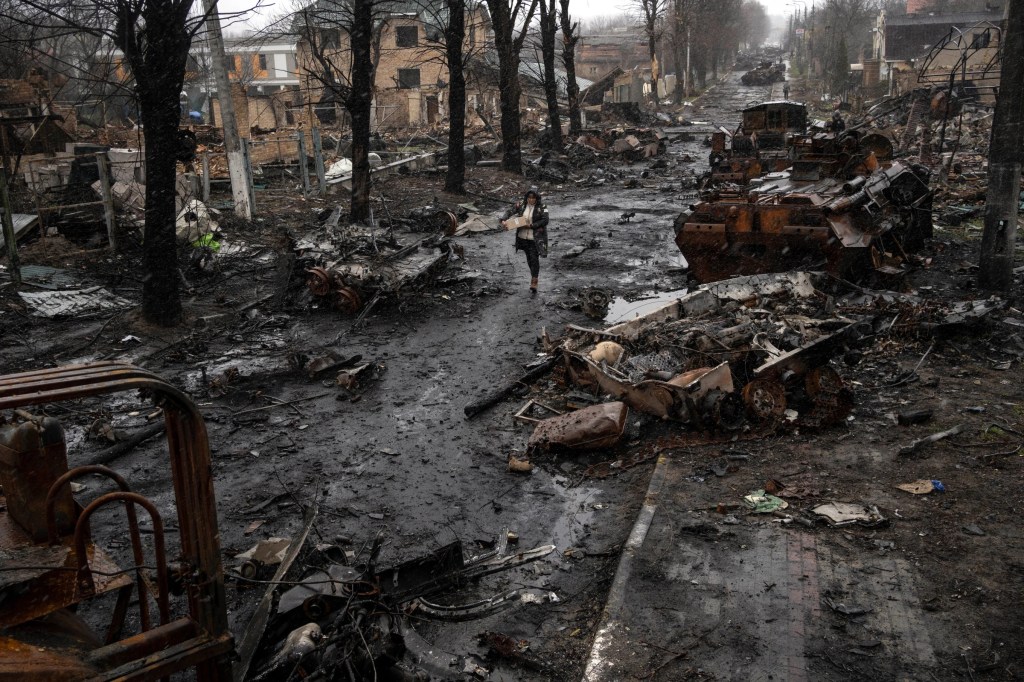
A woman navigates a debris-filled street where destroyed Russian military vehicles stand in Bucha on the outskirts of Kyiv, Ukraine, Sunday, April 3, 2022 (Credit: AP Photo/Rodrigo Abd)
The war in Ukraine has been raging for four years. Ukraine continues to need help.
Russia launched its unwarranted, unprovoked, and cold-blooded invasion of Ukraine exactly four years and one day ago. It has cost the lives of over 14,999 civilians with a further 40,601 wounded. This is the UN’s confirmed minimum tally as of December 31st, 2025, but the actual numbers (as with all wars) are thought to be higher. The UALosses Project lists 186,025 soldiers killed between February 24th, 2022, and February 19th, 2026. These rivers of blood come from Russian’s imperialistic dreams which spawned in Moscow’s lingering resentment of losing the Cold War.
2022 did not mark the outbreak of this war. Russia began it in February 2014, when they illegally annexed the Crimean Peninsula, and the territories of Donetsk and Luhansk. This act of aggression went unpunished by the world at large, emboldening Vladimir Putin to order the full scale invasion of Ukraine eight years later. This war can only end with Russia’s full surrender and retreat, the restoration of Ukraine’s borders to what they were before the illegal annexation of Crimea in 2014, and for Ukraine to be the master of its own destiny – including joining the European Union and NATO – without any outside interference.
Last night, the man currently occupying the Oval Office who was impeached in 2019 for holding Ukrainian military aid hostage barely mentioned the nation struggling for its independence it the State of the Union Address. On the anniversary of the outbreak of open warfare by an aggressor neighbor’s open invasion, the President of the United States did not mention Ukraine’s struggle for freedom
Four years on in this war, and Ukraine’s struggle for its own liberty has become old hat to us in the West. The Russian asset in the White House compromising American aid as well as rocking the foundation of the country has left many of us with greater concerns. The dithering and cowardice shown for years in the governments of Western Europe has emboldened Russia. The Ukrainians have given their lives to stop terror being carried out against all of us.
The situation is untenable.
Homelands Under Foreign Flags
During the 2012 United States Presidential Election, Republican nominee Mitt Romney accused Russia of being the greatest geopolitical threat to the United States. He was mocked for such a stance at the time but turned out to be correct in hindsight. Just two years later, Vladimir Putin would begin the first phase of the war, and the kind of warfare Putin practiced before would be on full display to the world during the course of Russia’s brutal and unjustified invasion of Ukraine.
Vladimir Putin’s ambitions for Ukraine are a restoration of borders established under the Soviet Union. The USSR was one of two superpowers during the Cold War, with Moscow’s leadership taking advantage of the natural resources in Ukraine and the other constituent republics to keep the USSR in its place on the world stage. After the dissolution of the Soviet Union, Russia had far less to work with but had centralized much of the wealth and therefore the costs inside its own borders. Without Ukrainian agriculture and other resources, Russia struggles to create a society that can pull itself out of the corruption birthed by its transition to free market capitalism. This invasion and the dreams of conquest, for Russia, are as much a shot of adrenaline to the heart of a dying economy as they are about national ‘pride.’
Ukraine is fighting a war against Russia to defend itself from the reassertion of those old borders. Ukraine was an independent nation after the Russian Revolutions of 1917 and only fell back into Moscow’s control during the Russian Civil War which saw much of the former territory of the Russian Empire controlled by the new government in town. Many Russian politicians see their control over Ukraine as necessary, due to Ukraine being where the ethnic Russian peoples all originated from.
The insidiousness of Moscow’s designs for Ukraine is the colonialist actions of the past being ‘excusable’ for the progress of modern Russia. Ukraine is as much a victim of colonialism in Eastern Europe as South America and Africa were under the Western European powers leading up to the liberation movements of the 19th and 20th centuries. During Soviet times, Russia starved Ukraine and then settled ethnic Russians in Ukrainian territory. Then, it would go onto claim Ukrainian accomplishments, like in the Olympics, as being for the glory of Moscow. Meanwhile, the Ukrainian language was going extinct, local customs were replaced by those the Soviet government deemed ‘acceptable’, and any thoughts of Ukrainian independence were smothered as quickly as possible.
The modern occupation of Ukrainian territory has seen the Ukrainians suffer similar crimes. From shortages on housing, water, and power to the ongoing efforts to push Ukrainian civilians out of their homes to resettle with native Russians (a tactic also employed by Nazi Germany during their attempted conquest of Europe in the 1940s), Russia has returned to brutalize Ukraine once more. Russia is now repeating the Soviet era in Ukraine by terrorizing and taking from the local populations and mandating new educational curricula that rewrites history to better fit Moscow’s vision of the truth. In the same way that the Soviet Union occupied territories which did not belong to them, Russia is now taking over what it feels rightfully belongs to the regime in Moscow by force. Ukrainians are starved, much like in the Holodomor of the 1930s. Military and state security forces drag away dissenters, many of whom are never seen again.
Russia conducts warfare by using the Geneva Convention as a checklist.
Russian Warfare
In 1991, when the Soviet Union collapsed, the Chechen Republic of Ichkeria, or Chechnya, declared its independence. The Russian government did not approve of this particular declaration and intervened militarily, sparking the first Chechen War of 1994-1996. It was a disaster for the Russians and resulted in a black eye for Moscow and Chechnya’s de facto independence.
When Vladimir Putin became Prime Minister of Russia in August 1999, President Boris Yeltsin was in very ill health. Putin became responsible for much of the day-to-day running of the nation. In September, there were apartment bombings in Russia, which lit a fire in Russia for war to bring the Chechens to heel. The apartment bombings are long alleged to have had Russian security services involved in executing them as false flag operations. No matter their origin, these bombings benefitted today’s would-be tsar. Vladimir Putin rode the wave of popularity for advocating a harsh response against Chechnya into the Russian Presidency in March 2000.
The Second Chechen War would last for ten years and ended in 2009 with Chechnya finally under Moscow’s thumb. The Russian military was stalled outside the Chechen capital of Grozny once more and resorted to indiscriminate bombing and shelling to flatten the entire city. Russia then installed a favorable strongman leader who would be subservient to Putin, ending Chechnya’s resistance to the Kremlin’s rule.
Chechnya was seen by the West as an internal power struggle. International intervention was a no-go for the Western powers. Initially, it was a feeling that internal affairs of a nuclear power did not concern the nations who had just recently intervened to stop genocide in two separate instances during the breakup of Yugoslavia. The second of which had come only a few months earlier starting in March of 1999 to stop the Serbian armies from committing genocide in Kosovo. While Russia dealt with the Chechen insurgency starting in 2000, just over a year later, the Global War on Terror would take all of the West’s military focus.
In fact, due to the instability caused by the United States’ similarly unjustified invasion of Iraq, oil prices went up around the world. Iraq’s status was one of the world’s leading oil suppliers, and the instability of their situation and destruction of their infrastructure forced the world to turn to Russia. Putin seized the opportunity to direct the rebuilding of Moscow and Saint Petersburg to show the world that Russia had emerged from the shadows of the 1990s and the Soviet collapse as a major player on the world stage. In addition to being frightened of a potential nuclear exchange, the western world did not want to run the risk of disrupting their oil supply even further. Dealing with Russia was a ‘necessary evil’ according to most of western Europe. The purchase of Russian oil and natural gas funded Putin’s imperial ambitions, and the west’s hesitance to use violence in the aftermath of the Cold War and the disastrous results in Iraq and Afghanistan meant that Putin’s dreams of a ‘greater Russia’ would go unchecked.
This ability to commit unspeakable violence without reprisals from the west emboldened Putin’s war of conquest. The West’s reluctance to act allowed Putin to set the precedent that Russian could freely invade and slaughter its neighbors. When Georgia expressed an interest in joining the EU and NATO in 2008, Russia illegally invaded Abkhazia and South Ossetia, sparking a border crisis and preventing NATO membership. The West, in response, did nothing but impose a few minor sanctions.
When Russia illegally annexed Crimea and started the War in Donbas by covertly funding and directing militants in the Donetsk and Luhansk regions, the West refused to deliver support to Ukraine’s resistance efforts and responded with weak sanctions again. It was only when Vladimir Putin was bold enough to order the invasion of Ukraine in 2022 with the intent to take control of the entire nation that the West would get involved. Too little, far too late.
Chechnya retroactively became a grim teaser for the horror show on the frontlines of Ukraine.
The Humiliation of a Nation Obsessed With Not Being Humiliated
“Our power comes from the perception of our power” is a line spoken in the second episode of the HBO-Sky UK series Chernobyl by the show’s depiction of final Soviet leader, Mikhail Gorbachev (played by David Dencik). In context, the line was an admonishment to the senior officials present regarding the cleanup of the Chernobyl disaster about how damaging it was that the west knew about the problem. It serves as a great summary of Soviet geopolitics, which the modern Russia inherited.
Vladimir Putin felt that Russia was humiliated by the fall of the Soviet Union and loss of its influence, the West’s superiority, and Boris Yeltsin’s embarrassing behavior. Part of his desire to get even is to return the territory of the Soviet Union to Moscow’s control. While he may play the idea of reuniting ethnic Russians under ‘rightful’ rule for the crowds, the truth is, Putin wants the territory and resources alone.
To facilitate an easier time taking Ukraine, Russia launched a coordinated campaign of disinformation and disruption against the West by boosting divisive opinions online, finding ways to influence opinions through social media, carrying out cyberattacks, and winning over politicians, opinion makers, and powerful individuals through coercion, blackmail, or direct financial pathways. With its opponents divided against themselves, Russia would be free to assault Ukraine, knowing its enemies would refuse to mount a worthwhile response.
America developed numerous social fractures in the years leading up to Putin’s ascension in Russia. The former KGB officer needed to only pull on the strings which were already coming undone thanks to the heated partisanship showing up before and during the War on Terror, and the struggles faced within. Partially in revenge for the Cold War, partially as a practical way to help secure his long term goals, Putin’s efforts in undermining America was one step in a decades long plan to secure Russian dominance after the Soviet Union was relegated to the history books.
Russia could never hope to take the United States in a fair fight. After the Cold War, America was unified in peace, optimistic for the future, and grateful the world didn’t end in a nuclear firestorm. Russia, however, did not have such a bright decade in the 1990s. Boris Yeltsin was originally a leader who could have brought about change to Russia, but quickly realized the unsavory position he was in. Instead of safeguarding the fledgling Russian democracy, Yeltsin sold out to the new oligarchs in order to secure his reelection. The result was a Russian society dominated, not by a government of its people, but by a government of its richest shareholders. Yeltsin centralized power in 1993 during an attempted coup d’etat over his supposed overreaches. His health deteriorated, Russia stagnated as a nation, and he resigned December 31st, 1999. Prime Minister Vladimir Putin became the Acting President of Russia to usher in the new millennium and then would be elected President a few months later. Yeltsin died in 2007.
Putin began his career in the KGB, the internal security and foreign intelligence service of the Soviet Union. A spy by trade, Putin tended to solve problems in a roundabout way, obscuring information and seldom taking the direct route on anything. As his power and influence grew within the post-Soviet Russia’s political establishment, he became more unabashed in controlling the nation, routinely having journalists, political rivals, and other troublesome individuals killed. Putin deeply resented the United States for winning the Cold War and wished to see a return of Russia’s influence to the days of the Soviet Union.
Putin, however, is no communist. He believes the might of the Soviet Union should be exercised in the manner of the Russian Empire which came before it. Ukraine’s territory in Crimea – home of the Black Sea fleet and the only warm water port Russia can access – is necessary for Russia to hold onto its military influence. The rest of the nation produces a great deal of agricultural products. Ukraine was known as the breadbasket of Europe, and Moscow’s loss of direct control over Ukraine’s food output meant that they had a harder time feeding their own citizens. On ethnic grounds, Ukraine was the birthplace of the Kievan Rus, the predecessors of the modern Russians. To Putin, not controlling the Russians’ ancestral homeland is an affront to Russia’s national identity. The Romanov Empire was an outgrowth of the Kievan Rus’ kingdoms, so Ukraine not answering to Moscow (or Saint Petersburg in the Romanov era) for the first time in hundreds of years is an ongoing source of irritation for Putin.
Putin has a habit of justifying his aggressive actions by claiming Russian sovereignty and rewriting history. In 1994, under the presidency of Boris Yeltsin, Russia signed the Budapest Memorandum, in which Ukraine agreed to give up its nuclear weapons in exchange for a promise never to be invaded by Russia. Vladimir Putin broke that promise in 2014 when Russian soldiers without identifying markers invaded the Crimean peninsula and supported rebellions in Donetsk and Luhansk. Putin subsequently announced that Crimea was part of Russia. Putin further violated Ukrainian national sovereignty and its past promises in 2022 with the full scale invasion of Ukraine. His justification was that NATO (a purely defensive alliance) is encroaching on Russia territory, that Zelenskyy is leading a nation under the controls of a cabal of Nazis, and that it must be saved (Zelenskyy is Jewish), and finally that Ukraine is technically Russia anyways (Ukraine attempted to gain independence from Russia during the Russian Revolution and Civil War Period from 1917-1921). Putin’s dishonesty threatens to corrupt the view of everyone outside this conflict by lying and getting others to repeat the lie so often it becomes the truth.
Dictators don’t think in years, they think in decades. Putin has long dreamt of uniting Ukraine under the Russian tricolor and taking its land and resources for Russia’s gain. Supporting political division in the west was a way to grant Russia a more favorable situation for its invasion of Ukraine. A weakened NATO, and a United States reluctant to send military aid due to political infighting would make defeating the Ukrainians easier. Reality has born Putin’s gambit a success.
Vladimir Putin and his followers dishonor their country and every single Russian man, woman, and child who has only ever sought peace with their neighbors and the rest of the world. Russia’s actions are bloodthirsty and indefensible. All of this effort, however, is to bandage the wounded pride of a mob boss with dreams of being the tsar of a gas station masquerading as a world power. The Soviet Union’s loss during the Cold War, the terrible state of the economy, the United States’ wealth and material goods, Yeltsin’s embarrassing behavior on the domestic and international stages, and the poor state of modern Russia are all causes of humiliation for Vladimir Putin.
The effect this war is having on Russia is significant, but it pales in comparison to the absolute devastation being dealt to Ukraine thanks to Putin’s inadequacies.
Ukraine Will Not Fall So Easily
Ukraine has, as one nation, shown it will stand up to oppression. Despite being underprepared and underequipped, Ukraine was able to halt the Russian advances in the early months of the war, and over the last four years has been slowly taking back territory. The Ukrainian people have shown an immense amount of humor, spirit, and bravery in the face of an incredibly oppressive adversary and little to no help from its erstwhile allies. Western Europe has moved too slowly in ramping up its own military capabilities, choosing to rely on the United States for the majority of its force projection and military might. With the United States deeply compromised and hostile to longtime allies, Europe has been caught completely incapable of supporting their own defense and that of Ukraine’s. As a result, aid is a fraction of what Ukraine needs to win, and the people of Ukraine stand on their own.
Eastern Europeans know sacrifice better than anyone, and Ukraine is more intimately acquainted with sacrifice than most people give them credit for. And yet, when the simple, safe solution was to roll over and accept Russia’s boot on their neck, the people of Ukraine chose to fight. From the opening days of this phase of the war, Ukrainians proved themselves heroes, and worthy of admiration. When their hour came, they met it with a bravery and a fire that most of the world could only hope to match.
President Volodymyr Zelenskyy, and his administration remained in their country, pledging to fight until the bitter end, from the very onset of the conflict. Even amidst dedicated attempts by Russian special forces to assassinate Zelenskyy, he stayed. When the Americans offered him extraction, Zelenskyy instead responded, “The fight is here. I need ammunition, not a ride.” True leadership is jumping into the same fire which you ask your subordinates to leap into.
Engineer Vitaliy Skakun was tasked with planting explosives on the Henichesk bridge to destroy it and stop a Russian tank column from advancing over it. When he realized he was out of time to escape and still cut off the tank column, he radioed his comrades to get clear and he blew the bridge with himself still on it, denying the Russian forces passageway at the cost of his own life.
On Snake Island in the Black Sea, there were thirteen Ukrainian border guards tasked with keeping the island secure. The Russian cruiser Moskva advanced to the island and told them to surrender. The Ukrainians instead responded, “Russian warship, go fuck yourself” before they were bombed. Despite early reports stating that the Snake Island Thirteen died in that assault, they all survived the incident. Later, the Moskva was sunk in an attack on the Russian Black Sea fleet. The phrase “Russian warship fucked itself” became a humorous response and a powerful rallying cry.
Yaryna Arieva and Sviatoslav Fursin were a young couple who rushed their wedding during the invasion, and then immediately signed up for their local Territorial Defense Center so they could join the fight to save their country.
The Ukrainian Ambassador to the United Nations at the time was a man named Sergiy Kyslytsa. After the UN Security Council declined to take action on the invasion, Kyslytsa said, “There is no purgatory for war criminals. They go straight to hell, Ambassador.” to the Russian Ambassador to the United Nations who was chairing the meeting.
In the four years since open warfare broke out, countless stories echoing the bravery of these people from its opening days can be found. The war has touched every aspect of Ukrainians’ lives. Everyone in Ukraine or who has been forced to flee the war knows someone who was injured or killed in the fighting. Someone whose hometown was devastated by the fighting. Russia continues its campaign of terror by barbarically attacking Ukrainian cities on the eve of peace talks. That is not the tact of a nation seeking peace.
Russia has been committing acts of genocide in Ukraine for the entirety of the war. The UN even states that Russia has been committing war crimes for the length of the conflict. Actively targeting civilians, open massacres of the unarmed into mass graves, rape, torture, and the constant terror of being attacked just for the psychological effects are all Russian hallmarks of this war. It is an almost unbearable assault on the human psyche and flies in the face of all human decency. Russia is using barbarism as a tool to wear down the will of its opponents. In spite of it all, Ukraine stands firm.
Ukraine will continue to stand against its invaders, but they cannot stand forever without assistance. Russia’s status as a nuclear power, having inherited the Soviet Union’s arsenal, allows it to avoid open combat against peer adversaries for fear of the end of the world. So it chose instead to bully a far weaker nation in violation of the rules-based order which became the global norm over the last several decades. Permitting Russia to take over Ukraine shatters the idea of national sovereignty and diplomacy which has shaped the world since the end of World War II. Abandoning the principle of national sovereignty could spell the end for the world order as it has stood for decades and usher in a new and frightening future.
Tens of thousands of dead on both sides, countless more injured, and there is no end in sight. The cost of this war is already too high. A cost Vladimir Putin has determined to be acceptable to soothe his damaged ego. Ukraine needs aid if it will withstand. I wrote two years ago of the importance of arming Ukraine and the practical advantages of providing military aid. That reasoning has not changed. The situation is growing more dire as a war of attrition has set in even more intensely.
Every piece of equipment we can provide is a life saved. Whether from small arms fire, artillery barrages, drones, missile strikes, infection, disease, malnutrition, dehydration, exposure, or injury, every scrap of help we can scrape together will save lives. For four years, Ukraine was promised more help which never came. There is always the hope of a brighter tomorrow, but tomorrow never comes until it’s too late. The best time to act was four years ago; the second best is now. We must act today to save Ukrainian lives and give them the best chance at preserving their sovereignty and liberty.
Ukraine has been crying for help for years and it is time the world stopped tuning out that cry.
The Cry for Help Must Be Answered
The world is reacting to Ukraine’s existential struggle with a passive boredom, as though it’s a miserable sporting match we are waiting to end because it ran longer than expected and is taking up airtime for a drama we’d much prefer to see. If the governments of the world are unwilling to help Ukraine, we must shoulder that burden ourselves. Last year, in an editorial piece I wrote after the abhorrent way President Zelenskyy was treated during a meeting in the Oval Office, I provided a list of links compiled by r/Ukraine to donate to various organizations to help Ukraine. I have copied that list from that article below again, I urge anyone who reads this to give what they can wherever they feel will do the most good. The struggle for liberty is one the world helped us with back in 1776, while we made our own struggle for independence. Liberty is a universal responsibility, and we can triumph only when we all stand together.
War Effort Organizations
- Come Back Alive: This NGO crowdfunds a variety of military equipment, such as thermal vision scopes and vehicles, and directly supplies the front lines. It also provides crucial training for Ukrainian soldiers, as well as research of troops’ needs and enhancing the social reintegration of veterans.
- Hospitallers: This is a medical battalion that unites volunteer paramedics and doctors to save the lives of soldiers on the frontline. They crowdfund their vehicle repairs, fuel, and medical equipment.
- Ukraine Front Line: A US-based and registered 501(c)(3), this NGO fulfills front line soldiers’ direct defense and humanitarian aid. It’s also the official in-house partner for r/Ukraine mod team fundraisers, and updates from initiatives are posted for the community regularly. Represented on Reddit by u/UFL_Robin.
- Protect a Volunteer: Get matched with a volunteer in Ukraine who needs financial support or equipment or fund a flight to get a badass to the frontline. You will be put in direct contact with a defender and can help with flight costs, life saving gear, medical kits, cold weather clothing, and other expenses. Represented on Reddit by u/tallalittlebit.
- Azov One: The official fundraising unit of the Azov Brigade, covers the battleground needs of Azov servicemen with non-lethal and lp protective equipment. They stay in direct contact with the Azov command and deliver supplies to the frontline. Represented on Reddit by u/azov_one.
- Renegade Relief Runners: Partners with other NGOs to source and deliver military, medical, and humanitarian aid wherever it’s needed. Feisty, cagey, and carefully fearless, they just wanna help Ukraine. Represented on Reddit by u/3xR_team.
- Kozak Drive Foundation: A Ukraine-based foundation that supplies frontline soldiers with whatever they request. Represented on Reddit by u/KateKozakDrive.
- Ukraine Aid Ops: Volunteers around the world who are helping to find and deliver equipment directly to those who need it most in Ukraine. Represented on Reddit by u/Ukraine_Aid_Ops.
- Sustain Ukraine: Providing soldiers and combat medics with a variety of gear and medical items. Represented on Reddit by u/sustainUkraine.
- Superhumans: Thousands of Ukrainians have suffered life-changing injuries, wounded on the battlefield and on the street. Superhumans Center is a modern rehabilitation center for adults and children in Ukraine that gives these people the superhero life they deserve.
- United24: This site was launched by President Zelenskyy as the main venue for collecting charitable donations in support of Ukraine. Funds will be allocated to cover the most pressing needs facing Ukraine.
Help for Ukrainian Civilians
- Help People: Help People provides evacuation support and humanitarian aid to vulnerable communities around Ukraine. They operate refugee housing for more than 30,000 people and have delivered over 100,000 tons of humanitarian aid, all free of charge to recipients. They’re represented here by u/olexiy_voronin.
- B50: B50 restores peaceful life in communities affected by russia’s invasion of Ukraine. They clear rubble, restore damaged buildings, stock libraries, transform school bomb shelters into fun, child-friendly spaces, and more. Represented on Reddit by u/b50_volunteers.
- Bird of Light: Bird of Light Ukraine creates a humanitarian supply line for medical and defense aid into hard-hit parts of Ukraine. Working with local and international partners, they provide a rapid response that is difficult for larger NGOs. They’re represented here by u/Feylin.
- TeleHelp Ukraine: Provides free, high-quality medical and mental health support to Ukrainians affected by the war through telemedicine services from a global network of clinicians, interpreters, and volunteers with a focus on patient advocacy and care coordination.
- Laptops for Ukraine: This NGO is a collaboration between the Ministry of Digital Transformation of Ukraine and the European Commission. Donate your unused devices to help address the severe shortage of working electronic devices for nurses, teachers and students in Ukraine.
- Safe Passage 4 Ukraine: This NGO helps the most vulnerable in Ukraine by facilitating ground evacuations, travel assistance, resettlement, and providing life-saving winter equipment.
If I can leave you with anything, it’s that the people of Ukraine are deserving of their freedom as much as anyone. And with our governments unable or unwilling to help, we must stand together as a global community
And to mark the fourth year of this war, here is Sir Ian McKellan reading the poem “The First Letter to the Corinthians” by Ukrainian veteran Artur Dron. May it serve as a reminder to all of us of the sacrifices made by the Ukrainians for their sovereignty. May it give us all the perspective about the cost of this war that Ukraine is ready to pay to beat back an evil invader. May it remind us all why Ukraine chooses to fight, and why we must also do the same when we are faced with struggles far less destructive and terrible than what has befallen the people of Ukraine. May it remind us of the heroes.
Slava Ukraini!

 Ark of the Lost Angels
Leave a comment