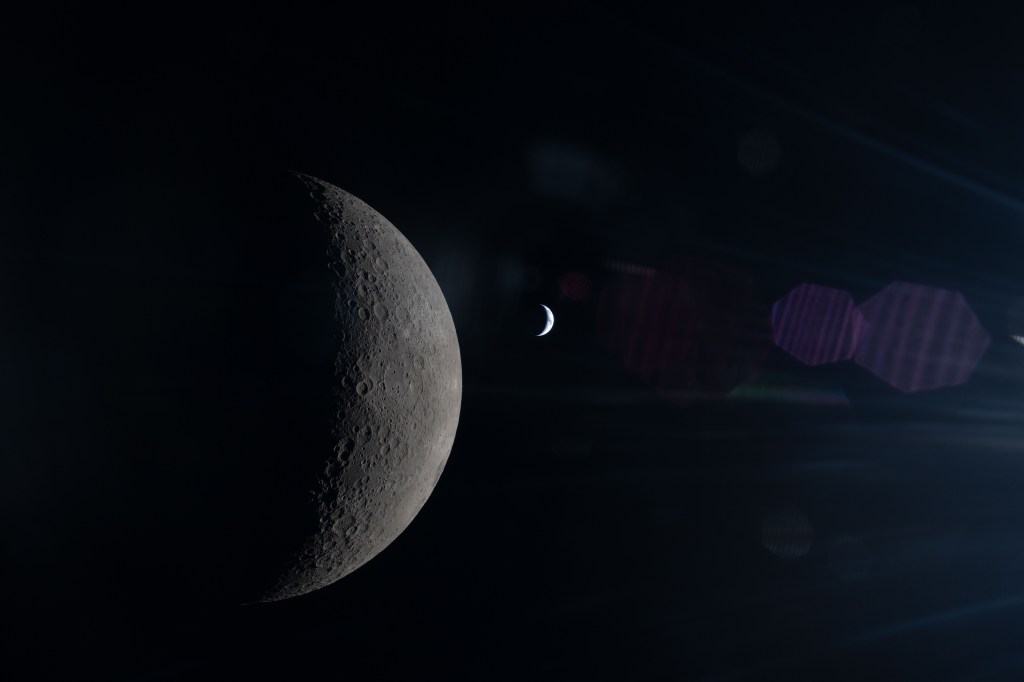
New Perspective of Home (Credit: NASA)
The return of the Artemis II from their orbit around the Moon is the first step in a new era of space exploration.
“We go to the moon and do the other things not because they are easy, but because they are hard.” – John F. Kennedy
A week ago this Wednesday, the NASA Artemis II mission launched from Cape Canaveral, Florida to send humans back to the moon for the first time since 1972. Today, the spacecraft Integrity returned home with its crew, Astronauts Reid Wiseman, Victor Glover, Christina Koch, and Jeremy Hansen. They traveled farther from Earth than any humans ever have before.
Mankind has always desired to reach the stars. To reach out beyond this pale blue dot and into the great dark unknown beyond our humble little planet has been the dream of billions of humans over tens of thousands of years. Such a feat only became possible less than a century ago when the weapons of war were found to have more idealistic applications.
The beginnings of the space program were rooted in Germany’s V2 Rockets during World War II. Operation Paperclip saw German scientists and engineers move to America to start new lives in the wake of Germany’s surrender in 1945. Scientists such as Wernher von Braun would become instrumental in forming the nucleus of NASA. Still, the first rockets which took people to space were intercontinental ballistic missiles which had their payloads removed and their trajectories altered. The R-7 Semyorka missile became the vessel which carried Sputnik 1, the first manmade satellite to orbit the globe, into orbit and history. NASA’s Project Gemini launches were all conducted using modified versions of Titan ICBMs. These missions, which sent objects, animals, and eventually humans into Earth’s orbit were a way for the great geopolitical chess match between superpowers to play out. Despite the Cold War paranoia, that seemingly inevitable nuclear confrontation never came. Ironically, the truth is that ICBMs have done more to advance human exploration than to hasten its destruction.
However, nothing quite matched the accomplishment it took to put humans on the moon. From the start of the Space Race when the Soviets put Sputnik 1 into Earth’s orbit in 1957, the USSR developed a habit of hastily throwing together missions to beat the Americans without regard to crew safety. NASA developed rigorous safety standards, and gave ample time to ensure that each mission, especially with humans headed beyond Earth’s atmosphere, was safe and all protocols were sound. Internal dithering within the Soviet Union stalled their efforts towards reaching the moon while NASA was given every resource and pulled together nothing short of a miracle.
At the time, the Saturn V rocket which was the vessel for the Apollo missions was the first purpose-built rocket for space exploration. The requirements of the Apollo missions necessitated something greater than any rocket which had been built before. Thousands of engineers, designers, and scientists came together to create the Saturn V rocket, a towering colossus of explosive potential which took mankind farther from Earth than it ever had before.
The word, ‘moonshot’ exists because it was seen as an insane, impossible dream for humans to ever walk on the moon. Yet, with less computing power than fits into the palm of a human hand today, NASA sent humans to land on the moon and come back safely. As humans so often have done, they told the laws of the universe to step aside and pushed their way past physics problems and into the annals of history.
The Apollo Program ran from 1961 to 1972 and saw six landings on the moon spanning Apollo 11 to Apollo 17. Apollo 11, crewed by Neil Armstrong, Buzz Aldrin, and Michael Collins, was the first of these missions to actually attempt to land on the moon. The mission set out on its journey on July 16th, 1969, and Neil Armstrong took humanity’s first step on the moon on July 20th. They returned to Earth and splashed down in the Pacific Ocean on July 24th. Most of the Apollo missions went off extremely smoothly. Apollo 13, on the other hand, was a “successful failure” due to an explosion damaging the mission’s service module in transit to the moon. The three astronauts – Jim Lovell, Jack Sweigert, and Fred Haise – all made it home alive thanks to the dedicated efforts of the NASA personnel back on earth helping solve the unprecedented problems they faced. If there is no greater summary of humanity’s first efforts to reach the moon than herculean, then humanity has lost its flair for language.
There was opposition to humanity’s initial push for the moon. In the wake of Soviet Cosmonaut Yuri Gagarin becoming the first human to orbit the earth, President Kennedy delivered a speech on May 25th, 1961, before Congress wherein he said:
“I believe that this nation should commit itself to achieving the goal, before this decade is out, of landing a man on the moon and returning him safely to the earth. No single space project in this period will be more impressive to mankind, or more important for the long-range exploration of space; and none will be so difficult or expensive to accomplish.”
At that time of Gagarin’s trip around the Earth in April 1961, Kennedy has been an opponent of the United States’ space program. However, Kennedy had delegated his responsibilities in overseeing NASA to Vice President Lyndon B. Johnson, who was a large proponent of the manned space program. With the pressures of not falling behind the Soviet Union on the nation’s mind, Kennedy committed America’s vast resources to reaching the moon before the Soviets did. In actuality, there were several contributing factors as to why the Soviet space program fell off after their initial burst of victories in the Space Race. The fundamental truth is that going to the Moon was a goal that America prioritized and worked on many smaller goals to build towards that eventual outcome while the Soviets were wracked with internal infighting and saw their space program as an outgrowth of their missile program. While the Apollo missions had their origins in sticking it to the Soviet Union as part of the great geopolitical measuring contest, that has been overshadowed in importance by the leaps they provided in understanding the closest celestial object. Great discovery has no roadmap, and the Apollo missions still serve as potent examples that exploration of the known universe is a worthy goal in and of itself to sate humanity’s curiosity and inspire us to literally reach for the stars.
After Apollo ended, Skylab was the country’s first foray into a manned space station. Between May 1973 and February 1974, Skylab hosted American astronaut crews for a total of twenty-four weeks to run scientific experiments. Skylab was the first effort which built to the International Space Station. The Soviets placed the first station in the Salyut programme into orbit two years before Skylab. After Salyut 7 was decommissioned, the Mir space station began operation in 1986 and would come back to Earth in 2001. Russia, the United States, Canada, Japan, and the countries of the European Space Agency would come together to launch the International Space Station in 1998, which has been occupied almost continuously since then, and expanded upon many times. The work all of these space travelers have done has advanced our understanding of the world in which we live, our own physiology, and the incredible space around us in numerous ways. These people, both who have lived in space or who helped those travelers reach their temporary destinations and come home, have moved humanity forward in ways we cannot begin to understand.
Space exploration isn’t just for exploration’s sake. The technology developed to send people to orbit the Earth, to live in space stations hanging above our small blue planet, to take them to the moon and back all have palpable benefits for the average life on Earth today. Many normal aspects of life as we know it would not be possible without the technology developed for the Apollo missions. Other technological aspects, such as GPS, would not have been possible without the immense effort of NASA and the American space programs. Technologies which have changed the world would not be possible without mankind’s exploration of space. NASA’s Voyager Program launched two probes in 1977 to study what is outside our solar system (and has already made discoveries), with Voyager 1 finally crossing out of the heliosphere in 2012 and Voyager 2 reaching the boundary in 2018 (headed in a different direction from Voyager 1). The technology of their time is still alive and well, sending back data to Earth. It is nothing short of a miracle that humanity, having scratched so little of the surface of hypothetical technology necessary for deep space exploration, is still attempting to brush its fingers against the face of the known universe just to learn something.
If the headlines today show what is the worst about humanity, then the Artemis II mission is showing us the best of it. Our program to return to the Moon is a testament to the human will, drive, ingenuity, bravery, intelligence, and willingness to leap into the unknown to discover something new. Artemis II has also given us a gift like no other, and that is high definition images of the Earth and the Moon. A picture says a thousand words, and the photos that the crew of Artemis II have sent back to Earth have been nothing short of extraordinary. It’s a powerful message that we are all on this pale blue dot together, in a vast and cold universe. That our petty struggles and hate are so inconsequential to everything else that is out there.
In a parallel to the opposition to the Apollo missions in the 1960s, the reason for the Artemis program is being questioned now. The novelty of reaching the moon is significantly less than it was in 1969 simply because the crew of Apollo 11 already set foot on Earth’s largest satellite. Perhaps it doesn’t have to win approval numbers to be the right thing to do. Artemis II is about so much more than just returning to the moon after so long. It is the latest in a long stretch of achievements of flight and space exploration. Artifacts from NASA history with significant meaning have accompanied the Artemis II crew on their journey to the moon and back. Many others have been the first to say so, but the spirit of the two lost Space Shuttles were with the crew of Artemis II, with Challenger (which exploded shortly after launch in 1986) seeing the crew safely out and Columbia (which disintegrated during reentry in 2003) protecting their return to Earth. The crew of Artemis II is continuing the brave work of humanity’s journey towards the stars. They are honoring the sacrifice of Laika, the crew of Apollo 1 (Gus Grissom, Ed White, and Roger Chaffee), Valentin Bondarenko, and all the others who have given their lives in service of humanity’s exploration of the universe around us. The Artemis program is about learning answers to questions we may not have even asked yet, by pushing forward because great scientific discoveries happen by accident, and proving that when we listen to our best minds, we can reach incredible places.
If Apollo 11 was “One small step for man, one giant leap for mankind,” then Artemis II is the largest leap humanity has taken down the long road of discovery after having stayed its feet for a very, very long time.






 Ark of the Lost Angels
Leave a comment