
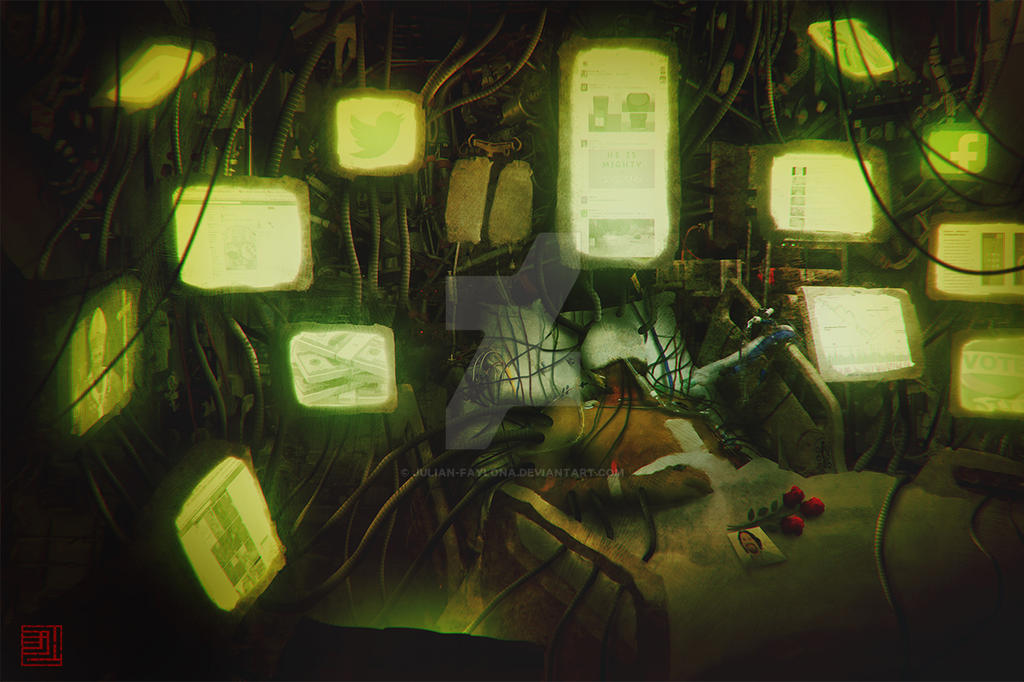
“Server Room” by Razorb (Credit: DeviantArt)
Thoughts on the place of human writers amidst the AI Revolution
Fear The Machine
“I’m sorry, Dave. I’m afraid I can’t do that.”
Encapsulated in the most infamous line from Stanley Kubrick’s science fiction epic, 2001: A Space Odyssey is the fear that humanity will develop sentient Artificial Intelligence, and it will decide to destroy humanity due to our mistreatment and abuse, or simply make the decision from the jump based on cold logic. A list of television shows, movies, video games, comics, novels, and music using this plot would be longer than the rest of this article. In reality? The development of sentient AI is still so far off, that there is no consensus on how long it will be until we can start dreaming of such an occurrence.
And yet, these fears of the fantastic rest on the very real concerns that keep human minds awake at night. The reason people are willing to dive into a cyborg apocalypse, or the battles of a kingdom against dragons, or mysterious crimes during wartime is because they seek an emotional resonance with something. Books scratch the itch for some, movies for others, and still some other people go to games or comics or any number of combinations of all of these.
Everyone looks for something different, but everyone is after something.
Humanity is the Mother of Decent Screenplays
The Writers Guild of America went on strike last year to protest the lack of fair treatment regarding payment for services rendered in the streaming age. Partially. Another tent pole issue of the strike was the use of AI in entertainment writing. The final deal put some great guardrails on the use of AI, as this article by the Los Angeles Times helps to outline, but there’s a larger point at play. The article, written in the midst of the concurrent SAG-AFTRA strike, goes on to discuss the implications of actors’ work being supplanted by AI. Studio executives and the public at large seemed to miss what the creative unions were saying: We’re important because this entire industry fails without us. We understand how to make the audience feel what we want them to feel.
The most important goal of any creative work is to emotionally connect with the audience. How many of us have forgiven bad dialogue or clumsy writing because the characters, the story, or the world make us feel something profound? Whether it’s the longing of the protagonists in a Jane Austen novel, or the childlike delight in watching the fliers in Avatar zip between floating mountains that many of us couldn’t dream of, there is always something in what we watch and read and listen to that resonates with us.
Humans have been telling stories for our entire existence. From oral histories to performed plays to novels to comics to films and television and all the interactive media now at our fingertips on a moment’s notice, the core of this rich history has been humans telling stories. Humans know what makes us laugh or cry or shake with fear. We’re still so far off from that sentient Artificial Intelligence that nothing but the human hand connected to the human mind can tell a story that enthralls a human so thoroughly.
Artificial Intelligence is imitative, not innovative.
Today’s AI writing solutions can only synthesize a result based on preset parameters after performing a crude analysis of what comes before. Without the ability to think and feel the way humans do, and the irrationality that is a cornerstone of our very existence, the AI of today can only rehash what we have already created.
AI created work is derivative and soulless.
There’s an argument that the very act of inquiring into the nature of existence is enough of a barrier to determine sentience. ChatGPT will not be asking “Does this unit have a soul?” anytime soon. It can only respond to the input of its users. Therefore, “soulless.”
The “derivative” part has larger implications in the ongoing epic showdown between art and commerce. Currently, writers are paid for their work. As they should be. However, the learning models for these AI programs are drawn from hundreds of thousands of copyrighted works. The original authors never signed off on their work being used to train their supposed replacement. More to the point, the original authors were never paid for training AI to write. As CNN reports, there are thousands of authors who believe they should be. And they should be.
Intellectual property theft is a major issue. Writers are trained professionals. IP theft seems to be not a big issue if movie studios do not have to pay someone to commit it. It gives them legal cover. Hypothetically, a movie studio could use AI to write a movie, without ever paying a human writer to look at the screenplay before it gets turned into a shooting script. Now, let’s say that this AI program plagiarized an obscure sci-fi novel from 1963, but the studio claims the story to be an original screenplay. The movie comes out, and people notice the movie is ripping off this obscure novel. A studio boss gets to come out and make a press statement saying “Whoops! Our AI screwed up! We’ll be taking additional steps to ensure this doesn’t happen again, but really, such problems are going to come with living in the future.”
Writers are taught about the ethics of writing. Nothing any human creates is wholly original, there are only so many concepts bounced around, and we as a species are constantly reinterpreting each other’s works and perspectives through our own lenses. However, when a human writer writes something, they are putting their own spin onto those stories and concepts. Blatantly ripping someone else off and never crediting the original creator is seen as a death blow to a writer’s credibility. So why is it when the machine does the ripping off, we’re supposed to cheer for it as growing pains of the new age?
Why are we supposed to cheer for the day when we can no longer think of new ideas?
Writing Opens Doors, Some Better than Others
Artificial Intelligence has other concerns with creating writing beyond just the creative fields. A society which cannot express itself artistically can also struggle to express itself intellectually. A society which struggles to express itself intellectually leaves itself vulnerable to abuse and manipulation.
Academics are concerned about students using AI to write their papers. While the act of writing those papers is laborious, using AI prevents the students from learning the critical thinking skills which the process of writing the essay is supposed to teach. Writing is not easy, and expecting every college student to be a masterful author is a fool’s errand. However, a college student who does not develop the critical thinking skills required to be a passable writer while in college will be at a serious detriment within the real world. Without a solid understanding of how to craft an argument, it will be much more difficult to dissect arguments from the other side. AI writing typically falls apart after a few paragraphs of cohesive argument. If that becomes the new normal, how can we hope to navigate a digital world where the truth lies in the murk beneath words crafted with audience engagement and visibility in mind, rather than truth and logic?
In times of content manipulation and algorithm-based news, it’s important to know how to dissect arguments and writing in order to discern the truth or reasons for the lie. Every author’s job is to make the audience feel a certain way. A fiction author may want the audience to feel doubtful about their own mortality or overjoyed when the heroes vanquish the villain. The manipulation required by an author is fairly innocent in the context of fiction writing. However, when the same forms of manipulation are used to push an agenda for an election, or a business proposal, or argue in favor of going to war, the idea of an author manipulating their audience becomes a lot less comfortable.
On a technical level, human writers are still absolutely needed because AI writing just cannot match the cohesive quality of human writing yet. It lacks that emotional core which resonates with people, which makes a movie endlessly quotable, or a song become the cornerstone of someone’s worldview. In that struggle of art vs. commerce, it is important for art to win to be fair to the artists whose skills are being used to replace them in commerce because those artists are being ripped off. However, it is also important for art to win because art reflects humanity’s story through human eyes, and that is an aspect where Artificial Intelligence still comes in a distant second place to the all-natural stuff.
On a philosophical level, there will always be people dedicated enough to pursue writing the old fashion way. If the process of writing is understood less by the common person, then the ability for those who do understand that process to manipulate those who do not is greatly enhanced. If AI is used to craft all of our writing for us, then it is also performing all of our thinking for us. AI may not be at the level of enslaving humanity yet, but it presents a clear and present danger if handled carelessly.
Artificial Intelligence has already placed its mark upon the writing world. The human touch is still vitally necessary to tell human stories. The audience’s awareness of AI’s shortcomings is a much more important reason for people to put pen to paper for the foreseeable future.




 Ark of the Lost Angels
Leave a reply to Penny Cancel reply