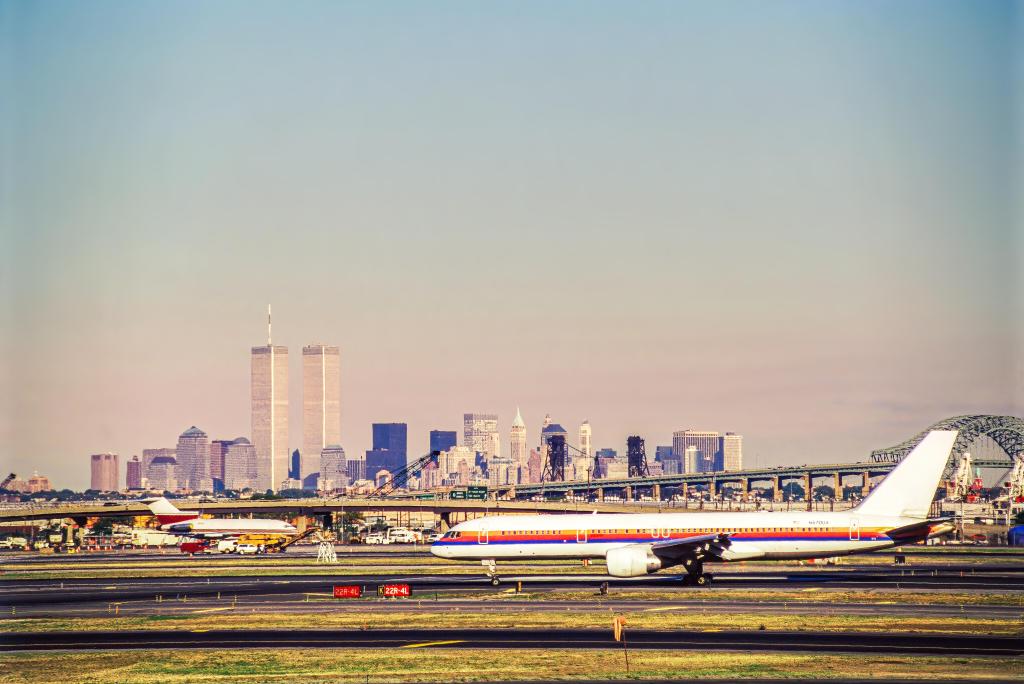
Newark Airport runway with Twin Towers in background (Credit: Unknown)
Al Qaeda’s attacks on September 11th, 2001 were the grand finale of a series of attacks against America.
“Where were you on 9/11?” is a frequently asked question when referring to major world events. Everyone remembers where they were when the towers came crashing down. Personally, I was at my grandparents’ house. I had been isolated from the news all day until my grandmother switched on the television. I was too young to remember what time of day it was or anything like that, I just remember the TV was switched on shortly before the South Tower, WTC 2, collapsed. Whether it was when it happened live, or it was one of the replays that they showed throughout the day, I’ll never know for sure.
I remember the images but lacked the proper context. I didn’t even know those buildings were in New York City. I have the feelings of life being different before and after, but nothing concrete to point to. The Iraq War, Bush and Rumsfeld briefing on the nightly news exist in flashes in my memories, but I never knew what they were talking about.
They liked to paint it as a battle of good and evil. The world simply doesn’t fit such a black and white sense of morality. Evil acts are justified by a good cause, even if that isn’t viewed the same everywhere.
It’s why the phrase “your terrorists are our freedom fighters” shows up with such frequency.
The Crossroads of Terror
The Taliban’s victory in Afghanistan gave Osama bin Laden a place to call home, as they hated the Americans and the West as much as bin Laden did. With the backing of other Arab freedom fighters from many other areas, bin Laden pulled together a network, funded by the wealth he had from his family and the connections to sympathetic people of means. Important to note that the bin Laden family is a very large and influential family who made their fortune in construction, and an overwhelming majority of them did not support Osama bin Laden’s campaign of terror. Osama bin Laden was one of about 52 siblings or half-siblings from his father’s 22 marriages.
During his time as a freedom fighter in Afghanistan, Osama bin Laden would meet other similarly minded individuals who would start their own networks, eventually coming together to form Al Qaeda in 1988, shortly before the Soviet occupation ended. While bin Laden would return to Saudia Arabia after the end of the Soviet invasion, he would find his way back to Afghanistan once the nation was under Taliban control after being kicked out of Saudi Arabia and Sudan.
Al Qaeda and its predecessor organizations launched attacks against the United States for their presence in the Muslim holy lands in Saudi Arabia during the Gulf War, their support of Israel, and generally for being a bastion of tolerance which did not fit with the extremist interpretation of Islam that is about as Christian as what the KKK believes. Al Qaeda’s stated goal was to bring about a new Islamic caliphate across the world and bring about the downfall of the West-dominated world order.
They were willing to make Americans bleed wherever they were in the world to service that goal.
Strikes All Over the World
The original World Trade Center in New York City was one of the most iconic images of America. In every establishing shot of New York City, in the background of every local news channel’s roll-in, towering above the city in the background of iconic and regular photographs, the Twin Towers (World Trade Center 1 and 2) stood proudly. New Yorkers initially disliked the towers, with one famous joke comparing them to the boxes which the Empire State Building and the Chrysler Building arrived in. However, as with all great landmarks, once they became accepted by the city, they became accepted by the city.
With these great symbols of international cooperation, unrestricted decadent capitalism, and American ingenuity, it would only make sense for Al Qaeda to target them. In 1993, Ramzi Yousef and his crew attempted to bring down the towers with a truck bomb in the parking garage. It succeeded in devastating the garage and killing six people, however the Twin Towers remained standing. The 1993 bombing was a predecessor to the larger attack on September 11th, 2001. The symbolic victory of destroying an American landmark famous the world over was too good an opportunity to pass up.
One of the important connections for Al Qaeda and its preceding terrorist cells was a man named Khalid Sheikh Mohammed. KSM was the uncle of Ramzi Yousef, who oversaw and carried out the World Trade Center Bombing of 1993. KSM was one of the most influential members of Al Qaeda, assisting in planning and execution of many of their plots. However, Ramzi Yousef and his operation in 1993 were unconnected to Al Qaeda at large, as claimed by KSM during his interrogation after being captured in the wake of 9/11. The family effort, however, would become more voracious in its targeting of the United States in the years to come.
Two years after the World Trade Center bombing, Ramzi Yousef and his uncle started planning the Bojinka plot, a three-stage terrorist attack on targets across the world. The first was an assassination of Pope John Paul II, the second was planting bombs on eleven different US-bound flights, and the third was to suicide bomb a small plane into CIA headquarters in Langley, Virginia. Alternatively, the third stage would have included more targets across the United States, hitting iconic landmarks in major cities. There was a fire in the apartment building in the Philippines where Yousef was planning the operation in early 1995. This led to the discovery of the entire plot. With the plans discovered and the original iteration of the plot stopped, Al Qaeda opted to rework their attack to use airliners as the weapons instead of the targets and hit multiple American landmarks. The specific targets and methodology would be worked out over the next few years. The attackers would be chosen and trained starting well in advance of New Year’s Eve 1999. In the meantime, Al Qaeda was determined to continue making the United States hurt overseas.
Inspired by the efforts of the 1993 World Trade Center bombing, Al Qaeda itself began planning a major attack. By 1996, the Taliban had won the Afghan Civil War and taken control of the country. In recognition for his strong anti-American stance, they offered bin Laden a place to set up his operations after being kicked out of Sudan. It was symbolic as Al Qaeda was formed in Afghanistan in the late 1980s by Arab mujahideen fighters who had traveled to the country to fight against the Soviet invaders. They were now invited ‘home’ in a fashion to continue the struggle against the other superpower encroaching upon Muslim lands. Al Qaeda now had a place to gather and plan their operations, as well as train their martyrs, free from the prying eyes of western intelligence services.
1998 would be a big year for Al Qaeda. In February, Osama bin Laden issued a fatwa declaring a jihad against Americans. A fatwa is a type of non-binding Islamic legal opinion. In the 1998 fatwa, bin Laden outlined his grievances against the United States for desecrating the Muslim holy land – recall the presence of US troops in Saudi Arabia after the Gulf War of 1991 – and his other gripes with the Western world. This followed a similar fatwa issued in 1996. In both, Osama bin Laden warned of grave consequences, which he reiterated in May 1998, when he spoke to ABC in his last interview with western media. In late summer, two US embassies in Africa would be hit with truck bombs.
On August 7th, 1998, the United States Embassies in Nairobi, Kenya and Dar es Salaam, Tanzania were bombed. These were the first instances of Al Qaeda making large scale attacks on United States personnel. These were followed by a lukewarm response by the United States against Al Qaeda. Additional attacks, such as a plot to take place on the dawn of the millennium would be foiled. Despite the largest attack being years away, Al Qaeda would not stop making assaults on the United States. Their beliefs were that any and all Americans were viewed as acceptable targets in order to punish American interference overseas.
The first symbol of the United States military to be assaulted was the USS Cole. The Cole was in the middle of refueling off the coast of Aden, Yemen in October 2000. Suicide bombers took a small boat out towards the Cole, and ignited explosives within which tore a hole into the side of the ship and killed seventeen sailors, injuring a further thirty-nine. The Cole remained afloat and was repaired and returned to service. Kuala Lumpur, Malaysia was the site of an Al Qaeda summit in January 2000 to plan the USS Cole bombing and the attacks of September 11th, 2001. Surveillance of this meeting was taken by Malaysian authorities, but the participants were not identified by American intelligence until much later.
This was one of several intelligence failures which prevented the September 11th attacks from being stopped.
The Giant Remains Sleeping
Lawrence Wright’s 2006 book, The Looming Tower: Al-Qaeda and the Road to 9/11 (and its Hulu miniseries adaptation) covers much of the lead up to 9/11, including many of these attacks. The other aspect discussed is the behavior of the US Intelligence Community. Before September 11th, there were clear distinctions in the roles of the FBI and CIA. They were legally mandated with separate missions and had very little overlap. This was to protect American citizens from overreach and breaks of their rights, but it had the adverse effect of breeding a mutual animosity between the two agencies. There was a refusal to share intelligence or cooperate even when allowed because of that mutual animosity. This breakdown in communication and cooperation led to the lackluster American response to all of the warning signs.
Former White House terrorism advisor Richard Clarke opened his testimony to the Congressional 9/11 Commission with an apology to the American people. It highlighted many of the issues wrong with the Intelligence Community’s activities before 9/11. One of those failures was the refusal to answer the concerns of John O’Neill. FBI Special Agent John O’Neill (played by Jeff Daniels in The Looming Tower miniseries) headed up the FBI’s counterterrorism team in the lead-up to 9/11. O’Neill believed Osama bin Laden and Al Qaeda to be the gravest threat to US National Security. O’Neill was put in charge of the USS Cole bombing investigation but returned to the US soon after due to clashing with US Ambassador Barbara Bodine. Despite being drummed out of the FBI for multiple factors, O’Neill was right about the threat Al Qaeda presented.
Operation Infinite Reach was President Clinton’s response to the 1998 embassy attacks. It consisted of missile strikes against suspected Al Qaeda training camps in Afghanistan. Many people believed that it was not sufficient enough to try and kill bin Laden, and instead was to distract the American people from the ongoing Monica Lewinsky scandal. Its ineffectiveness as a military response was one of many factors that showed the reluctance of the American government to commit to actions against Al Qaeda.
America’s behavior would change dramatically once the Twin Towers were nothing but dust and rubble.
The Day Which Shook the World
September 10th was the last day America was invincible. It was the last full day of the old world, and the end of a decade’s worth of sunshine which capped off a half-century-long storm. It was a normal Monday morning with only hours ticking down until the sky was cracked open. It was the last day of the twin testaments to American ingenuity and enterprise. September 10th was the last day at the office for hundreds of people, and thousands more took the last normal flights to ever occur. On September 10th, nobody was thinking of sending their children to the desert in service of a war that would define a generation. Nor would they believe they would so willingly hand over domestic freedoms in the name of security on an unprecedented level.
September 10th was unusually quiet. Nobody realized it would be the last time Windows on the World would serve dinner against its majestic backdrop of the Greatest City in the World. A storm in New York would clear up by the end of the evening to make way for the glorious weather the next morning. New Yorkers would be worried about the primary elections up until the first plane hit World Trade Center 1. It was quiet, too quiet, on the airwaves that morning.
September 11th was called “a clear-in-a-million” day. The conditions were extremely favorable, the weather was gorgeous. When news of a plane hitting the World Trade Center first broke, most people dismissed it as a mistake by a small prop plane or a small commuter plane. Most people questioned how a mistake could occur in such amazing conditions. Those who suspected it was deliberate were proven right when the second plane hit World Trade Center 2 shortly thereafter. The timeline of the day demonstrated the tight planning and superb execution Al Qaeda’s grand finale to their series of terror attacks against the United States.
The strategy involved four planes, hijacked around similar times, crashing into four targets.
American Flight 11 was a Boeing 767 which took off from Boston’s Logan International Airport at 7:59 AM bound for Los Angeles International in California. Hijackers took control of the aircraft at around 8:15 AM, and crashed it into the North Tower, WTC 1, at 8:46 AM.
United Airlines Flight 175 was also a 767 which took off from Logan International bound for Los Angeles International. United 175 departed at 8:14 AM, was hijacked at around 8:42 AM, and crashed into the South Tower, World Trade Center 2, at 9:03 AM.
American Airlines Flight 77 was a Boeing 757 which departed from Dulles International Airport in Virginia, near Washington DC, at 8:20 AM. This flight was also bound for Los Angeles International. American 77 was hijacked around 8:51 AM and crashed into the Pentagon at 9:37 AM.
United Flight 93 was also a 757 which took off from Newark International Airport 8:42 AM. United 93 was bound for San Francisco Airport, and its original scheduled departure was at 8:00, but was delayed due to runway congestion. United 93 received a warning about potential hijackings a few minutes before they were hijacked at 9:28 AM. Due to communication from the ground about the attacks which already happened, passengers rose up at 9:57 AM and attempted to take back control of the airplane. The plane crashed in a field outside Shanksville, Pennsylvania at 10:03 AM, marking the last hijacked plane down without having reached its objective. It remains unclear whether United 93’s target was the White House or the Capitol Building.
When American Airlines Flight 11 hit the North Tower, President Bush was in Sarasota, Florida for an education initiative. At first hearing that a plane had struck the World Trade Center in New York, the President ordered his staff to get more information while he continued the event as planned. It was in the middle of reading to school children that United Airlines Flight 175 hit the South Tower. Captured in a photograph which will forever live in the history books, White House Chief of Staff Andy Card walked over to the President and informed him that the second plane had hit the South Tower. Once done the reading, the President calmly exited the room and faced one of the most harrowing days ever faced by an American President.
New York City’s emergency responders were focused on Lower Manhattan. Plans had existed for every possible contingency after the 1993 bombing except something like this. Nobody had imagined planes would be utilized as weapons against two of the tallest buildings in the world. New York City firefighters rushed from all over the city even from being off duty to assist. 343 of them would perish. In addition, 23 New York Police Department officers, 37 Port Authority Police Department officers, one member of the Federal Bureau of Investigation, and one member of the United States Secret Service would also perish. The impacts caused difficulties for rescue efforts as elevator access and stairwell access were completely cut off above the impact zone on World Trade Center 1 due to structural damage, and only one staircase was accessible on World Trade Center 2. The impact zone on WTC 1 was between floors 93 and 99, while the WTC 2 impact zone was between floors 77 and 85. Both towers were 110 stories tall.
The Twin Towers were built to withstand impacts from a Boeing 707, but the larger airliners which impacted it were not foreseen when they were designed in the 1960s. The structural damage by the impacts, and subsequent heat from the fires weakened the steel to the point that the impacted floors could not support the weight of the building above the impact zone. The collapse of those sections generated enough force to overwhelm the supports below and collapse the building. It was a difficult confluence of events to foresee the method of attack, and almost impossible to plan for from an engineering perspective. The mass of the building above the impact zone on the South Tower was greater due to the lower impact zone. WTC 2 collapsed at 9:59 AM, and WTC 1 collapsed at 10:28 AM. More people survived above the impact zone on the South Tower because they elected to evacuate after the North Tower was hit. 2,606 people were killed by the collapse of both towers.
After the Twin Towers were hit in New York, the government apparatus in Washington DC was figuring out how to respond. The White House had to determine rules of engagement for fighter planes, and the President was forced to give authority to shoot down civilian airliners believed to be hijacked. That order was finally given much later, shortly after United Flight 93 went down near Shanksville, Pennsylvania, rendering it ultimately moot. It was in the middle of gathering information to assist this decision making process that American Airlines Flight 77 hit the Pentagon in Arlington, Virginia at 9:37 AM. Luckily, the section of the Pentagon which was struck was undergoing construction at the time, meaning many offices were unoccupied, and only 184 innocent people in total were killed.
United Airlines Flight 93 had an interesting course of events. Passengers on the other hijacked flights had managed to make calls to the ground after the hijackings started. Due to flight delays, United 93 didn’t take off until moments before World Trade Center 1 was hit. This allowed information on the other hijackings to reach passengers on Flight 93. They decided to take the heroic route. It remains unknown whether the target was the White House or the Capitol Building, but the passengers rose up and took the plane back. It also remains unknown whether or not the passengers took control back or the hijackers crashed the plane to avoid losing control of the aircraft. What is known is that action was taken by the brave passengers on board the flight, and that action saved lives on the ground at the cost of all 40 innocent souls on board.
The Federal Aviation Administration’s position during that morning was unenviable to say the least. They had to determine the location of every flight and try to find the hijacked flights in the haystack of commercial aviation. Ben Sliney had just started his first day as National Operations Manager for the FAA. He was responsible for ordering all flights grounded. It was admirable work by the Air Traffic Controllers to put hundreds of flights on the ground, staying in constant communication with all of them to ensure that they weren’t hijacked.
When the attacks occurred, miscommunication was the name of the game. The original FARK thread shows some of the misconceptions which made the rounds when information was easy to misconstrue. Howard Stern was on the air when the attacks happened and provided an avenue for people to offer information and information to be disseminated. He stayed on the air past the scheduled end of his show to continue providing information to people. Reports of a bombing at the State Department and a fire at the Old Executive Office Building next door to the White house were aired on the news broadcasts despite neither being true. It wouldn’t be until hours later when a more complete picture would be provided to the American people.
News broadcasters were unsung heroes of the day. Shortly after the attacks occurred, CBS Evening News anchor Dan Rather, NBC Nightly News anchor Tom Brokaw, and ABC World News Tonight anchor Peter Jennings all took over the broadcast from their respective networks’ morning show hosts who anchored the initial minutes of coverage of the disaster. Guiding the American people glued to their television sets through an unprecedented day in American history, the anchors of the Big Three reported on the biggest story to hit American airwaves since perhaps the end of World War II. Jennings anchored coverage for seventeen hours in a monumental feat, Tom Brokaw went from 9:30 AM until after midnight, and Dan Rather stood his post for many hours as well. It was through their professionalism and diligence that many Americans were given the facts, misinformation was dispelled as quickly as possible, and the country was reassured in a moment of unspeakable shock and horror. Journalism in America had some of its finest hours on one of the nation’s darkest days.
On the day itself, 2,977 innocent people perished at the World Trade Center, the Pentagon, and the crash site of Flight 93. Hundreds of thousands more would perish in the ensuing wars. Al Qaeda’s leadership remained safe in their camp in Afghanistan some 6,700 miles away from the carnage and bloodshed. They would be the subject of NATO’s invasion of Afghanistan a scant month after the attacks, and light off the first of the forever wars which shaped American foreign policy in the 2000s and 2010s.
September 11th, 2001 would be the ugly beginning to the 21st century, and the definitive end to the bliss felt in the wake of the Cold War.
Welcome to the 21st Century
The world woke up a different place on September 13th. It ushered in an era of paranoia, unending asymmetric warfare, and total uncertainty. The 9/11 first responders were called heroes but were never treated as such. A hero would die for their country but would rather live for it. America was challenged on a sunny Tuesday in September. That challenged was answered by men and women who walked into the fire so as to walk others out, hands grabbing ahold of other hands and not letting go, soldiering on to save the lives they could, often at the cost of their own. Duty and desire to do what’s right transcend fear of death. Not many people can stare death in the face and shove their way past, but every soul who marched into the burning towers did so. Every single one earned their places as heroes. America failed in its obligation to those heroes by denying healthcare, and wasting lives in two pointless wars in Western Asia which still has ramifications today.
It is important to remember and honor every single soul who charged the gates of hell without knowing if they would make it back out because there were other people to save. It is important to remember those who sifted through the rubble and took on pain and suffering for years because they could not fathom doing otherwise. It is important to provide for them and their families and to make decisions as a nation which honor those sacrifices and avoid further pointless bloodshed.
September 11th is a difficult day, with a complex, messy, complicated history. At the end of the day 2,977 innocent people laid dead, victims and heroes both. In his speech at Shanksville, Pennsylvania on the 20th Anniversary of the 9/11 Attacks, former President George W. Bush asked, “Are we worthy of their sacrifice?”
Based on the actions taken afterwards by the United States, in Afghanistan and Iraq, in other theaters across the Middle East, and in other areas of the world, the answer would be a resounding, “No.”


 Ark of the Lost Angels
Leave a comment