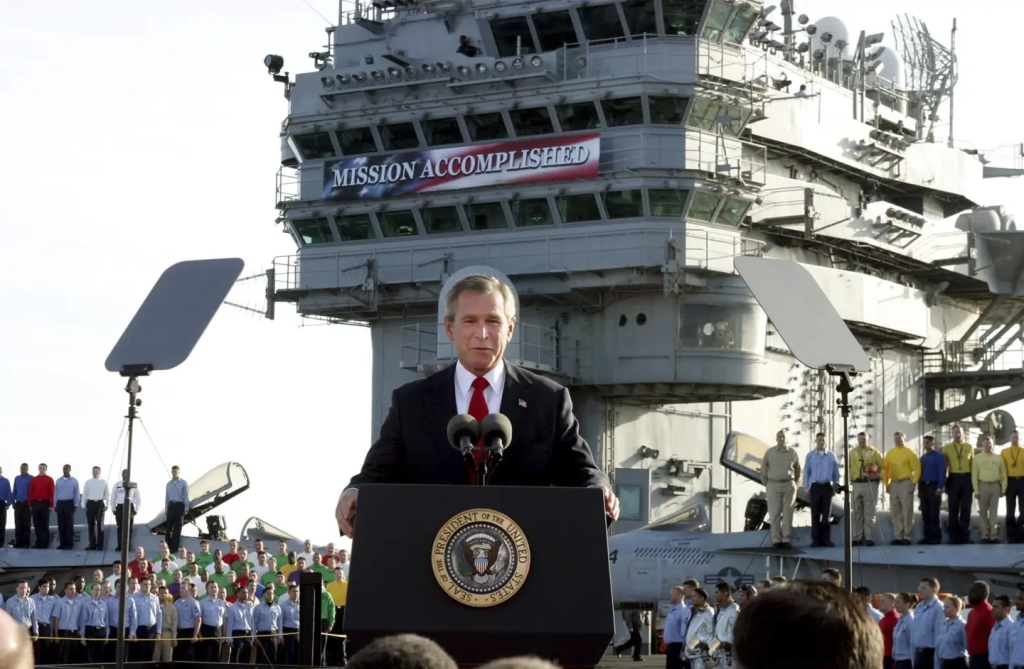
President George W. Bush on the deck of the USS Abraham Lincoln during the infamous ‘Mission Accomplished’ speech, May 1st, 2003. (Credit: Associated Press)
The wars in Afghanistan and Iraq were crucial theaters in the War on Terror. They were mishandled dramatically.
The genesis of this article came from my complete ignorance of the historical events which shaped my childhood. In 2021, when President Biden announced that American forces would completely withdraw from Afghanistan, I realized I didn’t know a damn thing about Afghanistan other than Al Qaeda used to use it as a hideout. In trying to understand Afghanistan’s history, I had to reckon with the role of the United States in world affairs, and the current state of western Asia. I started consuming more and more information in regard to these phenomenally important events which helped shape my childhood. I was forced to reexamine what had always been casually accepted as fact and kept readjusting my views on these events.
I recalled 9/11 but didn’t have the full context of the day. YouTube has a surprising amount of news coverage of historic events, including 9/11. I’ve watched the entirety of ABC’s coverage anchored by Peter Jennings multiple times over. I’ve done the same with coverage of the opening of the Iraq War, and other monumental events related to the War on Terror. Seeing these events firsthand, in a delayed fashion, gave me the appreciation for what was going on while history was unfolding, instead of the pure hindsight I had been operating off of.
Much of the content of this week’s article, along with last week’s, owes itself to the information gathered in the Netflix documentary, Turning Point: 9/11 and the War on Terror. This documentary released in 2021, about the time when I was looking into these events, and provided a dramatic improvement in my insight regarding the War on Terror.
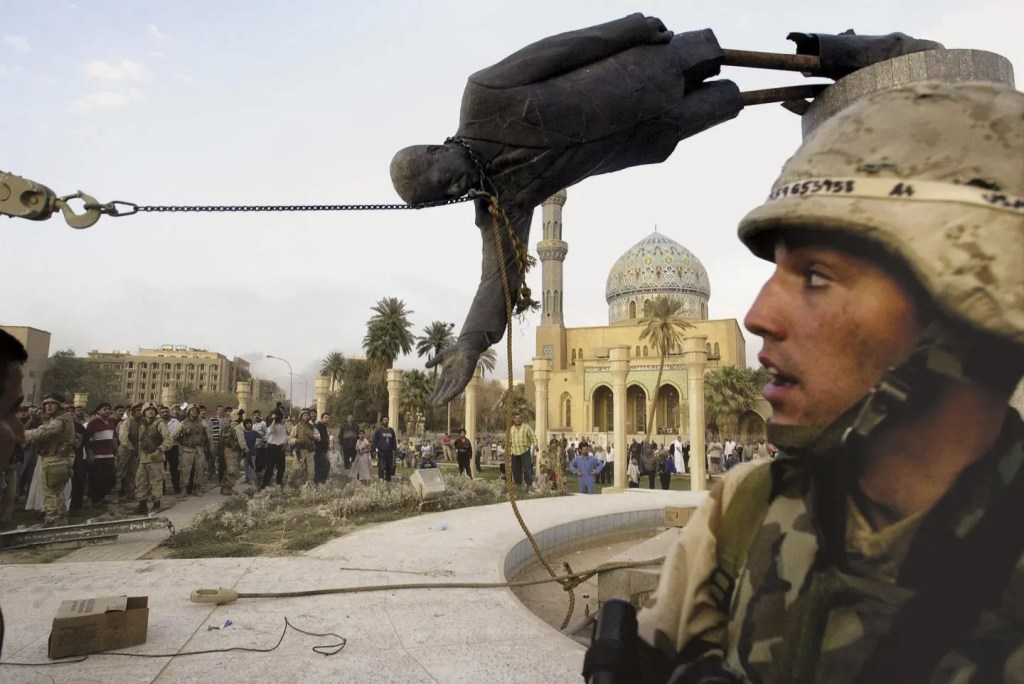
It’s a weird experience to have one’s childhood underscored by a war nobody can tell you why you’re fighting. Green-hued shots of Baghdad lit up by the frequent bombings, the statue of Saddam Hussein being pulled down by the tank, and George W. Bush in front of that infamous ‘Mission Accomplished’ banner were all key images surrounding the Iraq War. When I used to go to church, we’d offer intercession prayers during mass for the soldiers deployed. We’d write letters to soldiers ‘defending our freedom.’ We renamed French Fries and French Toast to “Freedom Fries” and “Freedom Toast” for no discernible reason. We added massive displays of patriotism before sports games. We put American flags up everywhere to support our nation. We bought gold ribbon magnets for our cars to show we supported the troops.
But nobody could ever explain to me why we were even there.
Enduring Freedom Has a Twenty Year Shelf Life

Afghanistan had been Al Qaeda’s hideout since 1996, just after the ascendance of the Taliban as the leaders of the nation. In the immediate aftermath of 9/11, the United States demanded that the Taliban hand over Osama bin Laden or risk invasion. They refused. America invaded.
The War in Afghanistan started on October 7th, 2001; a scant three weeks and five days after Al Qaeda crashed airliners into the Twin Towers of the World Trade Center in New York City, the Pentagon in Arlington, Virginia, and passengers foiled their attempt to hit the White House or the Capitol Building with a fourth plane. The ground war began in earnest two weeks later on October 21st. Early on, an attempt was made to minimize American forces on the ground. This resulted in using local forces as the bulk of the muscle, supported by American air assets and special forces.
Ahmad Shah Massoud was a mujahideen fighter during the Soviet occupation. He was a respected and effective military commander, a deeply religious man, and a strong believer in Afghanistan’s freedom. After the Taliban took over the nation, Massoud took up arms and founded the Norther Alliance, which held about 10% of the nation in northern Afghanistan. On September 9th, 2001, Massoud was assassinated by Al Qaeda suicide bombers posing as western journalists by request of the Taliban. This was to prevent the Americans from working with Massoud to build a new Afghanistan after they were deposed, knowing that the upcoming attacks against America would cause a massive retaliation. Massoud’s Northern Alliance would fight in his honor alongside the Americans and would form a crucial component of the new government of the Islamic Republic of Afghanistan once the Taliban was deposed.
The United States invoked Article 5 of the NATO charter after 9/11. This called all NATO members to support them in their attack, and built a strong, American-led coalition to oust the Taliban from Afghanistan. As the fighting dragged on, more American troops entered Afghanistan, and the Taliban were pushed back to Kandahar as their last stronghold by the end of November 2001. It would take one last push, and Afghanistan was free. One stroke of good luck, and Osama bin Laden would be captured or killed, and that would be a decisive victory in the opening salvo of the War on Terror. American leadership chose to avoid capitalizing on that stroke of good luck.
The Battle of Tora Bora took place in December 2001, when Afghan coalition forces believed they found Osama bin Laden’s hideout in the Tora Bora mountains. The American forces hammered the area with airstrikes, but requests from the American CIA forces on scene for a deployment of Army Rangers were denied. Instead, the local Afghan forces took the lead. This fell in line with the American strategy of keeping a small footprint in Afghanistan, which as history would bear out, was not a viable strategy. As a result of American hesitancy at Tora Bora, Osama bin Laden slipped over the border into Pakistan, and the American mission in Afghanistan changed. Osama bin Laden was no longer in play due to American incompetence, and there needed to be a ‘win’ for the Bush administration to justify continued action in Afghanistan. There was no exit strategy, breaking one of the core tenets of post-Vietnam military doctrine. History repeats itself if its lessons are not heeded. America refused to heed the lessons it learned in Vietnam and created a myriad of mistakes.
With bin Laden unaccounted for, the task turned to building a new government in Afghanistan, which would be a difficult task, and a telling prelude to Iraq. Unlike Iraq to come, Afghanistan did not have a central identity as a state. The country is mountainous, and transit is difficult between regions. There wasn’t much modern infrastructure outside of its capital, Kabul. What did exist was devasted after the Soviet invasion, subsequent civil war, and the American invasion. Afghanistan’s other major difficulty is the tribal nature of its people. The idea of a nation state didn’t matter to most Afghans, they were more concerned with their direct region, often along ethnic lines. Afghanistan’s ethnic makeup is quite diverse. This does mean, however, that there are many cultures at play, though some traditions to help these diverse groups get along exist. A loya jirga or “grand council” in Pashtun, is a gathering of tribal leaders to make decisions in Afghanistan. The loya jirga in 1747 helped create the modern concept of Afghanistan when Ahmad Shah Durrani was selected as king.
In 2002, another loya jirga was held. Hamid Karzai chaired that meeting. The 2002 loya jirga was to decide the future of Afghanistan. The proceedings were less than smooth. Mohammad Zahir Shah – the former monarch who was deposed in a coup by his cousin in 1973 which started the chain of events that led to the Soviet invasion in 1979 – opened the 2002 loya jirga. The former king was the popular choice to lead the newly liberated Afghanistan, and many regional and tribal leaders were in favor of restoring the monarchy. Influence from the United States, however, pushed the meeting in a more ‘democratic’ direction. The 2004 loya jirga would ratify the constitution of the new Islamic Republic of Afghanistan, and Hamid Karzai would be elected its first president.
This brought Operation Enduring Freedom to its end. America would now provide support in building the new nation of Afghanistan. The Taliban had been defeated, not eradicated, and would prove themselves to be a thorn in the side of any hopes for a free country. Eventually, thanks to years of corruption, resentment towards the remaining Americans, and the fragmented nature of Afghanistan as a whole, the Taliban would retake the nation in the wake of America’s withdrawal in 2021.
Afghanistan’s freedom would not be so enduring after all.
All Warfare is Based on Deception
Once the situation in Afghanistan had stabilized in 2002, America’s focus turned towards Iraq for uncertain reasons. A great deal of armchair psychology has gone into discerning the reasons as to why George W. Bush decided to focus the American war machine on Iraq, but the truth remains somewhat out of reach. The fact remains, with the Taliban vanquished, Al Qaeda scattered, and Bin Laden in the wind, the American people remained unsatisfied in their desire for vengeance. Therefore, George Bush and his administration would give the American people a new enemy. What followed was an extensive effort to convince the United States and its allies that Saddam Hussein of Iraq was the next greatest threat to liberty across the free world. Not everyone bought the line, but there were enough who did for America to invade anyways.
The Bush administration asserted that Saddam Hussein was harboring Al Qaeda members, and when no evidence could be found, that they were harboring other terrorists. The second argument was that Saddam Hussein was in possession of WMDs and was making efforts to manufacture more. He would then give them to terrorists, and who would use them to strike against the United States and its allies. The third argument was that Saddam Hussein was oppressing his people and without him, there would be a true democracy in the Middle East and the Iraqi people deserved their liberty. Therefore, Saddam Hussein must be removed from power.
The entire argument was based off of outright lies.
The Iraq War was a blatant instance of American warmongering. In the lead up to the start of the war, there was a concentrated effort by the Bush administration to lie to the American people. As part of the effort, Defense Secretary Donald Rumsfeld set up the Office of Special Plans. The Central Intelligence Agency could not find concrete evidence linking Al Qaeda to Iraq, which created a problem for the Bush administration. The Office of Special Plans – which was led by Rumsfeld, his deputy: Paul Wolfowitz, and Vice President Dick Cheney – took raw intelligence and ‘stovepiped’ it to the White House. In essence, OSP cherrypicked the information that would help them justify the decision the administration already made, no matter how accurate it was. No longer was America reacting to information, they were using over-stretched truths to justify a war of aggression.
Normally, intelligence is vetted by the CIA, meaning it is analyzed for how accurate it may be. This typically takes the form of looking at the source of said intelligence. Documents are always preferred, as they spell out the information and can be pointed to as concrete evidence. Testimony from people tends to get a bit trickier, as the motivations of the individual have to be discerned. Did the person offering the intelligence offer it voluntarily? Was it under duress? Were they captive and they offered information in return for more favorable results in their upcoming trial? Were they paid? Were they tortured?
The answers to all of these questions were needed before a piece of intelligence could be considered reliable. Ali Soufan is a former FBI Special Agent who worked under John O’Neill, the former head of the FBI Counterterrorism team. O’Neill spent a considerable amount of the end of his career focused on finding Osama Bin Laden before he was drummed out in August of 2001 and took a job as chief of security at the World Trade Center. O’Neill was killed on 9/11. Ali Soufan was the lead investigator of the USS Cole bombing and was active in the Bureau’s activities in hunting Al Qaeda in the aftermath of 9/11 until he left government service in 2005. Much of the information Soufan gathered was through interrogation with Al Qaeda members. For example, Soufan was the one responsible for discovering Khalid Sheikh Mohammed’s link to Al Qaeda in 2002.
Ali Soufan’s most notable public statements would be the condemnations of the CIA’s ‘enhanced interrogation’ techniques. To not mince words, ‘enhanced interrogation’ was a more publicly acceptable way of saying ‘torture’ and the activities were most certainly torture. Torture does not produce reliable information. Torture creates compliance, not cooperation. Meaning, that the confined spaces, sleep deprivation, physical abuse, dogs, cold water blasts, forced nudity, and other methods of torture practiced by the CIA would make the person they’re interrogating tell them what they want to hear, and not necessarily offering up true or useful information. In conditions such as these, telling the person causing the pain what they want to hear to make the pain stop is not hard to believe. These activities took place in places like Guantanamo Bay, and other places where American legality wasn’t a factor. Recent efforts may force the nation to rightfully reexamine the legality of such measures.
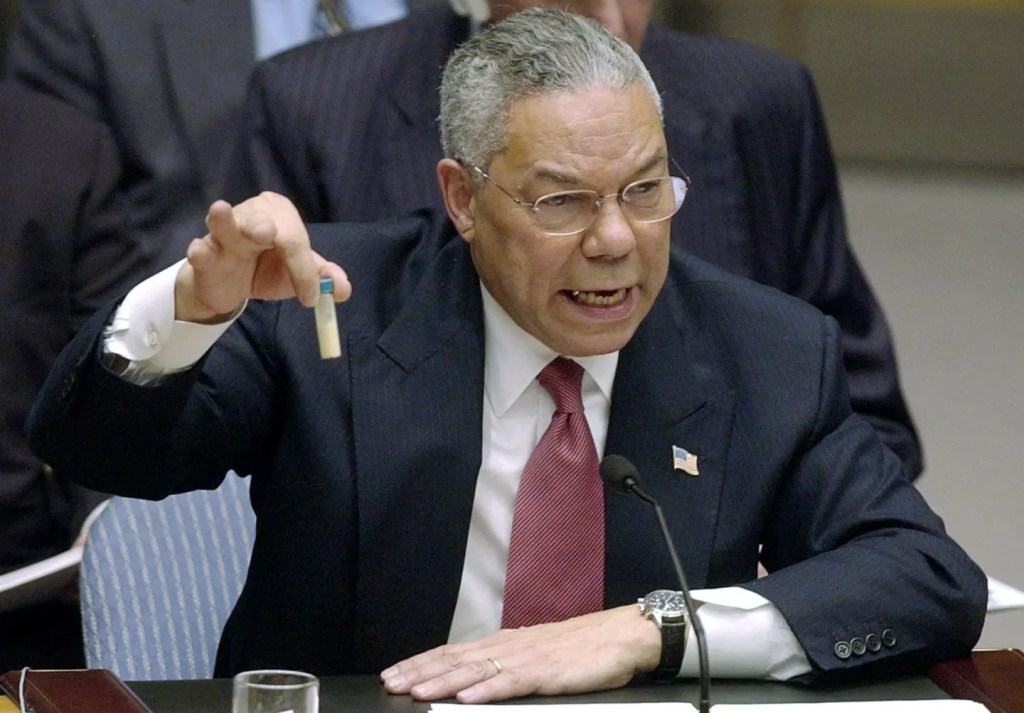
Perhaps the torture was the point. By ‘interrogating’ suspected or confirmed terrorists and getting them to confirm inaccurate information, it provided the Bush administration with the justification for the decisions they had already made. It could use ‘true’ statements to feed the lies and shady justifications already building the case for war against Iraq. Colin Powell made an appeal to the United Nations Security Council on February 5th, 2003, regarding Saddam Hussein’s WMD programs and the dangers it possessed. The UNSC remained unconvinced, but George Bush would put together the ‘Coalition of the Willing’ and invade a month and a half later. The only thing Powell’s presentation did was diminish America’s credibility on the world stage and sully the reputation of perhaps the most respected member of Bush’s cabinet.
The campaign of dishonesty worked. The American people, who were less enthusiastic to enter Iraq in early 2002 were ready to go by early 2003. To be against Bush’s war against terrorists was seen as un-American. In hindsight, many Americans disagree with the war. The campaign of hints, references, and assertions that Iraq had anything to do with 9/11 eventually convinced the American people to back the conflict, but years on and the revelation of the truth behind those reasonings left many Americans feeling burned by Bush.
Maybe the most sensible reason for the Iraq War that anyone has ever been able to lay out is Cpl. Ray Person’s extremely explicit rant on the layers of incompetence practiced by all parties involved. 1
New reflections with twenty years since the start of the war seem to shed new light and dispel many of the commonly cited recommendations. Today’s most compelling narrative ascribes the rationale for the Iraq War being George W. Bush’s desire to stop new terrorism breeding grounds from forming to cut off any new potential attack before it starts. It would seem to many that it was paranoia and insecurity. It’s almost understandable. It doesn’t take a stretch to believe people would be a bit overzealous and react strongly after the worst attack on American soil since the War of 1812 happened on their watch. A certain level of trauma is to be expected from the leaders of the most powerful nation on earth who had a terrible tragedy happen on their watch, and posses a desire to prevent it from happening again. Were it not for the blatant lies to the American people, the abject horror show of American war crimes, and the utter incompetence of rebuilding a post-war Iraq, then the war might have been seen as a good move to keep the world secure from terrorism.
The roughly 300,000 dead Iraqi civilians would say otherwise.
Shock and Awe
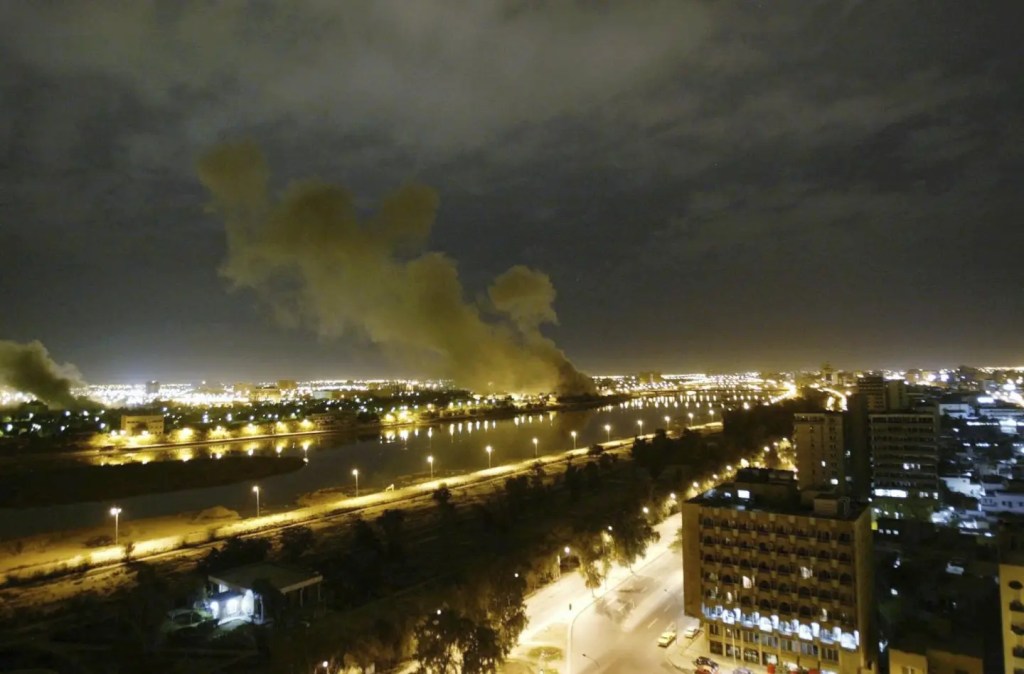
The Iraq War was initially a pretty open and shut affair. The initial phase of the invasion took roughly forty days. Much of Iraq’s military might had been severely depleted after the Gulf War of 1991, and much of its air defenses had been obliterated in the enforcement of the no-fly zones over northern and southern Iraq. George Bush had given Saddam Hussein an ultimatum to leave the country and allow UN inspectors in to look at the supposed WMD sites. The Iraqi president had refused to leave country by the deadline. Upon expiry, the American troops which had been staging in Kuwait began moving towards Iraq on March 19th, 2003. In the days leading up to the crossing of the Iraq-Kuwait border, American air elements based off of carriers in the Persian Gulf and other airbases set up throughout the region in friendly countries launched strikes against Iraqi air-defense installations and ground targets.
American troops pushed hard and fast from Kuwait, meeting little resistance on the road to Baghdad. The regular Iraqi Army, still devastated from the Gulf War in 1991, largely surrendered when American troops neared. They were not very disciplined or willing to give their lives up for the war. In contrast, the Iraq Republican Guards were much more willing to fight the Americans but were still heavily outclassed. The Republican Guard were the best of the best of the Iraqi Army and reported directly to Saddam Hussein. They were more zealous in their devotion to their leader and had better training and equipment than their ordinary brethren. By far the most fanatical fighters, however, were the Fedayeen. The Fedayeen Saddam was a paramilitary formed by Saddam to operate as his will outside all laws or command structures. They were a volunteer unit of those dedicated to Saddam and fought as irregular guerilla forces against the Americans. They would be the most prominent precursor to the insurgency America would face after the war’s end.
Once Baghdad fell on April 1st, 2003, and Saddam was on the run, the main invasion pivoted towards rooting out the last of the major resistance strongholds. This process took about another month. George Bush would declare, “Major combat operations in Iraq have ended. In the Battle of Iraq, the United States and our allies have prevailed” in his infamous ‘Mission Accomplished’ speech on May 1st, 2003, from the deck of the USS Abraham Lincoln. However, much of Iraq was still unpacified. Saddam Hussein would remain in hiding until his capture on December 13th, 2003. Even after his capture, armed militants would continue harassing and attacking American forces for invading their home, breaking the nation, and causing more pain and suffering while ineffectively trying to rebuild it.
In a speech at Verdun on July 20th, 1919, French Prime Minister Georges Clemenceau declared, “It is easier to make war than it is to make peace.”
A Litany of Incompetence
As the Iraq War turned to occupation, problems began to set in. Teams hunting for the supposed WMDs were coming up with nothing. Iraq was also subject to militant resistance, and for the first several months of the war, the American people were getting fed up with the inability to find their enemies with Saddam Hussein remaining hidden in a fractured and lawless nation. The decisions made by the Coalition Provisional Authority would make the future of Iraq much more difficult. Not listening to the will of the Iraqi people was one mistake. Another was firing the entire military without ever bothering to collect their weapons or pay them severance. The greatest sin was when George Bush said, “We are not here to nation build.” Had the proper resources been allocated towards Iraq’s reconstruction, and a government built by the Iraqi people with the proper respect to its sectarian divides, then perhaps its current state wouldn’t be quite so bleak.
This would have required a level of dedication and competence and a willingness to be unpopular to the American people if it meant doing the right thing which the Bush Administration did not possess. Building a nation from the ground up is no easy task for the best and brightest, and unfortunately the second rate only ever hires the third rate.
The architect of Iraq’s subsequent disaster is a man whose name seldom appears in conversation about the Iraq War. It’s important to know Paul Bremer’s name, and why his decisions were so disastrous for the state of Iraq.
In the wake of the successful capture of Baghdad, the deaths of Uday and Qusay Hussein, and Saddam going into hiding, the Administrator of the Coalition Provisional Authority Paul Bremer would kill the body of the newly decapitated Ba’athist Iraq. On May 23rd, 2003, Bremer signed Coalition Provisional Authority Order 2 into effect, which disbanded the Iraqi military, security forces, and intelligence services. This was a hasty measure to wipe away the remnants of Saddam Hussein’s regime as a political win. Eliminating the surviving apparatus of the state, which could have helped stabilize the volatile situation after the ouster of Saddam Hussein, only served to plunge the country into further chaos. With no native forces to maintain security or build a functional state, the American military was forced into the role of police and diplomat amongst a population which spoke a language very few Americans were familiar with. This inflamed the already large frustrations the Iraqis had with their American occupiers. Indeed, while the American forces were initially greeted as liberators, once it became clear they had neither the skills nor patience nor interest in building a new nation and were content to let the Iraqis fend for themselves, that gratefulness turned to fury. Order 2 was one of the 100 Orders designed to wipe away the remnants of the Ba’athist regime and create a new Iraqi state. In the long term, it would be a lofty goal. In the short term, it would make securing Iraq more difficult.
Nathaniel Fick was a Marine Lieutenant during the invasion of Iraq. In his book, One Bullet Away, Fick describes the chaotic scenes of Baghdad after the initial phase of the invasion. People lacked water, there was rampant looting and fighting between Shia and Sunni Muslims settling scores which had to be put on ice during Saddam’s time in power. Fick was angry over his unit being constantly moved around and unable to develop a rapport with the locals in a specific area and see to their needs. It served to highlight the problems with the American occupation forces.
Al Qaeda didn’t exist in Iraq before the Iraq War. However, in 2004, the terrorist organization started by Abu Musab al-Zarqawi pledged its allegiance to Al Qaeda. His alleged presence in Iraq before the invasion was one of the justifications the Bush Administration used to justify the Iraq War. Al-Zarqawi himself was a complicated figure. Born in Jordan, he started a jihadist organization in 1999, and ran a training camp in Afghanistan. When the American invasion of Afghanistan began, al-Zarqawi was in Iran but returned to Afghanistan to help fight American forces, before being wounded and ending up in Baghdad for medical treatment. Eventually making his way back to Iran, al-Zarqawi helped set up terrorist cells in preparation of the American invasion of Iraq. He led an insurgency against the American invaders inside Iraq before being killed in an American airstrike.
Ironically, al-Zarqawi’s legacy was to bring Al Qaeda to Iraq, but there was still no link to Saddam’s government. Ba’athist Iraq was not harboring or supporting terrorists but became a hotbed of terrorist activity in the wake of the destruction of the Iraqi state. With no one to keep the peace, and the American and coalition forces seen as illegitimate invaders, the power struggles continued drawing blood. During President Obama’s tenure, American forces began withdrawing from Iraq. The sectarian power struggles devolved into serious violence. Iraq’s future was bleak and uncertain, with many of its factions jockeying against each other for power. With violence. Many of whom were backed by outside powers.
The citizens of Iraq continued to suffer.
Cleaning Up The Mess
Americans were still untrusted after the inability to keep the situation stable in Iraq. Their credibility was destroyed after scandals such as the Abu Ghraib prisoner abuse or the rampant killings of civilians by private security forces such as the Nisour Square Massacre in 2007. Obama fulfilled a campaign promise to withdraw troops from Iraq, removing American combat troops by 2010. Only 50,000 American troops remained in the country to serve as advisors to help train the Iraqi military. This was a step in the right direction and would quickly be undone.
The rise of ISIS would complicate Iraq’s future with American forces. The Islamic State of Iraq and Syria was a dream of religious extremists; a new Islamic caliphate in the cradle of civilization to spread across the world. They were brutal and efficient, and dangerous. The Battle of Mosul in 2017 highlighted the sheer brutality of ISIS, and helped underscore the importance of building an effective coalition against them. The threat they posed to Iraq’s warring factions brought the nation together. Even then, the Iraqi government was struggling. So, President Obama authorized an American troop surge in 2014. The strategy worked, and ISIS was no longer a threat to power within a few years. The United States continued stationing troops in the country until 2021, when the American withdrawal was completed under President Joe Biden, having been started under his predecessor.
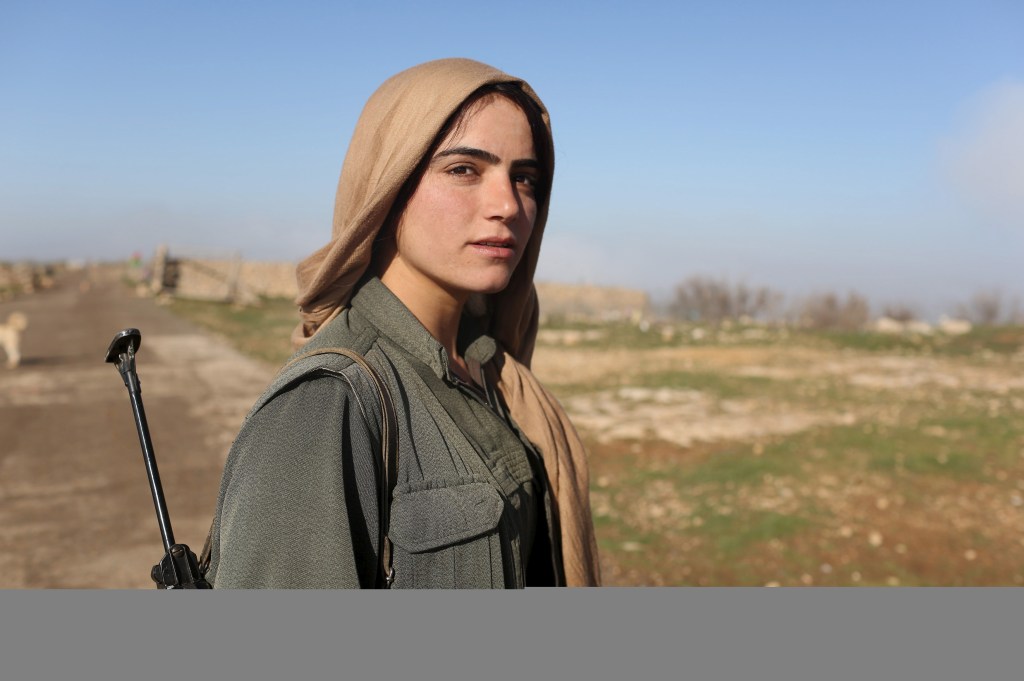
President Obama ordered a troop surge in Iraq to help fight the threat of ISIS, and those troops were withdrawn once ISIS was destroyed as the existential threat to the Middle East it was during its prime. It seems that ISIS will not rise again. The Kurdish people were part of the reason why, being effective fighters and consistent allies in an incredibly volatile region. Donald Trump rewarded the Kurds’ efforts in helping American troops for years with a brutal betrayal. He allowed the Kurds to be slaughtered by Turkish troops for reasons beyond understanding. The actions only served to undercut the American position that allies are only supported so long as they’re useful.
Ultimately, Iraq exists today as a semi-functioning nation. It’s neighbor, Iran, has a great deal of influence in the nation. For Iran, this protects their border. In the years before the American invasion, Saddam Hussein’s Iraq was the biggest threat to Iran. Furthermore, Iran’s freedom from having to deal with Iraq means it can dedicate more resources to funding terrorist activities abroad in service of its proxy wars with various other powers, including Saudi Arabia and Israel, and the oppression of its own people.
Iraq may be slightly better off than it was under Saddam Hussein, but the nation still has very far to go.
Geronimo

Osama bin Laden was the face of evil for a decade. He represented the September 11th attacks, the evil of Al Qaeda, and the threat of terrorism to the United States in a way few other faces could. One of the most famous moments in the War on Terror was when George Bush declared that Osama bin Laden was wanted ‘dead or alive.’ The sentiment was definitive, even when the goals were beyond grasp. Another of the most famous moments in the War on Terror was when Barack Obama announced that Osama bin Laden had been killed in May 2011.
In May 2011, Barack Obama had the chance to give the go order on Operation Neptune Spear, which brought a ceremonial end to the first era in the Global War on Terror. Ten years after September 11th, and the mastermind of the attacks had finally been brought to justice. Amidst an uncertain situation in Iraq, the looming rise of ISIS, and concerns over the use of drone strikes, America had successfully delivered a total victory that even many of its critics could agree was a good move.
The raid itself was one of the most secret operations in American history. It had to be. Osama bin Laden was found at a compound near Abbottabad, Pakistan. Pakistan was officially an ally to the United States but had many of its citizens and officials sympathetic to Al Qaeda’s mission for a variety of reasons. It was believed that letting Pakistan know about the raid could have tipped off bin Laden and he would have been able to flee. It also meant that the SEALs would get one shot to kill bin Laden, and failure would result in him going back into hiding for years. Pakistan’s status as an ally meant that Neptune Spear was technically illegal and risked a great deal of political blowback. It was a violation of Pakistani sovereignty and would have probably caused a much more prominent international dustup had it not been as efficiently executed, and the target was someone other than the perpetrator of the deadliest terrorist attack in history.
Despite trouble with the helicopters including a crash, members of the Naval Special Warfare Development Group, also known as SEAL Team Six, made their way into the compound, killed Osama bin Laden, gathered valuable intelligence, and exfiltrated after 38 minutes. It was a cleanly executed operation and gave the United States valuable information on Al Qaeda’s activity. President Obama was then able to give the American people the news on national television, and bring an end to Osama bin Laden’s tenure as the specter of evil against America.
Once bin Laden was killed, his second-in-command took leadership of Al Qaeda. Ayman al-Zawahiri was an Egyptian jihadist who brought his organization in as a large component of Al Qaeda at its inception. Not as charismatic as Osama bin Laden, al-Zawahiri was a brilliant tactician. Donald Trump had the chance to take him out multiple times and refused. Joe Biden would be the president to order the strike which killed al-Zawahiri on July 31st, 2022. With another head of Al Qaeda removed from the board, the United States underlined to the Taliban that it would not suffer their acceptance of a return to the pre-9/11 days where Afghanistan was a refuge for terrorists. Al Qaeda, which had functionally deteriorated after the American invasion of Afghanistan in 2001 and subsequent counterterrorism operations in the years since, is still a worldwide force. Ayman al-Zawahiri’s death causes questions for Al Qaeda’s future. Al Qaeda is less centralized than it was at its zenith, and many of its associated organizations are focused on their regional conflicts in Africa. However, the name and its trappings still have worldwide influence, and causing further uncertainty in their future is in the interests of world powers to ensure their brand of extremism never again threatens innocent lives.
Al Qaeda is functionally useless as an international terrorist actor and has been so for many years. In one sense, the war in Afghanistan was a resounding success. The Taliban controlling the nation again, however, leaves a sour taste in the mouth when discussing Afghanistan.
Kabul is the New Saigon

It’s important for most Americans to realize that Afghanistan was a nation of people all its own as well. The repression under the Taliban was not just political, but also social. Under the Taliban, women were to be kept hidden and not allowed to work. Music was forbidden. Men were required to grow beards. Public executions for crimes were normal. Thanks to America’s invasion, these things were the way of the past, and Afghanistan would see a new era, especially for its young women.
By 2021, Afghanistan was seeing the first fruits of the labors of its own best and brightest, and the Americans who helped liberate the country from the Taliban. A generation born around the time of the invasion were coming of age, and the youth were blazing a new trail for Afghanistan. With music returning to its streets for the first time in years, rock bands like Kabul Dreams made their debut. The country had influencers on social media. The results of twenty years of nation building were beginning to show themselves in Afghanistan, and a national identity was beginning to emerge. Sadly, years of corruption, ineffective governance, and an over reliance on American military support would enable the Taliban’s return to power in the aftermath of the American withdrawal in August of 2021, and smother the hopes of Afghanistan’s future in their cradle.
The American military mission started promisingly enough in the post-invasion phase. Part of that role included training and supplying the Afghan National Army and Afghan National Police forces so they could take over security. By 2014, American forces were largely in support roles for the locals, and for good reason. The Afghan Commandoes were lethal and highly effective at striking back against the Taliban all on their own. The Afghan National Army was a point of pride for its people, and its leaders felt that America’s withdrawal was a betrayal. The military arm was marred by the same corruption which plagued much of the rest of the nation, but there were still plenty of members who believed in Afghanistan and wanted to serve their nation.
The efforts to build Afghanistan into a prosperous nation would be stymied by rampant corruption. President Hamid Karzai would preside over a culture of corruption, enriching himself and many of his ministers at the expense of the people of Afghanistan. He became an increasingly unreliable partner to the Americans, but there was a perceived need to keep him placated. As Afghans starved while Karzai grew richer, much of the resentment against the government in Kabul would be focused on the Americans as well.
The Afghan National Army collapsed within a matter of days of the American withdrawal. Many people were shocked that this process happened so quickly. Once the multitude of reasons for this dramatic collapse are well understood, however, it should come as no surprise the Afghan National Army gave up the fight. Simply put, it was a fight they had no chance at winning once the Americans pulled the rug out from underneath of them. Many Afghans grew bitter towards America due to the United States’ support of factions committing heinous crimes against them or committing those crimes themselves. A litany of abuses on and off the battlefield lends support to those feelings of anger and frustration. Once the United States made the decision to pull out of Afghanistan, many felt that they stood no chance. The entire ‘peace’ process was a betrayal by America. Especially since the Afghan National Government had not been involved in the peace talks.
President Donald Trump had made no secret of his disdain for America’s forever wars. In Doha, Qatar in 2020, officials in the Trump administration signed a peace deal with the Taliban to protect American troops for their total withdrawal from Afghanistan. The fact that the Afghan National Government was not in the room for these negotiations undercut any potential success they might have against the Taliban. This factor is blamed for the Afghan government’s collapse and the Taliban’s lightning fast resurgence. No effort was made to gain concessions from the Taliban, the deal was just so that America could wipe its hands of the affair and walk away, leaving the people of Afghanistan to the Taliban. This was the penultimate step in America’s betrayal of Afghanistan.
The final step was 2021’s evacuation of the country. America cutting and running on the people of Afghanistan was a horrendous enough crime on its own. The chaotic and messy nature displayed in the Fall of Kabul compounds the fact. The fault for this chaos amidst the American evacuation can be placed on President Joe Biden’s administration. Agreeing to a timeline just slightly overdue from what the Trump administration promised with a lack of planning or decisive and timely shot calling from the Biden Administration meant that the Americans were ill-prepared for the herculean undertaking that would be completing the withdrawal from the country. Thousands of refugees were crowding Hamid Karzai International Airport, the last bastion of American-friendly territory even as the Taliban were at the gates of the airport on the final days of the evacuation. They were begging for spots on American planes, some hanging off of the wheels when the airplanes lifted off the ground, only to fall to their deaths. This was still a preferable alternative to life under the Taliban. American forces airlifted roughly 100,000 Afghans. Far too many were left behind. Many of the ones who made it out are still facing troubles two years later. They are unable to secure the visas to stay in the country, and safely out of the Taliban’s hands.
In its aftermath, America left behind scores of military equipment, which emboldened the Taliban. They left behind a broken nation, once again at the mercy of brutal oppressors. And they left behind their interpreters. Afghan interpreters were vital to America’s ability to operate within the nation, since the multitude of languages spoken in Afghanistan were unlike to be spoken by substantial members of the United States Military. The visa process for these interpreters is long, overly complex, and time-consuming, like the rest of the United States’ immigration system. One could consider the process to be overly cruel. For many of these interpreters, time was not an available luxury. Many of them put their lives and their families at risk to help the Americans, and they were repaid by being left to the mercy of the Taliban, and the Taliban are not known for their mercy. The problem of interpreters allowed to stay in the United States has been a longstanding one and serves as a perfect encapsulation of issues with immigration in America. If those who put their lives at risk for American troops were not given a clear and quick track to building a new life in the United States, nobody else would be either. America abandoned those who helped serve its mission in their country to their oppressors.
The people of Afghanistan lacked leadership on the domestic front as well. President Karzai’s successor, Ashraf Ghani fled the nation when the Americans withdrew in 2021 while his Vice President, Amrullah Saleh, declared himself caretaker president and vowed to fight. Saleh, together with Ahmad Massoud (son of Ahmad Shah Massoud), started the National Resistance Front in the Panjshir Valley which Massoud’s father had fought so hard to protect for so many years. The National Resistance Front lasted a few months, but ultimately fell to the Taliban. Saleh and Massoud fled to Tajikistan but remain committed to the fight for their nation.
By the end of 2021, the Taliban had returned to control Afghanistan. The Taliban are currently faced with infighting and other struggles, but it seems that they will maintain their grip on Afghanistan for the time being. Afghanistan today is in the same place it was almost thirty years ago.
In many respects, the American efforts after 9/11 seemed to have accomplished very little.
Lessons Learned?

In some ways, the end of the War in Afghanistan is too recent to provide a decent retrospective on. In others, it is absolutely valid to criticize the American exit. Not only was it hasty and slapdash, but it was America once again abandoning people who relied upon its power to stay safe. Afghanistan was never given a chance as a nation and a democracy. American Presidents on both sides of the aisle committed to the narrative that the United States did not enter Afghanistan to nation build. They should have. There was an attempt to build a nation that was handicapped by a lack of political will. From a pragmatic, practical perspective, Afghanistan would have been valuable as an American ally to counter Iran and provide a place closer to China and Russia from which to monitor their activities. From a humanistic standpoint, the Taliban are one of the worst regimes for human rights, and to have eradicated their effectiveness by helping to build Afghanistan into a prosperous nation could have done wonders to revitalize interest in American aid worldwide, and clearly state the American values of supporting freedom and cooperation to the world in ways which had not been done previously.
The retrospective on the Iraq War has been less than kind as well. Dan Rather described the Iraq War as A Blunder of Epic Proportions. The title is apt to describe the Iraq War in hindsight. Journalistic integrity in America was shattered when the fourth estate refused to call the Bush Administration out over its lies about Iraq possessing WMDs and the nation’s connections to terrorism. The willingness to speedily invade a sovereign nation with no just cause flies in the face of international relations the world over. Furthermore, the refusal to develop an in-depth and effective plan to build a new nation state led to the rise of terrorist groups which carried out attacks against our allies, and further brutalized the citizens of Iraq and Syria. A substantial portion of their blood is on America’s hands. From a pragmatic standpoint, the lack of friendly nations and willing allies in the region makes combatting and countering other bad actors more difficult. Iran, of its own volition, is engaged in a proxy war with Saudi Arabia, and funds militias which disrupt the lives of ordinary people all over the world. Having an effective platform from which to counter these forces was relegated in favor of a quick and dirty ‘victory.’
The War on Terror launched after September 11th, 2001, could have been a great moment for America to show the triumph of its ideals. To root out those who had wounded us so deeply, but also the benevolence and willingness to support freedom and liberty in places lacking. America appointed itself the leader of the free world, but refused to shoulder the responsibilities which are attached to that crown.
Iraq and Afghanistan should be potent lessons for America when it comes to the next crisis.
The Child’s Perspective
The end of the War in Afghanistan was a mistake, in my eyes. I spent summer 2021 opening my eyes to Afghanistan as a nation. I read about the history of the nation, the history of America’s war. I was horrified while watching the American evacuation. The images of people falling from the wheels of planes to their deaths will forever haunt me. The shocked and saddened looks of young girls who had the first hopes for a positive future for Afghan girls in generations stolen from them will haunt me until my dying day. It’s led to many confusing feelings regarding military intervention abroad, but I am absolutely certain of the moral responsibility to fix what we break in every situation.
In June 2023, I met a young woman from Afghanistan on a dating app. We talked for a few weeks over text, and then she asked if I wanted to hang out while she was in town thanks to a layover at National Airport. She didn’t want to spend the night in the terminal. I accepted enthusiastically. We spent a night hanging around Washington DC. I showed her Georgetown, we ate a late meal at a 24 hour diner, and we talked for hours. She told me that growing up in Afghanistan was difficult as a child of the war, especially regarding America. On one hand, the Taliban was a terrible organization that oppressed people, especially young women, and caused pain and bloodshed. America liberated Afghanistan from their oppression and brutality. On the other hand, by prosecuting a war in a nation with no will to build a peace, America also gained its fair share of enemies in Afghanistan. Here she was, this refugee of the fall of Kabul, certain she would never see her family again living a somewhat cozy life in the nation which had abandoned her and her people. She was grateful that America took her in on a student visa as she pursued a master’s degree which she had no desire to pursue because it was her only way of keeping safe after her first place of refuge, Ukraine, was invaded by Russia in February 2022. She fled the Taliban to Ukraine, then fled Ukraine after Russia and ended up in the United States. She doesn’t know what will happen next, or at least she didn’t when we last spoke.
She was one of the lucky ones.
I think that leaving a nation whose people who are willing to cling to airplane wheels and fall to their deaths rather than stay in their homeland signals that something is drastically wrong. I firmly believe that America leaving Afghanistan was the wrong move. We shirked the responsibility we took upon ourselves when we invaded the nation and deposed the Taliban. As a nation, we failed the people of Afghanistan. We failed the world. We failed the ideals enshrined in our founding documents. We failed ourselves.
I believe that refusing to commit to nation building in Afghanistan and Iraq was wrong. We chose to invade and destabilize these countries, and we elected to throw together something which resembled American democracy without ever thinking about how they may not fit with nations who did not have the same history and culture as us. We invaded Afghanistan and Iraq to topple their governments. We owed it to the people of both nations and to our stated missions to help build new governments inline with the beliefs and culture of those people which could stand on their own without necessitating the muscle of the American military. We should have been able to help the great Afghan intellectuals forced into exile by the Soviets, and the Taliban, and our invasion to return from their exiles to their homelands and build what they saw as a great nation. We should have been able to build a strong, independent, and free Iraq which could have welcomed visitors from across the world to see the cradle of civilization. These nations could have been strong countries of their own, grateful allies, and helped break the colonialist views of western Asia as being a savage and unfriendly place. Instead, we continued instigating the conflict which we use to chide and dismiss the region.
America must examine its decisions more carefully and commit to seeing through its actions. We have the strongest military in the world, and that has effectively deterred conflict and kept peace in a harsh and difficult world where the only rule of geopolitics is self-interest. We have modeled freedom for the world, and now that it is under siege at home, we have refused to learn the lessons abroad taught by places which lack the liberty we take for granted. There is space to put American interests first, and still fulfill the responsibilities towards the people of the countries in which we intercede. We have the resources to take care of our citizens at home, and help other places build themselves up to their potential as well. We can intervene in countries and help them create freedom and liberty for themselves in ways that are acceptable to their own people.
That is the America which all of us should aspire to build.
- Series name is Generation Kill from the same creative team as The Wire, broadcast on HBO in 2008. It is an extremely accurate look at Marines from the First Recon Battalion and their activities during the opening forty days of the war. The miniseries is adapted from the book by Rolling Stone reporter Evan Wright which compiled his articles written while embedded with Bravo Company of Second Platoon of First Recon Battalion. ↩︎
Part II: The Growing Sandstorm




 Ark of the Lost Angels


Leave a comment