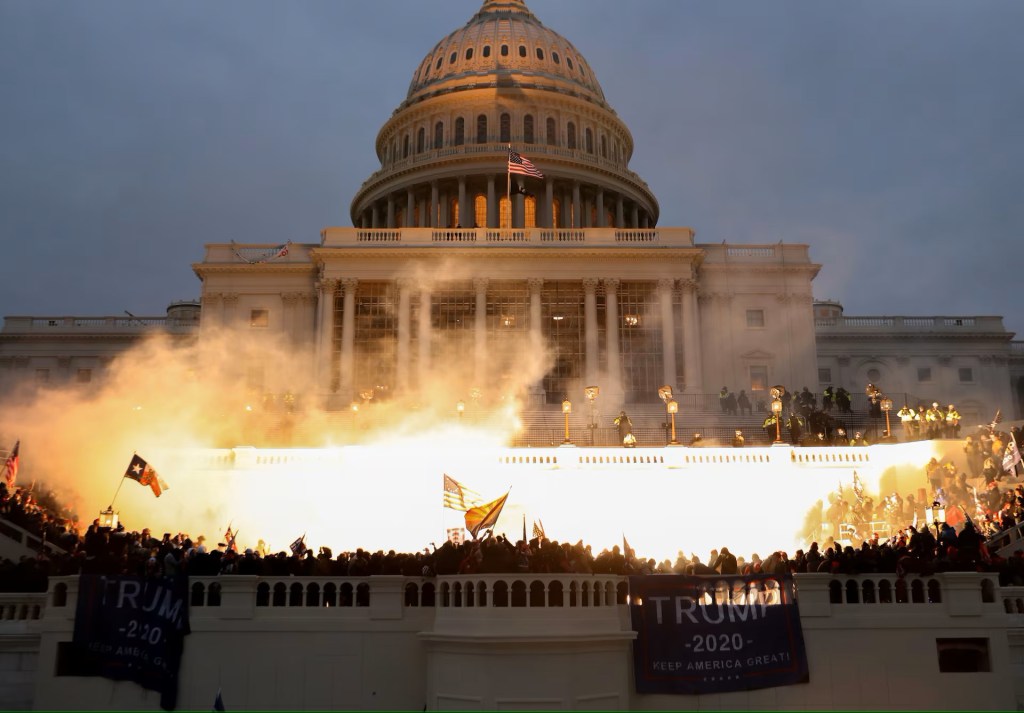
The United States Capitol Building on January 6th, 2021. (Credit: Leah Mills/Reuters)
The legacy of the Cold War and the War on Terror are alive and well in America today.
Growing up in America in the wake of 9/11, the reaction to the attacks shaped a lot of my world as a kid. Everywhere around me was fear and forced patriotism. The wars in Iraq and Afghanistan were talked about endlessly. Every initiative was about public safety and how to stop another attack from happening. Then something flipped. Towards the end of George Bush’s presidency, we stopped caring about what happened elsewhere in the world, especially once the recession of 2008 hit. We found enemies in each other at home and enabled some truly bad actors to divide our nation, creating fissures which would be exploited by outsiders.
I grew up in a culture of fear. Terrorists were around every corner, hiding beneath every bed. The world was allied against us. France didn’t support the half-cocked invasion of Iraq, so they were cowards. Iran, Iraq, and North Korea were united in their hatred of the United States, Bush’s so-called ‘Axis of Evil’, and would spill oceans of blood on American streets. Your neighbor questioned why we’re overseas fighting, they must hate the troops, hate the President, and hate America. Point out where FEMA blew it in New Orleans after Hurricane Katrina, and you were lacking in patriotism. You thought that the other political party had a valid point, then you might as well have proudly drowned puppies in the town well.
We created a culture of division, and then we enabled bad actors to point us towards each other as enemies instead of viewing those with differing opinions as simply that: fellow Americans who didn’t think exactly alike. That facilitated the rise of truly hateful, spiteful people who sought to destroy this country. No longer were we a nation aspiring towards polite disagreements and earnest compromises, we became bitter and meaner. The preservation of America was no longer paramount, winning an ugly knife fight was. We left ourselves open so that outside powers could push us further down the road to ruin.
It had the effect of keeping us so focused on each other that we couldn’t notice the sharks circling in the waters around us. Today, the most impactful war owes its origins to the unharmonious fall of the Soviet Union, not to any aftershock of the 2000s terrorism. However, the America after 9/11 created fires of division stoked by outsiders.
Everything is connected in a way that’s frankly overwhelming and difficult to see at first glance.
Security Theater, Now Playing: Fear and Inefficiency
Overwhelmingly, history makes it seem as though the members of the Bush Administration were so shocked and surprised at 9/11 that they were willing to throw out freedoms and liberties and take extreme action in order to keep America safe from something else happening again. September 11th showed that America was woefully unprepared to fight the war which had been foisted upon the nation. It doesn’t take a far stretch to believe that many of the measures were seen as acceptable to the people in charge because they were as shocked and outraged and afraid as the majority of the nation.
The problem is, they didn’t work, and many stand antithetical to the ideas America aspires to as a nation.
Perhaps the most insidious result of September 11th is the mass surveillance on the American people by the government of the United States, all ostensibly in the name of safety. The PATRIOT Act was a piece of legislation passed after 9/11 which granted powers to the federal government for domestic surveillance. In the intervening years, it’s become a catch-all term for various activities enabled under other laws.
The National Security Agency was created in 1952 under President Harry Truman, as a continuation of the United States’ efforts to break Axis communications during World War II. With the tense standoff against the Soviet Union growing, an organization dedicated to Signals Intelligence (SIGINT) was deemed necessary. As technology evolved, the NSA’s mission expanded to cover all sorts of digital communications. For much of the Intelligence Community after the Cold War ended, the NSA was searching for purpose in the new peaceful world. Once the Twin Towers came to the ground, that purpose was clear as day: use the tricks of the trade to hunt down any who would do America wrong in an age of connectivity like never seen before.
The NSA’s considerable powers would be focused, not only towards foreign subjects, but the agency would begin listening to Americans as well. In the aftermath of 9/11, the NSA was tasked with a massive domestic surveillance program, the likes of which has never been seen before. The NSA’s program of warrantless wiretapping of phones was called STELLARWIND, while PRISM was a similar program targeted at internet activity. The history of these programs is long and sordid and flies in the face of established American civil liberties. Edward Snowden, a controversial figure in his own right, leaked documents which revealed these programs to the world. President Obama’s refusal to end the warrantless surveillance these programs began emphasized that America had chosen the path of security over liberty. Today, it remains difficult to ascertain the depth of the programs still active, but the concerns over the government peering too deeply into the lives of its citizens remain strong.
It remains unknown how many, if any, terrorist attacks this surveillance has stopped.
No terrorism has been stopped by the torture practiced by the government in the aftermath of 9/11. The release of the torture report in 2014 confirmed what many people in America had already suspected. The “enhanced interrogation” program which the United States had run against terrorist detainees was inefficient, inhumane, and deliberately concealed from the American people. Guantanamo Bay Naval Base is a facility operated by the United States military on an indefinite lease which can only be terminated by the United States. In the aftermath of 9/11, at the dawn of the War in Afghanistan, Guantanamo Bay was the legal equivalent of limbo, which allowed the Bush administration to create the Guantanamo Bay detention facility as a way to hold “enemy combatants” as “detainees.” The nomenclature was strictly enforced as recognizing those held in Guantanamo Bay as inmates or prisoners would have given them legal rights as prisoners of war. Under international standards, this deliberate name game didn’t matter. The individuals captured during the War on Terror would be considered prisoners of war and afforded the same rights as uniformed combatants captured during official military operations. The legal justification was to permit the use of torture.
Guantanamo Bay as a concept flies in the face of two important concepts enshrined in the Bill of Rights. The first is the right to a fair and speedy trial. None of the individuals held in Guantanamo Bay have been charged with a crime, therefore will never reach a trial. The second is the right to be free from cruel and unusual punishment. The behavior practiced as part of the “enhanced interrogation” programs qualifies as cruel and unusual punishment. President Obama, President Trump, and President Biden have all declined to close Guantanamo Bay, making it an unsavory remnant of the panic and fear which engulfed the nation after 9/11. Efforts continue by various groups to shut down the camp and stop this abuse of a legal loophole to justify the continued infringement on human rights.
Capitulating on American values against its enemies would only be the start of the shameful behavior practiced in the wake of September 11th. The country would turn to shameful and ineffective methods in the name of keeping its own people safe; willfully ignoring the principles which built the nation.
The Homeland Security Act of 2002 created the Department of Homeland Security, and one of its prominent subagencies: the Transportation Security Administration. The Act also reorganized the immigration system. Previously, the Immigration and Nationalization Service (INS) handled immigration into the United States and was part of the Department of Justice. In the reorganization, INS’ responsibilities were divided between three new agencies.
Before 9/11, airport security was the responsibility of individual airports. Metal detectors and x-ray scanners were commonplace beforehand, and Federal Aviation Administration regulations allowed for the box cutters which served as the weapons used by the hijackers. Many of these regulations were changed in the wake of 9/11. The TSA was created to standardize airport security, putting security officers for air travel under the control of the federal government. The TSA has a history of failing tests of its effectiveness. The creation of glorified transit police was to assuage fears based on perception. If a government agency is unable to work effectively in the realm of safety, they do not have the public’s trust. It’s the reason the FBI suffered criticism after the Ruby Ridge incident in 1992, the Waco Siege of 1993, and the failure to stop the attacks on September 11th, 2001. The creation of the Department of Homeland Security and the formation of the TSA were an overcorrection. They didn’t work to keep Americans safe; their only purpose was to make a show to the American people. Years later, the TSA doesn’t make flying any safer than it was before. The hands which keep Americans safe are often invisible.
Most terrorism is stopped by the Intelligence Community cooperating and learning who is planning to attack and investigating them ahead of to gain enough information to arrest the would-be terrorists before they have the chance to execute their plan. In light of that, we’ve seen a shift in the Department of Homeland Security’s focus. DHS has shifted from stopping terrorism to making immigration harder. Many of the families targeted by DHS are merely attempting to find new lives here, and they suffer tremendously inhumane treatment at the hands of a broken system. The Department has abandoned its goal and lost its way to severe mission creep.
As a result of paranoia and fear from immigrants, the United States changed its immigration policy to conflict with Emma Lazarus’ enduring words inscribed at the base of Lady Liberty herself in New York harbor:
Give me your tired, your poor,
Your huddled masses yearning to breathe free,
The wretched refuse of your teeming shore.
Send these, the homeless, tempest-tost to me,
I lift my lamp beside the golden door!
Immigration has been an important part of American history since before the nation was even dreamt of by the Founding Fathers in the 1770s. This nation was built off of European settlers arriving in mass numbers over the course of a few hundred years to settle a new land, driving out the native peoples through warfare and conquest, and building something of their own. The treatment of the indigenous populations is a great crime, one which this nation has continued committing at every generation. Today’s world looks at building civilization through the pacification and extermination of native people as barbaric and cruel, which it is. In the time when the American colonies were founded, it was seen simply as the cost of doing business. Therefore, this nation’s foundation being built on a great sin should only underscore the absolute necessity to do better with each generation. America should strive to be a place for all to come and live as they wish, with the liberties spoken of in the nation’s founding documents.
After the original settlers came to America and they had children and grandchildren. they did not shut the door to newcomers. Strong levels of immigration continued until well after the American Revolution secured the independence of the New World. The 19th and early 20th centuries were marked by the expansion of America’s population through immigration. Great American cities were built off of the contributions of Irish and Italian and Polish and Greek and other nations’ immigrants who arrived on these shores to build a new life. Since 9/11 and the culture of fear descended upon America, the golden door has been nailed shut and the lamp has been illuminating a sign reading “Get lost.”
When the Immigration and Nationalization Service was split up, three agencies were created in its place. These three agencies were now under the Department of Homeland Security, not the Department of Justice. The U.S. Citizenship and Immigration Services (USCIS) now handles the visa, green card, and citizenship processes. U.S. Immigration and Customs Enforcement (ICE) is responsible for tracking cross-border crime and stopping customs violations. United States Customs and Border Protection (CBP) is primarily responsible for enforcing the borders of the United States. All three agencies fall under the Department of Homeland Security, which signaled a shift of immigration from being a legal matter to a security matter. This shift went hand in hand with the Bush Administration’s failure to pass substantial immigration reform, and the continued demonization of immigrants by conservative movements. In the years since, a cornerstone of all three of Donald Trump’s presidential campaigns has been immigration. It’s echoed a shift in the Republican party’s immigration beliefs. The simple fact of the matter is that illegal immigration occurs because the legal system is incredibly inefficient. People with legitimate cases wait years and pay tens of thousands of dollars for their cases, and they remain trapped in limbo for years. The cases aren’t heard expediently and are often extremely costly for the people simply trying to move to the country legally.
The Department of Homeland Security not only targets those who seem to enter America for a better life, but those who seek to make America better from within as well.
The Department of Homeland Security has been used for suppression of domestic movements in ways antithetical to its stated missions. The Black Lives Matter protests were incredibly impactful in 2020. During these protests. DHS officers used unmarked vehicles to grab protestors in Portland. Many of those arrested were never charged with crimes, nor were the DHS officers within their jurisdiction to function in this capacity during these protests. The Border Patrol in the United States shows more cruelty than effectiveness in its mission. It would seem that the extreme measures taken in the name of national security, especially in the wake of 9/11, have failed in doing anything but building a security apparatus which encourages inhumane actions rather than effective methods to keep Americans safe. The Department of Homeland Security seems to have been politicized, tracking the activities of the Black Lives Matter movement in a way reminiscent of the FBI’s activities with COINTELPRO during the Civil Rights Movement of the mid-twentieth century.
Most national security experts believe that their role is apolitical because the safety of the nation falls above partisan agendas. In practice, this was not the case. When politics interfered with national security, then national security suffered. Richard Clarke was the White House counterterrorism chief during the Clinton and Bush administrations. Clarke’s position was demoted to below cabinet-level status when George Bush took office in 2001, because terrorism was a priority of Bill Clinton’s administration, and Bush felt the need to distance himself from his predecessor. The experts were ignored for short-sighted beliefs which saw the destruction of Manhattan landmarks, and a catastrophic blow to the American psyche. Further ignoring of the experts led to the dramatic overcorrections in response which took America to war in the wrong country without an exit plan.
While the United States was worrying about terrorism and how to keep itself safe, its old geopolitical rival was trying to squash its own internal concerns, retake lost territory for the sake of vanity, and give the winner of the Cold War a black eye or two.
Russia and Ukraine
During the 2012 United States Presidential Election, Republican nominee Mitt Romney accused Russia of being the greatest geopolitical threat to the United States. He was mocked for such a stance at the time but turned out to be correct in hindsight. In a disturbing turn, the modern Republican party shows a frightening allegiance to Russia and provides open support for Vladimir Putin during the course of Russia’s brutal and unjustified invasion of Ukraine.
In 1991, when the Soviet Union collapsed, the Chechen Republic of Ichkeria, or Chechnya, declared its independence. The Russian government did not approve of this particular declaration and intervened militarily, sparking the first Chechen War of 1994-1996. It was a disaster for the Russians and resulted in a black eye for Moscow and Chechnya’s de facto independence.
When Vladimir Putin became Prime Minister of Russia in August 1999, President Boris Yeltsin was in very ill health. Putin became responsible for much of the day-to-day running of the nation. In September, there were apartment bombings in Russia, which lit a fire in Russia for war to bring the Chechens to heel. The apartment bombings are long alleged to have had Russian security services involved in executing them as false flag operations. Whether the bombings were Chechen separatists, or Russian secret services, it doesn’t matter. Vladimir Putin rode the wave of popularity for advocating a harsh response against Chechnya into the Russian Presidency in March 2000.
The Second Chechen War would last for ten years and ended in 2009 with Chechnya finally under Moscow’s thumb. The Russian military was stalled outside the Chechen capital of Grozny once more and resorted to indiscriminate bombing and shelling to flatten the entire city. Russia then installed a favorable strongman leader who would be subservient to Putin, ending Chechnya’s resistance to the Kremlin’s rule.
Chechnya was seen by the West as an internal power struggle. This ability to commit unspeakable violence without reprisals from the west was emboldening for Putin. The West’s reluctance to act allowed Putin to set the precedent that Russia’s actions against its neighbors would be allowed, unchecked by the West. When Georgia expressed an interest in joining the EU and NATO in 2008, Russia illegally invaded Abkhazia and South Ossetia, sparking a border crisis and preventing NATO membership. The West, in response, did nothing but impose a few minor sanctions.
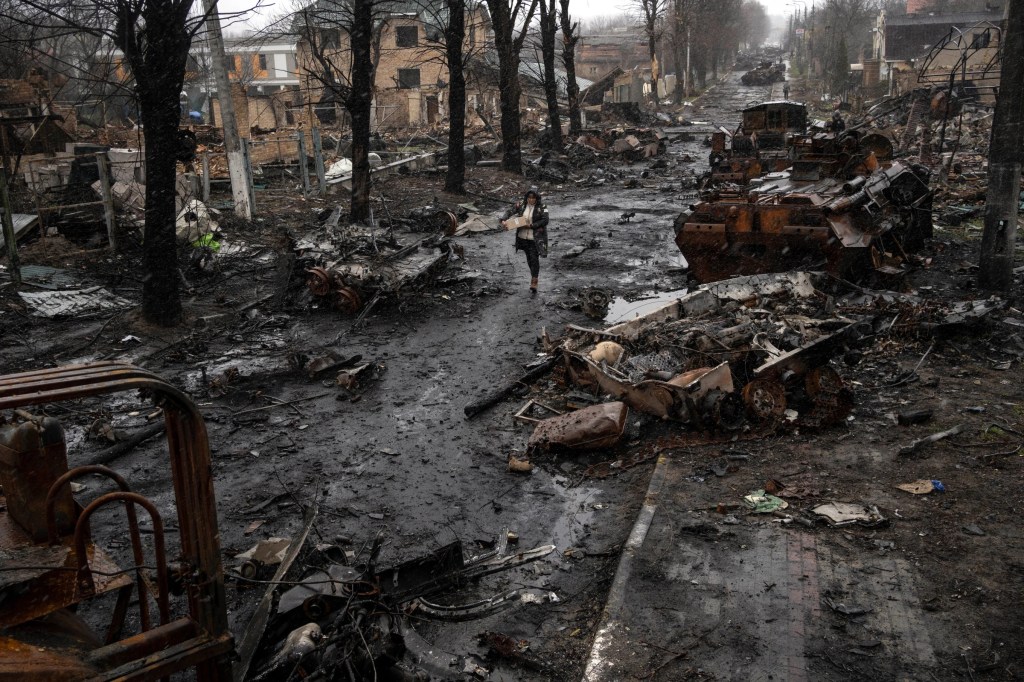
When Russia illegally annexed Crimea and started the War in Donbas by covertly funding and directing militants in the Donetsk and Luhansk regions, the West refused to deliver support to Ukraine’s resistance efforts and responded with weak sanctions again. It was only when Vladimir Putin was bold enough to order the invasion of Ukraine in 2022 with the intent to take control of the entire nation that the West would get involved.
Chechnya would be a grim teaser for the horror show on the frontlines of Ukraine.
Vladimir Putin felt that Russia was humiliated by the fall of the Soviet Union and loss of its influence, the West’s superiority, and Boris Yeltsin’s embarrassing behavior. As a result, Russia launched a coordinated campaign of disinformation and disruption against the West, especially the United States. Starting with the lead-up to the 2016 presidential election, and continuing to the present day, Russia has been undertaking a concentrated effort to interfere in American society by funding political candidates, spreading disinformation on social media, and other avenues.
The Republican party of today is a far cry from the days of Ronald Reagan. In the 1980s, opposition to the Soviet Union was a priority of the President’s agenda. Today, American aid for Ukraine has been held up by the Republican party in Congress. Supporting a nation fighting for its own freedom and democracy should be the paramount concern of the United States. Especially to those who claimed to be the most fanatical anti-communists and opposed to a world order dominated by the whims of Moscow.
A House Divided
After 9/11, America saw the rise in a very clear ‘Us or Them’ mentality in America. These issues which were previously the subject of national debate had become the subject of national screaming matches. The Tea Party movement laid the groundwork for the modern mainline Republican party. Longtime conservative members of congress faced primary challenges from the Tea Party, and the Tea Party won. Respected conservative lawmakers were beaten by people who showed less fidelity towards the foundations of this republic and more towards ideologues and vague ideas about ‘small government.’ This laid the groundwork for today’s Freedom Caucus, and the dangerous and divisive political rhetoric they’ve been espousing.
After 9/11, crimes were committed against Muslims in America for the simple fact that they were the same religion as the attackers. Sikhs were also targeted in revenge attacks taken by vigilantes, despite being from a region of the world thousands of miles away from the homelands of the hijackers. Islamophobia was encouraged by many across America. It would be used as an excuse to cut back on immigration, demonize immigrants, and tighten the restrictions around people coming here legally. Liberals and conservatives differ sharply in their beliefs regarding immigration. Immigration has become one of the wedge issues dividing the nation. Even George Bush is now in favor of gentler solutions compared to the modern GOP mainline.
Illegal immigrants have been demonized to the point of abhorrence, while legal immigration becomes harder and harder. It is deemed acceptable for an individual to demonize someone who comes to this country illegally to flee violence and terror. It’s one of many instances of the values practiced by American history – America being known as a nation of immigrants – are overturned in the modern age. It was seen as acceptable to separate families at the border under the Trump administration. A judge recently blocked the policy from being reinstated on humanitarian grounds.
Immigration is among the largest wedge issues facing the country today, and the state of the debate around immigration is a result of the War on Terror. Other wedge issues include civil rights for minorities and members of the LGBTQ community, economic policy, living and housing costs, and foreign aid. However, the largest issue faced in America is not on a policy position but is a lack of trust and cooperation between sides of the political divide. At one point, this may have been a rift which could be mended. In current times, the fissure is much harder to mend.
For the entirety of American history starting 1776 until 2021, America practiced the peaceful transfer of power under elected leadership. It was a phenomenon that only some established nations practiced at that time, and America doing so successfully would model it for other world powers in the years to come. Even during the American Civil War, the United States maintained its peaceful elections, with the Confederate States simply not taking part in the election of 1864 as they were attempting to illegally secede from the Union. That long tradition of the peaceful transition of power between rivals would break when supporters of Donald Trump stormed the Capitol building on January 6th, 2021, in the worst attack on Washington DC since the War of 1812. January 6th was an attempt by Donald Trumps’ supporters to overturn the results of the 2020 election, which saw Joe Biden win the presidency.
With a failure to install Donald Trump as leader on January 6th, the conservative movement in America pivoted towards reelecting Donald Trump legitimately, and then doing away with all checks and balances, and ensuring that he gets to keep the powers of the president permanently. Project 2025 is an attempt to destroy America’s government from within, and shatter the foundation of the republic. To say this is the greatest danger to global stability outside of Russia’s war against Ukraine is an understatement. The potential for a civil war in a nuclear power presents a danger for the entire world. America has the most powerful military across the world and serves as a moderating power in multiple potential conflict areas, such as the border between the Two Koreas or the Taiwan Strait. Shattering the unity of the United States not only enables a would-be dictator like Donald Trump to seize power, but it distracts the might of the American economy, society, and military from focusing on other areas overseas. The question everyone must ask when faced with severely troubling situations is “qui bono?”
Translation: Who benefits?
Freezing the Water in the Cracks
Russia could never hope to take the United States in a fair fight. Which is why it felt for the cracks, such as immigration, poured water inside, and waited for them to freeze. This is not to say that Russia manipulated America so thoroughly to create these wedge issues. They existed for years, and slowly pushed Americans apart. Much of the process was accelerated by the War on Terror, and the struggles faced within. It was these preexisting issues which Vladimir Putin’s Russia was able to capitalize on. Partially in revenge for the Cold War, partially as a practical way to help secure his long term goals, Putin’s efforts in undermining America was one step in a decades long plan to secure Russian dominance after the Soviet Union was relegated to the history books.
After the Cold War, America was fairly unified and peaceful. It was concerning that Ronald Reagan courted the evangelical Christian movement, which has led to a much more intimate connection with today’s right wing nationalists. Other situations, like the Bill Clinton/Monica Lewinsky scandal focused the nation’s attention, even as prominent critics of Clinton showed their own hypocrisy, such Newt Gingrich condemning Clinton’s moral character over infidelity while also cheating on his own wife. Overall, however, the country was unified in peace, optimistic for the future, and grateful the world didn’t end in a nuclear firestorm.
Russia, however, did not have such a bright decade in the 1990s. Boris Yeltsin was originally a leader who could have brought about change to Russia, but quickly realized the unsavory position he was in. Instead of safeguarding the fledgling Russian democracy, Yeltson sold out to the new oligarchs in order to entrench his position in power. The result was a Russian society dominated, not by a government of its people, but by a government of its richest shareholders. Yeltsin centralized power in 1993 during an attempted coup d’etat over his supposed overreaches. His health deteriorated, Russia stagnated as a nation, and he resigned December 31st, 1999. Prime Minister Vladimir Putin became the Acting President of Russia to usher in the new millennium, and then would be elected President a few months later. Yeltsin would die in 2007.
Putin began his career in the notorious KGB, the internal security and foreign intelligence service of the Soviet Union. A spy by trade, Putin tended to solve problems in a roundabout way, obscuring information and seldom taking the direct route on anything. As his power and influence grew within the post-Soviet Russia’s political establishment, he became more unabashed in controlling the nation, routinely having journalists, political rivals, and other troublesome individuals killed. Putin deeply resented the United States for winning the Cold War and wished to see a return of Russia’s influence to the days of the Soviet Union.
Putin, however, is no communist. He believes the might of the Soviet Union should be exercised in the manner of the Russian Empire which came before it. Ukraine’s territory in Crimea – home of the Black Sea fleet and the only warm water port Russia has access to – is necessary for Russia to hold onto its military influence. The rest of the nation produces a great deal of agricultural products. Ukraine was known as the breadbasket of Europe, and Moscow’s loss of direct control over Ukraine’s food output meant that they had a harder time feeding their own citizens. On ethnic grounds, Ukraine was the birthplace of the Kievan Rus, the predecessors of the modern Russians. To Putin, not controlling the Russians’ ancestral homeland is an affront to Russia’s national identity. The Romanov Empire was an outgrowth of the Kievan Rus’ kingdoms, so Ukraine not answering to Moscow (or Saint Petersburg in the Romanov era) for the first time in hundreds of years is a source of irritation for Putin.
Dictators don’t think in years, they think in decades. Putin has long dreamt of uniting Ukraine under the Russian tricolor and taking its land and resources for Russia’s gain. Supporting political division in the United States was a way to grant Russia a more favorable situation for its invasion of Ukraine. A weakened NATO, and a United States reluctant to send military aid due to political infighting would make defeating the Ukrainians easier.
Russia launched a coordinated disinformation campaign against the United States to further its own agendas. Putin took advantage of the United States’ existing political divides to further divide the nation. A house divided against itself cannot stand, and Vladimir Putin banked on that occurring in the United States so that he could execute his own agenda unabated. These efforts enabled people like Donald Trump and his ilk to further divide America. Russian disinformation efforts continue to weaken American support for Ukrainian President Volodymyr Zelenskyy.
The shape of the world today, and the problems facing America have their roots in the end of the Cold War, and the War on Terror. America’s division had never been as pronounced since the Civil War, leaving fertile ground for outside actors with their own agendas to take revenge and distract from their larger goals. Fears over nuclear war have reignited. On the day this article was written, May 21st, 2024, Russia began drills for the use of tactical nuclear weapons near the Ukrainian border. The United States is in the middle of its most contentious election ever.
It’s not hyperbole to say that these are some of the most dangerous times ever faced by mankind. The nations with the two largest arsenals of the most dangerous weapons ever created are Russia and the United States. Both are suffering from severe political instability and are at the center of the world’s attention. Permitting Russia to take over Ukraine shatters the idea of national sovereignty and diplomacy which has shaped the world since the end of World War II. The United States going to war against itself over its internal divisions could spell the end for the world order as it stands today.
The world awaits with bated breath to see which domino shall fall next.
The Child is Grown, the Dream is Gone
My parents grew up with nuclear war as the largest threat. Both major political parties in America were dedicated to the cause of preventing a nuclear war, or at the very least, winning one against the Soviet Union. I was born into a world of unparalleled optimism after the USSR fell apart, the Iron Curtain disintegrated, and freedom set in across Europe. That came crashing down at the same moment the Twin Towers did when I was three. By that point, American interventionism was expected. It was our duty to keep the world safe. Furthermore, we were attacked “for our freedom” they claimed. We justified invasions and other military actions under the guise of keeping us safe. Perhaps they were done for the right reasons using the wrong methods. More than likely the world would have been in better shape had we just stayed at home.
I think today we’re facing a lot of threats from different origins. The best way we can navigate this difficult and uncertain time is to think about where we’ve come from, and what we could do better. America’s division gave our adversaries an opening to further wound us and push us down the path of self-destruction.
I grew up in an America increasingly at odds with its stated vision and ideals. But I believe, deep in my heart, that we can overcome this as a nation. We’re in a difficult period of our history, ruled by fear and paranoia rather than empathy and reason. I think we have to reckon with our own sins, at home and abroad, and take action to make things right.
I was raised to believe that America was the greatest country in the world because we did everything better than anyone else. I think that the dream of that America isn’t quite reflective of reality. I do think, however, that the dream of an America which acts with purpose and integrity in righting its wrongs is well within our grasp.
I am the child of two shadows: the shadow of the grave of the Cold War, and the shadow of the smoke at Ground Zero.
In order to create shadows, there must exist light as well.
Part II: The Growing Sandstorm



 Ark of the Lost Angels
Leave a comment