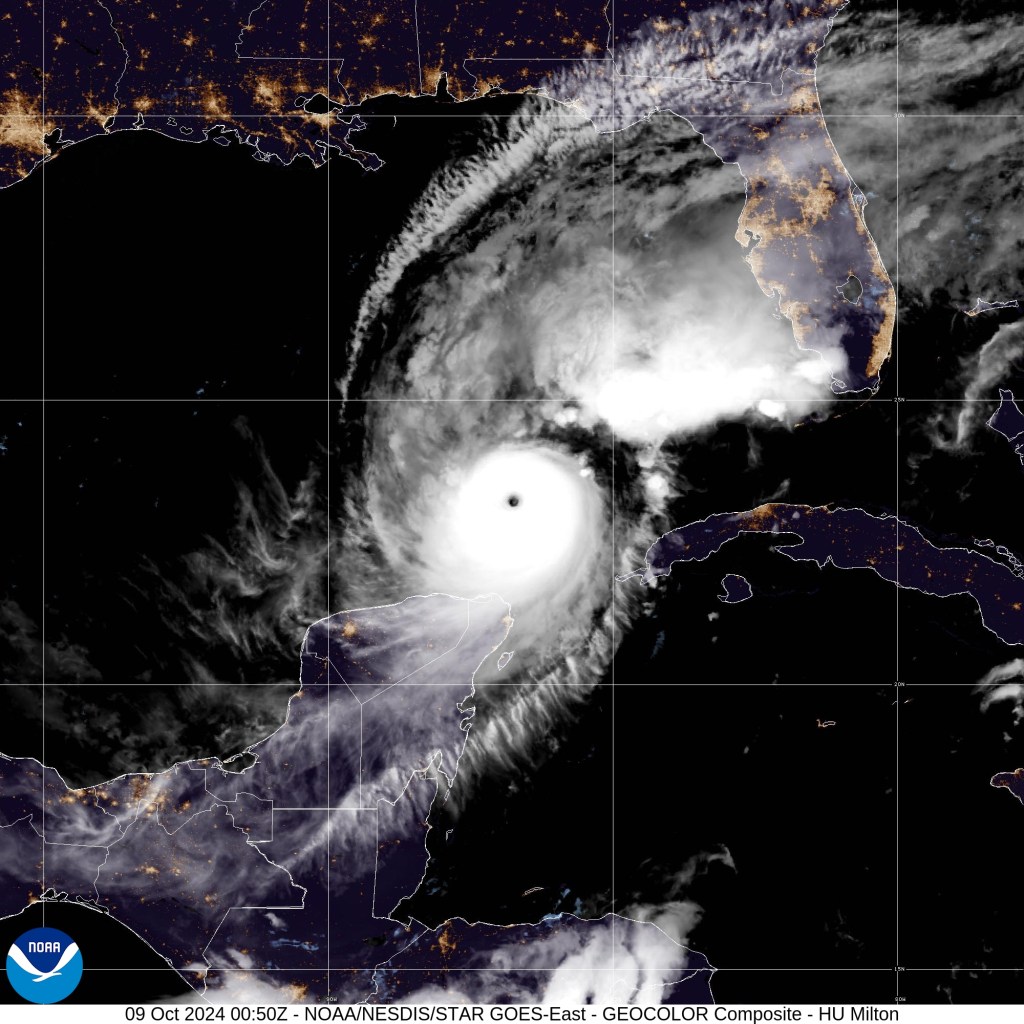
Hurricane Milton from the GOES Satellite (Credit: NOAA)
Climate Change has been dismissed as a hoax or unimportant for years, and it’s disaffected a generation.
Hurricane Milton is bearing down on Florida, ready to make landfall tomorrow. It is one of the most devastating Atlantic hurricanes ever seen, coming mere days after Hurricane Helene demolished parts of Florida, Georgia, and the Carolinas. The increasing frequency and intensity of these massive storms is one of those factors contributing to the sense of frustration in younger generations over climate change.
The first big hurricane I dealt with was Hurricane Isabel when I was very young. I remember sitting on the faded and dirtied white carpet of my living room, back pressed against the medium blue couch we used to have, playing with toys next to my parents as they watched the news on a big bulky Panasonic television we used to have and the rain beat against the window with an intensity I had never experienced before.
All in all, we weren’t affected by Isabel too badly in my area. A few short years later, when I was more aware of the world, I watched Hurricane Katrina hit New Orleans. While I was a kid, I understood part of what was going on.
Having gone to New Orleans a few years ago, I was granted insight into how bad the city was affected by the flooding once the levees broke while a cab ride came with a driver who explained the streets in the French Quarter which were completely submerged on our drive after picking me up from my hotel. Streets which, at other points of my trip, I was walking down on my way to listen to live jazz at a bar after dinner or get beignets from Café du Monde at 1:30 in the morning.
My more direct experience with a bad hurricane came while I was in high school, when Hurricane Sandy truncated which was already planned to be a four day school week into a two day school week. I sat in my house as the rains beat down. I remember seeing pictures on the news and across social media of the state of New York City. Streets I had seen just a year before on a trip up were flooded, entire metro stations were totally washed out. On the Jersey Shore, where I would end up going many times starting a few years later after making a close friend who lived there, the boardwalk was completely mangled for miles down the coast. The rebuilt boardwalks which I have walked on myself now.
The storms get worse. They get more frequent. We’re told it’s just the cost of living here.
My whole life, the idea of climate change has been a significant part of public discourse. And much of it has been dismissive of the very idea. Yet, the number of “unprecedented atmospheric events” keeps rising every year. I used to see white Christmases every so often, and at least one or two good snowfalls each winter, usually in January or February. Now, I’ve lived through Christmases that had weather better suited to Bermuda shorts and t-shirts than warm boots and sweaters, while I’ve seen significant snowfall on Easter. Summers are hotter, and last longer. The “occasional” rainstorm which lasts a week or so now happens once every three to five weeks. Droughts and floods are happening more often in different places. California has had a massive wildfire problem every year. Canada was so dry last summer that they had wildfires which made New York City look like something out of a post-apocalyptic wasteland with a sinister orange haze engulfing the entire city, and residents advised to not go outside for major health concerns.
My whole life, the “unprecedented” has become shockingly normal. I’ve watched the changes in patterns happen right before my very eyes, and yet I am still being told that climate change is a hoax.
Science is inexact, because the world is complicated and intricate and difficult to understand. However, science is based on empirical evidence. Ricky Gervais once summarized in an interview that if we were to destroy every copy of every holy book, or every piece of fiction, those stories would come back in a thousand years, but they wouldn’t be quite the same. Whereas, if we destroyed every record of every scientific fact, in a thousand years, they’d be back exactly as they are now. It’s based off of empirical data that can be tested and tabulated and observed.
Many people in religious spheres debase science as a contradiction of their faiths. Religion is just that, faith. It is unable to be tested. While any holy book may be seen as the divine word of a deity, they are still interpreted through the minds of man. Humans have agendas, and in the eyes of many world religions are imperfect. The holy books are, in many ways, merely stories passed down from generation to generation, given power through their influence. Who is to say if these stories, with claims of things unable to be proven, truly happened the way it is said they happened? Who is to say that the stories within these holy books are more than just stories? That is not trying to discount religion or mock people who believe. Faith is a place where many people derive their inner strength, balance their emotions, and guide their morality. Faith does not, however, provide scientific answers to questions as to the workings of the universe. Holy books are based on stories, not recorded facts.
Therefore, equating religion and science is an infuriating folly. With religion becoming increasingly intertwined with politics, the opposition to science on religious grounds is becoming opposition on political grounds as well. And that is not to take into account the pure partisanship that other opposition to science comes from.
Science is seldom politically expedient, but it is the expression and analyzation of facts as we best understand them this moment. Much of science is based off of methods to test and confirm or disprove hypotheses in an effort to further understand the world around us. Data is collected and the details of experimentation are collected, recorded, and made available so that the data may be checked by independent scientists conducting the exact same experiments.
The leading climate scientists tell us that the earth is experiencing massive changes in the atmosphere, and it could potentially be catastrophic for human life sooner than expected. There are ripple effects at play. The lack of drinkable water brought on by the saltwater oceans flooding freshwater sources will mean shortages and death. The destruction of arable land means lack of food and death. The displacement of people whose towns turn into diving attractions will overtax the areas not directly affected. The lack of resources will spark conflict over what remains and bring even more death.
Human industry is a gigantic, inspiring thing. However, the planet Earth is the only planet which humanity has settled. Whatever the mystery of creation, as the dominant species of the planet, we are charged with its upkeep and care. I will not see a terraformed Mars in my lifetime, but I could see massive changes to the ecosystem.
My generation feels like we’re fighting a war we’ve already lost. Large companies pollute the environment on a massive scale, but we are charged with bringing down our carbon footprint by recycling our plastic bottles and using paper straws. Meanwhile, the situation continues to deteriorate. More animal species are going extinct. The rainforests are being cleared for farmland or housing developments, while the CO2 in the atmosphere grows greater, and further damages the air we breathe. The polar ice caps are getting closer to melting which will drown significant portions of the population and kill scores of animals.
My generation has seen the science and evidence-based policies which would preserve our environment and take care of the Earth we live on get ignored or shot down in favor of blunt ignorance because of the argument that “God said the world works this way.” The facts are ignored because of politics, when facts are above politics. Critical thinking is required to navigate the world we live in. Faith is a good moral guide in many ways, but in terms of dictating legislation, it’s best to let the empirical evidence do the talking and chart the best way forward.
Economics is a human game. Manufacturing is a human game. Crime and punishment is a human game. Movement of people across borders is a human game. The world we live in is unfortunately not. And we owe it to ourselves and our children to ensure the planet is at its best, and that we are doing our best to live in harmony with nature.
I have grown up in a generation resigned to losing global treasures of nature like the Amazon Rainforest or the Great Barrier Reef we were told about because humans are acting in shortsighted ways with regards to the environment. The war for these things was decided decades ago, before we had a voice we could use. Now we’re reaping what our parents and grandparents have sown, and it’s depressing to see the beautiful natural world around us slip away before our very eyes.
Hurricane Milton, which is currently bearing down on Florida, is one of the most powerful Atlantic hurricanes ever recorded. Many of the hurricanes above Milton on the list of most powerful hurricanes have come after 1950, and many of the ones shortly below it have come after 2000. Unprecedented atmospheric and environmental events like his are happening with such a scary frequency that only seems to grow more intense and frequent. Yet we are told that we don’t need to do anything, large companies cannot be expected to affect their profit margins so drastically to achieve environmental preservation goals, and other excuses for inaction.
I don’t know if I have a point here today other than it’s a tragedy what’s happening to our planet, and we are to blame, and we could just fix it if we set aside our ego and greed. The future we have to secure is not just our own, but planet Earth’s as well.

 Ark of the Lost Angels
Leave a comment