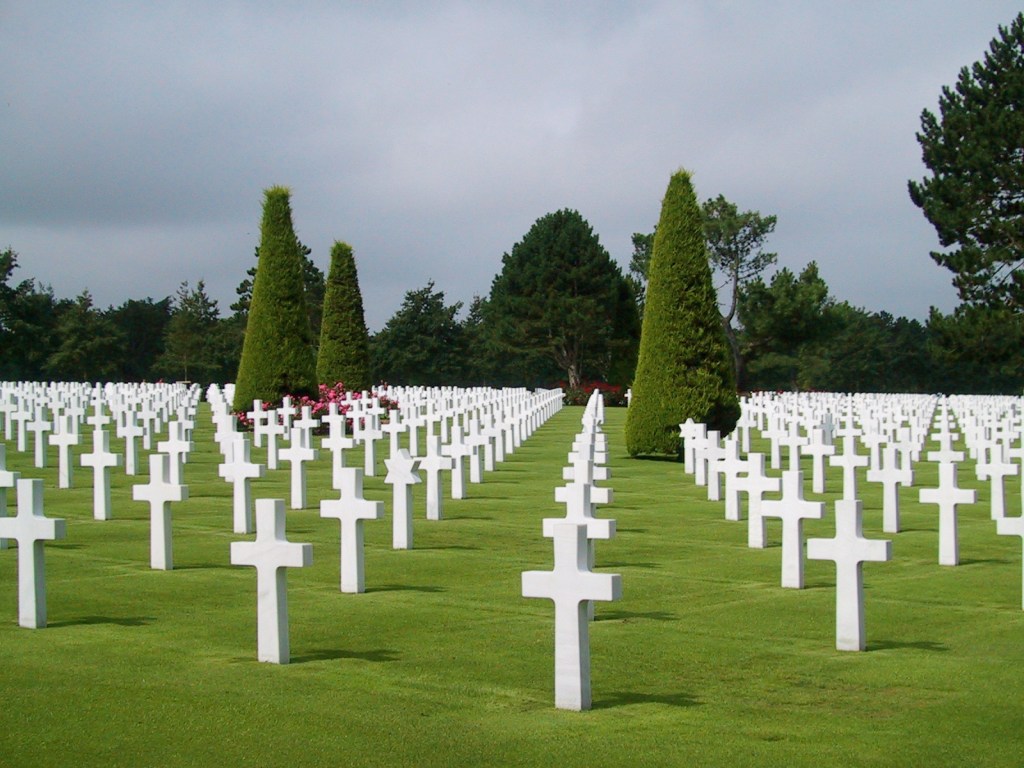
Graves at the Normandy American Cemetery and Memorial (Credit: Wikimedia Commons)
World War II ended eighty years ago. It taught us lessons we are forgetting.
Next week will mark eighty years since the end of World War II. It’s been eighty years since the Atomic Bombs were dropped on Hiroshima and Nagasaki. Eighty years since Europe was torn asunder. Eighty years since every corner of the globe was asked to sacrifice in service of a pointless war.
In these last eight decades, the world has begun to forget the great sacrifice of a generation which was supposed to have stopped major conflicts forever. The war reshaped the globe. Yet eighty years later, we have forgotten the lessons and repeat humanity’s greatest mistakes.
The World Between Wars
In 1914, long-simmering tensions throughout Europe would explode when a Serbian nationalist group backed by the government assassinated Archduke Franz Ferdinand II of the Austro-Hungarian Empire. Austria-Hungary demanded restitution from Serbia, which refused. So as those two nations declared war on each other, their allies soon joined the fray and Europe quickly mobilized into an all out war. The Central Powers of the German Empire, Austria-Hungary, and the Ottoman Empire sided together against the Allied forces led by Great Britain, France, and Russia. After four years of bitter fighting, revolution in Russia, and the entry of the United States on the side of the Allies, the war would come to a close.
Over the summer of 1919, the Treaty of Versailles blamed the war squarely on Germany, and put harsh penalties onto the Empire. Losing much of their territory, being forced to disarm, and pay horrendously steep reparations to the Allies, Germany was singled out by its longtime geopolitical enemies in Europe for this humiliating treatment. History as written by the victors would cast Germany as a would-be conqueror of Europe that was stopped by the Allied forces’ valiant efforts and tremendous sacrifices.
Russia would oust the ruling Tsar, Nicholas II, in February of 1917. The Bolsheviks, led by Vladimir Lenin, would overthrow the provisional government that October. This sparked five years of civil war which ended in 1922 with much of the former Russian Empire’s territory coming together as the Union of Soviet Socialist Republics.
With the Ottoman Empire already on its last legs at the outbreak of war, and the British victories in the Middle East, the ‘sick man of Europe’ finally collapsed, birthing modern day Turkey and many other nations out of the former Ottoman territory as the years marched on and things stabilized.
Austria-Hungary would suffer a similar fate. The Habsburg dynasty which had ruled Austria since 1282 finally lost its grip over the dual kingdom. A worsening food crisis, a war which the empire could not win, and nationalist secession movements finally toppled another empire.
By far the most impactful would be Germany. In 1871, the various German states were united. In 1919, Germany lost much of its territory birthing nations like Poland and ceding territory to France. The Kaiser was ousted in a revolution and a weak republican government was established. Germany would be defined throughout the 1920s with a general malaise across the population. The German economy was on track to recover until the 1929 Wall Street Crash cratered the global economy, which destroyed the already fragile German economy. As a result, the population became bitter, desperate, and angry.
That bitter, desperate anger would propel an Austrian man who fought for Germany down a path which threatened to burn the world.
Adolf Hitler rose to power in Germany through fear, intimidation, and lies. A veteran of The Great War, Hitler felt that Germany was treated unfairly in its aftermath. He whipped up a public frenzy, and by 1923, led a march on the governmental buildings in Munich with the intention to take over. He was imprisoned but released shortly thereafter. By 1933, he would seize ultimate power in Germany and plunge the nation into war.
The National Socialist German Workers’ Party rose from the various right-wing nationalist groups disaffected by the end of WWI and the harsh times in Germany. They believed that Germany was stabbed in the back by traitors within (a notion which history emphatically refutes), and that the worst thing to happen to their glorious nation was to become Communist like Russia to the east. When Hitler joined the Nazi party, his fiery speeches turned a relative footnote into the dominant power in German society and politics.
In particular, the Nazi party rested on a hatred for the Jewish people, and the idea that ethnic Germans deserved more living space which would be acquired by any means necessary. They opted to take political power within Germany legally. From 1925 to 1933, the Nazi party undertook a massive series of campaigns. Hitler’s followers used modern technology and the frustration of the Great Depression to win elections in the Reichstag and absorb other right wing groups.
Once being voted into absolute power in 1933, Hitler shredded the Treaty of Versailles. He rearmed Germany, created booming new industries, and brought his nation out of financial ruin. Germany began taking more territory by force, or rather, the threat of force. In the late 1930s, Hitler’s Germany signed a pact with the Soviet Union headed by Josef Stalin. This secret pact outlined how to partition Poland between the two nations and was a promise of non-aggression. A promise both Germany and the Soviet Union knew they would both break.
In 1938, Germany annexed Austria and parts of Czechoslovakia were willingly handed over in the Munich Agreement. British Prime Minister Neville Chamberlain called the agreement “peace for our time” but was secretly preparing Great Britian for war. Giving Hitler what he wanted in the short term bought time to relocate industrial facilities out of range of Germany’s new air force and ramp up production of planes and other material needed for the inevitable war.
The World At War
On September 1st, 1939, Germany invaded Poland, sparking World War II. This would envelop other conflicts, such as the Chinese Civil War and the Japanese territorial expansion, which had been going on for years beforehand. Japan, eager to expand its empire for resources, was conquering islands all over the Pacific and engaging in open warfare in mainland Asia. China, which had already been undergoing its own civil war, struggled to repel the invaders. Germany approached Japan about a potential alliance.
Germany’s invasion of Poland caused Europe to become agitated. France prepared for war, having spent the period between wars constructing a series of defensive fortifications. Germany avoided them by invading through Belgium, causing the British to declare war on Germany. The Nazis pushed rapidly through most of Europe, defeating Belgium, France, and occupying most of the territory between Poland and the Atlantic. In 1941, with Western Europe a non-issue, they invaded the Soviet Union in a surprise attack and pushed all the way to Moscow.
On December 7th, 1941, the United States was attacked by Japan. The Imperial Japanese Navy launched a surprise attack on the US Navy facilities at Pearl Harbor in Honolulu. America was outraged and declared war on Japan immediately, with Germany declaring war on the United States in turn. Between 1942 and 1945, the United States moved from island to island across the Pacific, capturing territory from the Japanese and moving closer to the home islands. In Europe, Allied invasions in Italy and France gave Britian, the United States, and their allies staging grounds to free territory and move towards Germany. The Western Allies pushed in from the West, and the Soviets pushed from the East, and Adolf Hitler was trapped in his bunker in Berlin with no way out. So, he shot himself. His successor, Admiral Karl Dönitz, surrendered a few days later. Nazi Germany was no more.
In the Pacific, the Japanese had been fighting to the last man. Bitter, barbaric tactics were used by both sides to control every island the Japanese had set foot on. Every inch was paid for in blood. The Americans had been secretly developing a nuclear weapon under the belief that Germany was building one as well. While the first successful test came after Germany’s surrender, Japan was fighting a losing battle as America came closer but showed no signs of surrendering.
The prevailing wisdom of the time was that a total invasion of the Japanese home islands would cost upwards of a million lives. The civilian casualties would be catastrophic, and the nation would be devastated by the fighting. The pride of the Japanese made surrender an impossible idea in the minds of the military leadership. Only when Hiroshima and Nagasaki were destroyed in August of 1945 by American nuclear weapons did Japan realize they would be unable to continue fighting.
On September 2nd, 1945, the Japanese signed an unconditional surrender on the USS Missouri in Tokyo Bay. Six years and one day after the war began, the most devastating conflict in human history was brought to its end.
The Post-War World
The world sought a massive realignment. The British Empire, which had ruled over a massive portion of the globe for centuries, granted more of its protectorates their independence in the years following the war. The United Nations was founded as a diplomatic forum so that all nations could come together and air their grievances instead of resorting to violence.
The war was so horrifying and traumatic on a global scale that it affected the political decision making for decades. As the war fades more and more from living memory, its lessons are heeded less and less.
The Holocaust, Nazi Germany’s systematic attempt to exterminate Jews, forced the world to define genocide in the wake of the war. The international tribunals which held surviving Nazi leadership to account for their activities during the war used the Holocaust as a large reasoning for the execution or life imprisonment of Nazi leadership. A new Geneva convention was established to lay down acceptable rules of warfare even as the world tried to find better ways to avoid fighting wars entirely.
The United Nations was founded as a diplomatic forum for nations to be able to communicate. As the power of global logistics grew, so did the idea that global trade could help stop wars. By building strong relationships between nations, statesmen of the time flocked to the idea that two countries reliant on each other would ever start shooting at one another was unlikely. The alternative was reliving a gruesome war that scarred every generation and killed far too many people.
As part of this increased diplomatic push, there was greater emphasis placed on respecting national sovereignty. Changes to borders could happen after the war with the consent of nations, but not due to outside influences. It was up to the powers of the world to safeguard this right of determination for all nations. This was seen early on with the Korean War, where the communist North Korea and anti-communist South Korea were vying for control over the whole peninsula. An early action of the United Nations Security Council, a UN coalition of nations arrived to assist the South Koreans and pushed the border back to the 38th parallel where it remains today.
Unfortunately, as the Cold War continued on, respect for national sovereignty would more often be ignored. The United States had all of its industrial capabilities out of range of Nazi Germany and the Empire of Japan during the war, therefore had the economic capital to become the world’s dominant superpower. The Soviet Union having moved their manufacturing facilities east of the Ural Mountains and out of range of the Germans were able to recover relatively quickly.
However, both superpowers would engage in neo-colonialism soon thereafter. The United States maintained military presences in bases all over the world as it attempted to contain the Soviets. The United States spearheaded the North Atlantic Treaty Organization (NATO) as a defensive alliance to formalize American protection of Western Europe in the event of a Soviet invasion. Many Western European nations accepted money to rebuild from the United States under the Marshall Plan.
On their part, the Soviets would take land in Eastern Europe both for themselves or to run as vassal states. After the surprise German invasion in 1941, the Soviet Union marched back across Europe once the tides had turned. The Baltic States of Latvia, Lithuania, and Estonia were forcibly integrated into the USSR by the end of the war. Moldova had been annexed earlier in the war as part of an occupation of parts of Romania. In Romania proper, as well as Poland, Czechoslovakia, Hungary, and the formerly Soviet occupied area of Germany, the USSR coerced the adoption of communist governments. Yugoslavia was also communist, but under Josip Broz Tito. Tito led the Partisans as resistance to the German occupation during the war and would break from Stalin afterwards despite Yugoslavia officially remaining communist. Yugoslavia would lead the unaligned movement during the Cold War of nations who did not side with either the United States or the Soviet Union.
The effects of Soviet colonialism across Europe are still being felt, with the Eastern European nations seeing political issues from their communist histories. These nations have suffered more economic problems without the prosperity afforded to the western nations. The fall of communism and end of the Cold War set in motion events which still shape the world’s path today. While these problems were not foreseen in their time, neither was the issues of America’s global interventions. Now, many western nations find themselves militarily relying upon an unstable and openly hostile country no longer aligned with their goals.
The two superpowers would continue to flaunt the idea of national sovereignty by backing coups in various nations to strengthen ties across the globe. Soviet military personnel flew MiGs during the Korean War on the side of North Korea while Soviet advisors would support the communist North Vietnamese against the alliance of South Vietnam and the United States during the Vietnam War. The United States backed coups in Iran in 1953, Guatemala in 1954, and fully invaded Grenada in 1983 to topple communist-leaning governments. The Soviets invaded Afghanistan in 1979 after multiple coups and revolutions. The heavy-handed nature of their erstwhile ally leading the nation and attacks by Islamic extremists were used to justify the assassination of the President and a full-scale invasion to restore stability to the country on their border. This kickstarted the Afghan conflict still raging today.
The idea of the powerful nations of the world involving themselves in the affairs of other nations to protect national sovereignty on a more universal front would not occur until 1991, over a year after most communist governments were ousted and a few months before the Soviet Union dissolved. Saddam Hussein, President of Iraq, ordered an invasion of neighboring Kuwait to claim its oil reserves. A massive UN Coalition set a deadline for Saddam’s army to leave Kuwait or risk invasion. The Gulf War kicked off with a month-long aerial bombardment of Iraqi positions in both Iraq and Kuwait before a 100-hour ground invasion ejected the Iraqi army from Kuwait. The Coalition stopped at the border and withdrew, their mission a success. This would be the clearest example of the global agreements put in place after World War II being fulfilled.
The use of the nuclear weapons in 1945 remains a hotly contested issue. Japan has a complicated legacy in particular. However, the use of nuclear weapons achieved the end of the war, which was the goal in the short term. With the atomic bombs dropped on Hiroshima and Nagasaki completely devastating the cities and killing upwards of 200,000 people, nuclear weapons became a hotbed issue of the latter half of the 20th century. Once the Soviet Union, Great Britian, France, and China all developed nuclear weapons, the idea of Mutually Assured Destruction worried global leaders. With the USA and USSR facing off, the idea that one hair trigger pull between the two superpowers could destroy the whole world forced the nuclear powers to the table in pursuit of non-proliferation.
The Treaty on Non-Proliferation of Nuclear Weapons came into effect in 1970. The United States, Great Britain, France, China, and the Soviet Union were all signatories. Russia took over the USSR’s nuclear arsenal upon the Soviet Union’s dissolution in 1991 and remains part of the treaty. The only modern nuclear states, which include India, Pakistan, Israel, and North Korea, have all refused to join this movement. South Africa voluntarily dissolved its nuclear program and joined the treaty.
During the Cold War, multiple treaties between the United States and Soviet Union would limit the numbers and types of nuclear weapons being developed. Further treaties after the collapse of the USSR and end of the Cold War would dramatically reduce the nuclear armaments in both Russia and America.
However, nuclear non-proliferation is in jeopardy because of the world’s refusal to safeguard international security and territorial integrity of nations across the globe. Ukraine was pressured into relinquishing the nuclear weapons within its borders after the breakup of the USSR. In response, Russia signed an agreement not to invade and the Western powers agreed to assist Ukraine in its territorial defense because it gave up nuclear weapons. None of these agreements were binding, and in 2014, Russia invaded Ukraine’s eastern regions and annexed territory while the world sat and watched. In 2022, at the onset of Russia’s full invasion of Ukraine, those agreements were broken without ramifications. If nations feel like the international order will not protect their sovereignty, then they will seek the means to secure their own security. Withdrawals from the nuclear non-proliferation agreements seem likely.
The right wing has seen a dramatic resurgence in recent years, both in the United States and in Europe. With so much power centralized during and after the war by Stalin’s government, the Soviet Union did run as much more of a dictatorship than it prided itself as. In post-Soviet Russia, the situation was ripe for the taking by an aspiring tsar. And in America, Hitler’s rise to power has been echoed by Donald Trump’s. A disaffected movement of people without respect for the current system got themselves elected in support of a unifying figure and granted that figure all of the power they should have reserved for themselves. In abdicating their authority, they abdicated their responsibility to check the power of any one individual and respect the will of the people.
The result is a frightening echo of Hitler’s Germany. A nation more focused on appearing strong than true strength. A country willing to spurn and burn longtime allies because it believes it has a mandate for rule by strength. A set of voters willing to believe disinformation and misinformation and willing to take up arms against a government working as intended because they are directed to. A regime believing itself to be the rightful rulers and willing to destroy anyone who stands in their way, especially the group they have demonized and blamed for all of society’s problems. A regime which entrenched itself on false promises and the willingness to dispose of anyone which might threaten their power, no matter how useful they were. A regime built off of the hate, which encourages and feeds off the hate of its own population.
That is the legacy of the greatest war the world has ever seen. For its mistakes to be repeated, and its sins to mar another generation.
For every brave and valiant story told of the war, there are a million more which remain in darkness. From the men of Easy Company, to every victim of the Holocaust like Anne Frank, to every survivor of the war which took place far away or destroyed their house, the war drew ugly marks on the entire world. Every family sacrificed, every place was marred, no one and nowhere were safe. Yet, here we stand, generations later, long after those who could speak of the hell they endured in their villages or caked in mud and blood on some foreign shores far away have almost completely passed on, we have forgotten the sacrifices they made. We have forgotten the lessons those sacrifices were supposed to teach us. We repeated the world which took so much from them because we were too stubborn to learn.
Have we learned from our sacrifices? No. We have not. We have repeated the mistakes of our grandparents and our grandparents and our great-grandparents. We have made their sacrifices mean absolutely nothing in the face of a world which looks so similar to the one they gave everything to avoid. We are among the last who have heard their stories firsthand. It is our responsibility to not only keep those memories alive, but to learn from their bitter lessons.
My great-grandfather was among the first to liberate the Dachau Concentration Camp in 1945. The man he became after witnessing those horrors was difficult for his family to live with for the rest of his life. It profoundly warped who he was as a person. His is not the only such story. If a war is so horrendous that the survivors suffer perhaps more than some of the dead, who are we as a global society to not have heeded these lessons? Israeli cruelty in Gaza, the governmental dehumanization efforts against immigrants in America, the rise of right-wing extremism in places like Poland, France, Italy, and Germany are all signs that we have not honored the sacrifices of a generation nearly enough.
The world has moved forward. The UN does an immense amount of work across the world with its aid organizations. The war in Ukraine is the largest land war since the end of World War II and it is predicated on the imperial dreams of a petty tyrant. Global technology has brought everyone closer together, both emotionally and physically. Perhaps the world the survivors of World War II envisioned is farther from reality, the aspirational goal. Our responsibility now must be to steward the world towards that goal, and to keep the torch of progress. To never forget the victims and the villains, and to refuse to travel those paths again.
I cannot say I will mark the eightieth anniversary of the end of the war with much joy. Rather, I chose to remember the war with a solemn vow to make the peace so long denied a reality to justify the cost of so much blood and so many broken spirits.



 Ark of the Lost Angels

Leave a comment