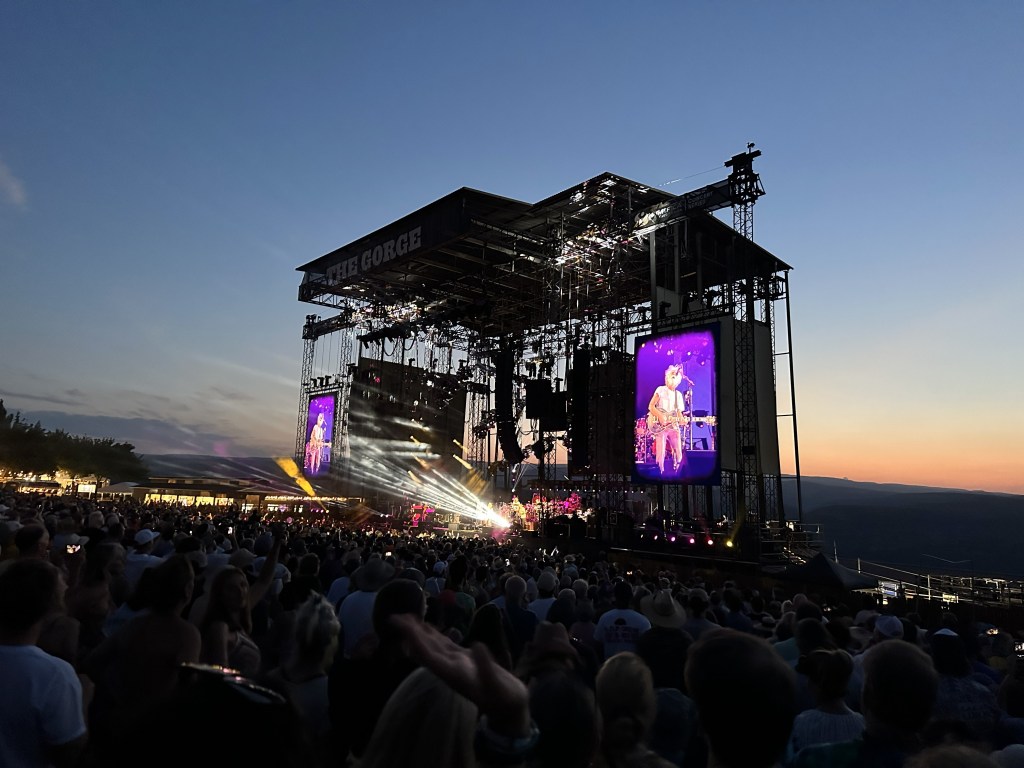
Dead and Company performing at The Gorge Amphitheatre in Washington, July 7th, 2023. Bob Weir shown on screen. (Credit: Author)
“Fare the well now, let your life proceed by it’s own design. Nothing to tell now, let the words be yours, I’m done with mine.” – Cassidy by Bob Weir
This past weekend, Bob Weir, the rhythm guitarist for the Grateful Dead passed away.
The Grateful Dead have been an indelible part of my life since I was born. The band disbanded before I ever walked this earth, when lead guitarist Jerry Garcia passed away in 1995. But the music and the scene lived on. My father raised me on the Dead’s music, and I became part of this incredible community from when I was really young. I count myself eternally lucky to have been able to be at one of the Fare Thee Well shows in Chicago in 2015, when the surviving members reunited and played with keyboardists Jeff Chimanti (a mainstay of Bob’s post-Dead projects) and Bruce Hornsby, and lead guitarist Trey Anastasio of Phish. I had seen the surviving members before, all of them with their solo projects at one point or another. I saw Bobby with Ratdog and Further (a band fronted by Bob and the Dead’s bassist, Phil Lesh), and all four surviving members with The Dead in 2009, accompanied by Warren Haynes of the Allman Brothers Band.
Bob Weir was my first concert. His post-Grateful Dead group, Ratdog, toured relentlessly in the years after Jerry’s death. One such tour was when I was ten years old. Very familiar with the Dead’s music, it was an experience to see someone I considered an icon play these tunes I had grown up on. As I grew older and went to more shows with my father, I understood the music better. But I also understood the people better. The Dead were, in many ways, the last vestiges of the hippie movement of the 1960s. While the end of the Grateful Dead’s touring years saw the community filled with many people who didn’t buy into the ethos or the music and were just there to party, the wake of Jerry’s passing was a sobering moment for the community.
That was the Deadhead tribe I grew up in. The party was over but the music lived on. Eventually, the party picked back up again. As time wore on, and the older heads continued maturing in the absence of the Dead as a juggernaut which toured almost incessantly, many younger folks like me found their way to the music. And where the music went, the people followed. Damn if the
Deadheads aren’t some of the most welcoming people ever. The line from Scarlet Begonias, “Strangers stopping strangers just to shake their hand” was never truer than at a Dead show. Because it was never about who you were outside the community, but if you lived the values everyone in there subscribed to.
One of the many iconic aspects of the Dead’s touring was Shakedown Street. Named after the song Shakedown Street (off the album Shakedown Street), Shakedown was the traveling caravan of revelers and vendors who would pop up at each venue. Almost like an extended tailgate except with most of the booze replaced by drugs, and a greater emphasis on goods crafted by their sellers in hopes of making enough money to get them to the next tour destination, Shakedown was a world like no other. The Dead back in the day saw this retinue of concertgoers and fans follow the band. They were one of the few bands where the fans went on tour with them.
While I had experienced Shakedown at all of the shows, Fare Thee Well was the first time it really felt like it did back in the day, according to my father. The crowd partying outside Soldier Field was massive, and everyone was there for the same purpose. It didn’t matter that you didn’t know the people next to you, or who you were talking to, or who you were hanging out with. The best part about being a Deadhead is that you had a family right there, bonded by a love of this incredible music played by a band beyond compare. Many of these people lived that hippie ethos of love and peace. There were some weirdos as part of the crowd, for sure. Many of them were on completely different planes of existence for a multitude of reasons (usually drugs) but the community didn’t judge. They didn’t care. If you came to get lost in the music and have a good time, you were one of them.
That’s not to say that the Deadheads don’t have their fair share of deadbeats amongst their numbers. But overall, I felt welcomed by this community of people, and encouraged to be true to myself by a bunch of people I had absolutely zero connection with. It was filled with genuine souls, bound together by a love for this music and the people playing it. I’ve had incredible conversations with people that I don’t even remember what they looked like, but the spirit of connection I had with them, even fleeting as it was, is something I still carry. I have trinkets people passed out in the parking lot because everyone was there to have a good time. It was a window into a past I had only ever read about; it was as though the sixties never stopped. For these people dancing and getting into the right headspace, that was all the world they needed to be concerned about. It taught me to check my earthly worries at the door and enjoy being part of a family several thousand strong to let the music take you where it will, and discover the feelings it evokes along the way.
While I was always more drawn to the songs Jerry Garcia wrote with lyricist Robert Hunter, the work Bob Weir did with lyricist John Perry Barlow is equally as iconic. Where Jerry and Hunter wrote these incredible musical and lyrical explorations of humanity, Weir’s songwriting had a storyteller’s nature. Much of his work harkened to more of the cowboy tunes that defined his youth, with a healthy dose of reflecting on the world through his own lens. He was an energetic personality on stage while remaining the band’s field captain. Bobby brought the band in from their exploration when they needed to and gave them the cue to go for it when they were holding back. His position as rhythm guitarist (which really was more like playing counter-lead guitar in practice) meant that he conducted everyone else to go where the song needed to go, a role he continued with the reunion groups after the Dead’s dissolution, including Dead and Company. Even while Jerry was the reluctant frontman of the Dead back in the day, Bob was the beating heart that kept the music going where everyone needed it to go without being obvious that he was doing it.
It’s hard to put into words just what Bob Weir meant to me. When Phil Lesh died in 2024, it was the first member of the Dead who died during my lifetime. I had seen Phil play with Furthur twice, The Dead once, and at Fare Thee Well. Phil had stepped back from touring years before his passing due to health concerns, but I’ll always carry part of him with me. I’m an organ donor because Phil Lesh at every show would ask everyone to become one since an organ donor saved his life. Despite only seeing Phil a few times live in concert, that stuck with me and I became an organ donor as a kid after hearing his speech the first time.
In contrast, I saw Bobby much more often. Fifteen times over the years. My first show with Ratdog, another show with Ratdog, twice with Further, once with The Dead, once sitting in with Bill Kreutzmann band Billy and the Kids(Kreutzmann being one of two drummers for the band alongside Mickey Hart), once sitting in with the Preservation Hall Jazz Band, once with his small touring project in his later years the Wolf Brothers, and the rest of the time with Dead and Company. Bob Weir was the member of the Dead I had probably the deepest connection with from that aspect. And in many ways, he felt like the standard bearer for keeping the music alive in the wake of Jerry’s passing.
In a letter to Jerry a year after his passing, Robert Hunter wrote, “The insane crush of the latter day GD shows is gone and that’s all for the best. From the show I saw, and reports on the rest, the crowd is discovering that the sense of community is still present, matured through mutual grief over losing you. This will evolve in more joyous directions over time, but no one’s looking to fill your shoes. No one has the presumption.” And I think that the same will ring true in the wake of Bobby’s passing. For thirty years after the Grateful Dead had run its course, Bob Weir helped keep the movement alive for as long without Jerry as it lived with him. The Grateful Dead’s postmortem second act wouldn’t have happened without Bob Weir keeping the torch going for so long.
Bobby said that he wanted the Grateful Dead’s songbook to live for three hundred years. I’d argue that it has already become an iconic part of the American musical canon. Not every song the band penned is widespread, but there are enough that have been covered and cherished by scores of performers to say that the Dead’s music will live eternal. Without Bobby keeping the train rolling for so long, I think the songs never would mean what they do. Back when Garcia, Hunter, Weir, and Barlow wrote these tunes, they were young men trying to capture life in all of its aspects. They were introspective, and had a wealth of experience to pull from, but I think they’d be the first to say that they weren’t privy to the secrets of the universe any more than everyone else. Many of the words they wrote then have only become deeper in their meaning with time, both with the band growing older as they played them and then with Jerry’s passing. The words they wrote when they were younger were suddenly much more profound in the way Bob would sing them after Jerry. I think it gives these songs the weight that many of the band’s influences in folk tunes and traditionals held back in the band’s prime. Instead of singing words laced with others’ sorrow and heaviness from generations before, now their words have the gravitas we associate with far older works. The Grateful Dead wrote some of the best Americana, and captured meaning beyond that which most of us could even dream.
The biggest lesson I got from being on the bus was to be true to myself. Every Dead show I ever went to was filled with thousands of people who were there to embrace and enjoy the music in the way that felt true to themselves. People danced and experienced something that moved them without giving a damn about the way it made them look or how other people felt about it. If there’s a takeaway from Bobby’s death it’s to keep doing things the way they feel right to me, and fuck everyone else. This was a man who probably spent more time on stage than off, who kept playing the music up until the very end. The music of the Grateful Dead is in many ways the past, and while it still lives, these are songs that are very much not unsung. So the other big lesson from Bobby’s stepping off is that my own creative endeavors to play music, take photographs, and write are absolutely vital. There is so much for me to explore out in the creative world and that’s the leap I need to keep taking. In many ways, it’s an affirmation that I’ve been on the right path for a very long time, and in a time where one of my icons will never again sing before me, that gives his loss meaning and provides me with some measure of comfort.
I don’t think there will ever be someone quite like Bob Weir who will walk this earth any time soon. I count myself lucky to have shared space with him for all the time I did, and even luckier that he used all of that time to sing that I could hear. It’s always hard because I grew up not having idols, seeing as people are so fallible and celebrities never show all of who they were. But from everyone who has said anything about interacting with Bob tells me that he was the kind of person who embodied exactly what you felt he was about. I think the world of music is worse off without his incredible talent on guitar and his songwriting. But I think his embarking on the next step of his journey should be a rallying call for the rest of us on this part of ours to not give up the things we do to spread light and joy and life to people.
Fare the well, Bob. May the four winds blow you safely home.




 Ark of the Lost Angels
Leave a reply to magnificenta93dc2e7d3 Cancel reply