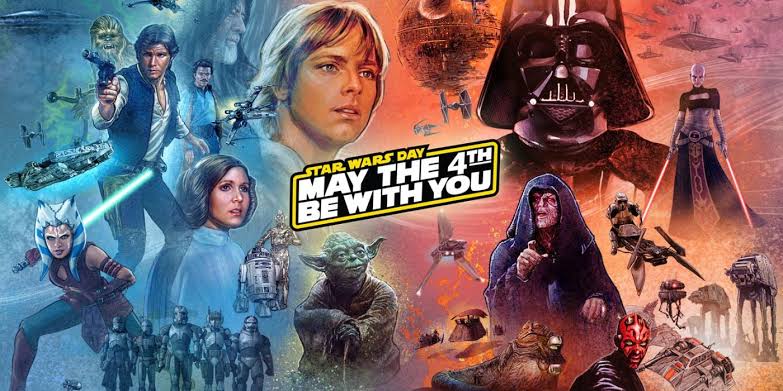
May the 4th be with you (a star Wars Celebration) (Credit: ftzrhm on DeviantArt)
Star Wars day reminds everyone what the franchise can and should mean to people.
This past Monday was May 4th, also known as Star Wars day as a play off the in-universe saying, “May the Force be with you.” Star Wars is perhaps the most famous film series of all time. The impact of the original Star Wars (later subtitled A New Hope) on filmmaking after its release in May 1977 cannot be overstated. Industrial Light and Magic set a new standard for special effects in movies, and George Lucas’ vision resonated with audience because it pulled back the curtain slightly on a fantastical world that audiences wanted to see more of.
What made the original Star Wars work so well is its simplicity. Lucas wears his influences on his sleeve. Star Wars is a mix of the classical hero’s journey with a mix of influences from westerns, the films of Akira Kurosawa, and the classic science fiction serial stories of the 1940s and 50s. What resulted was a story everyone has seen before told in a revolutionary way. Rather than wasting a ton of time with exposition, Star Wars opened with a brief description of what happened immediately before the first images of the film rolled across the big screen: the end of a pitched battle between the Rebellion and the Empire. That is where the film begins. Dropping the audience right in it immediately makes the world compelling and allows the story to take off without being weighed down by exposition. The audience will learn the world as they go, and the whole affair becomes more about experiencing events rather than watching a movie. The first movie tells a complete story which is only one part of a much larger chain of events in a universe ripe with compelling tales, leaving the audience wanting so much more. The original film’s release in 1977 turned a lighthearted science fiction romp into a global sensation chock full of incredible stories people cannot wait to experience.
This fantastical world of advanced technology as interpreted through the 1970s influenced the design language of the entire franchise. The available 1970s special effects and set design and props in the first film became the starting point for every piece of Star Wars media afterwards. The design language of the whole universe was influenced by World War II just as much as its themes were. The dogfights in space were all choreographed to mimic the old school dogfights of the war years, even as contemporary technology saw radar-guided missiles allowing for engagements beyond visual range in the jet fighters of the day in the real world. The Millennium Falcon’s cockpit and turrets used during the escape from the Death Star call to mind the bombers of World War II. Even with that, the rough robes worn by Ben Kenobi in the first film were inspired by samurai garb and would become the blueprint for standard Jedi attire decades later when the prequel trilogy was being released. Cinematography and special effects blended a collection of influences to shoot a retro-futuristic world in such a way that it feels timeless. The technology and methodology which Industrial Light and Magic pioneered for the first film created special effects which still hold up very well today and set the standard for special effects in Hollywood stretching all the way to today.
Part of Star Wars’ longstanding place in the hearts of moviegoers and science fiction fans and everyday people across the world is the universality of its themes. George Lucas has gone on the record talking about his influences, and how the entire original trilogy pulled from a variety of different historical sources. It is openly easy to see that the first three films were meant to be a commentary on the Vietnam War and imperialism. With the Empire pulling from the worst of the United States with the stylistic affectations of Nazi Germany, it wasn’t hard to see George Lucas’ point to the entire franchise is the condemnation of authoritarianism in all its forms. The Empire is an amalgamation of the United States and Nazi Germany, with the Death Star representing many of the fears surrounding the atomic bomb. The Empire’s completion of a powerful new superweapon in the first film reflected the precarious state of the world after the United States used the atomic bomb on Japan to end World War II and dared to ask the question about how an imperial power might have used them to bring the rest of the world in line. With the Vietnam War having ended only two years prior to the release of the first film, and the use of nuclear weapons in Vietnam being considered by the United States, these fears were very well founded. Richard Nixon’s corruption which led to his resignation as President of the United States was another motivating factor in its portrayal of the Emperor. Ewoks and their triumph over the technologically superior Imperial forces during the Battle of Endor deliberately invoked the Viet Cong’s victories over the United States military during the Vietnam War.
Another aspect of Star Wars that made it stand out is how it departs from traditional science fiction methodology. Science fiction is, historically, a commentary on the present through the lens of the future. George Orwell did not write 1984 imagining a surveillance state so horrific out of his own mind, but rather used the disturbing trends he noticed during the 1940s and took them to their logical extremes. Star Wars, on the other hand, is more of a science fantasy and delves more into the past for its stylistic affectations while still reflecting contemporary attitudes. Subsequent works have kept that theme alive in this universe. How the Empire’s tactics seen in Andor reflect the worst crimes of dictatorships throughout history all in their efforts to keep power, as well as the moral ugliness which comes with fighting a war against oppression. Yet, Star Wars also has stories of great heroes fighting sinister evils without much nuance in sight.
But what does Star Wars truly mean to people? Why has the franchise built such a long lasting legacy when other science fiction stories told around the same time never soared to the same heights? Take Blade Runner, the 1982 adaptation of Philip K. Dick’s novel Do Androids Dream of Electric Sheep? for example. Dick’s novel and the film adaptation (directed by Ridley Scott and also starring Harrison Ford) arguably have more emotional and philosophical depth than Star Wars, asking questions about what it means to be human, the place of empathy in society, and making a salient point about humanity’s negative effects on the world it inhabits. Why did Blade Runner not become a phenom the way Star Wars did when it had more to say about the human condition? Some would argue that gives Blade Runner more ‘literary’ value, but Blade Runner had a few spinoff books, some video games, and a few other ancillary pieces of media until the sequel arrived in 2017. By that point, Star Wars was in the middle of releasing its third trilogy of movies, not to mention the dozens of books, video games, comics, and close to two-hundred television episodes between The Clone Wars and Rebels. And the franchise has only grown since then.
I think the answer is that at its core, Star Wars is hopeful. It is an answer to the troubles of the world in a way that is not exceedingly obvious to the average person but still colors their perception. The foundation of Star Wars is hope. That good can and will triumph over evil, but it will not be without struggle, it will not be without sacrifice, it will not happen without people choosing to act. For as many stories focusing on the mysticism and power of the Force, there are just as many stories within the Star Wars universe that talk about how normal people can rise up against oppression and authoritarianism and evil. It is a world of fantastical adventure but contains lessons that are extremely prescient. George Lucas grew up in the postwar world. In the aftermath of World War II, there was a sense of societal responsibility to prevent something from the Nazis from rising again. They became heavily influential on the portrayal of villains over the course of the next several decades, especially in science fiction. That perspective permeates Star Wars, and in addition to the influences of samurai films, westerns, and the pulp fiction of Lucas’ childhood, creates something with enough influences to not feel derivative. The story told in the first film is the archetypal hero’s journey which crosses through Hollywood’s Old West to follow the trail of The Hidden Fortress but was memorable and unique enough with all of these influences that it gave people something to latch onto. The mystery of the Force, the compelling characters (Leia being a damsel in distress for about half the movie and then immediately taking over her rescue mission once she’s free was much better representation for women in Hollywood than a lot of 1970s films), and the idea of the struggle between good and evil drew audiences in further once their attention was hooked by the flashiness of epic space battles, and the tension of a lightsaber fight between an old master and his fallen apprentice. These themes resonate with people without forcing them to labor too hard on dissecting what they’re watching. They come away changed without needing to interface with the media in an intensively intellectual way, because Star Wars was never meant as something one needed to struggle to understand.
Lucas has gone on the record to say that Star Wars was always done for the kids. That there are obviously fans of the franchise who are adults and not everything needs to be completely juvenile, but the universe was always set to create a sense of wonder and hope in children. The reason the franchise is so longstanding is because it has an appeal to people of all ages. The almost dated aspects of the dialogue, the storytelling, and the design of the original trilogy cemented the franchise as something a little more timeless, thus they don’t feel dated at all, but rather contained within a universe all their own. Star Wars isn’t truly science fiction, it’s more science fantasy, or rather fantasy set in space. It becomes a vast sandbox in which authors and directors and writers and actors can play to create different types of stories for different audiences. The same franchise that can examine different types of extremism also has room for examinations of spirituality, of motivation, of the nature of morality, but also has room for fun adventures where the good guys always win, the bad guys are incompetent, and everybody gets to go home at the end of the day. For the most part. Not only does that mean that the same movies and television shows and so on can still feel fresh at different stages of life, but the love of Star Wars is something that can be passed from parent to child. The time spent in this universe becomes a shared experience between generations, and how every family interfaces with the universe might be different, there will still be so many moments that connect parent to child, and child to scores of other children out there, the way their parents connected to their peers, and so on.
The beauty of Star Wars is that there’s something here for everyone. Whether it’s the people who just stick to the movies (or even just the Original Trilogy), the ones fascinated by the tragedy of Darth Vader or the enduring spirit of Ahsoka Tano, the ones who want to look deep into how the Empire operates and see how the Rebellion rises to meet it, the ones who are fascinated with the Jedi and the Sith or the ones who love the more average tales of the smugglers and scoundrels operating on the fringes. Whatever stories people want to see, Star Wars has them. And Star Wars has optimism. It’s a reminder that there is always hope in the darkness, that great victories do not come without sacrifice but they do come, and that even in the worst of circumstances, there are things worth fighting for to be found.






Leave a comment