
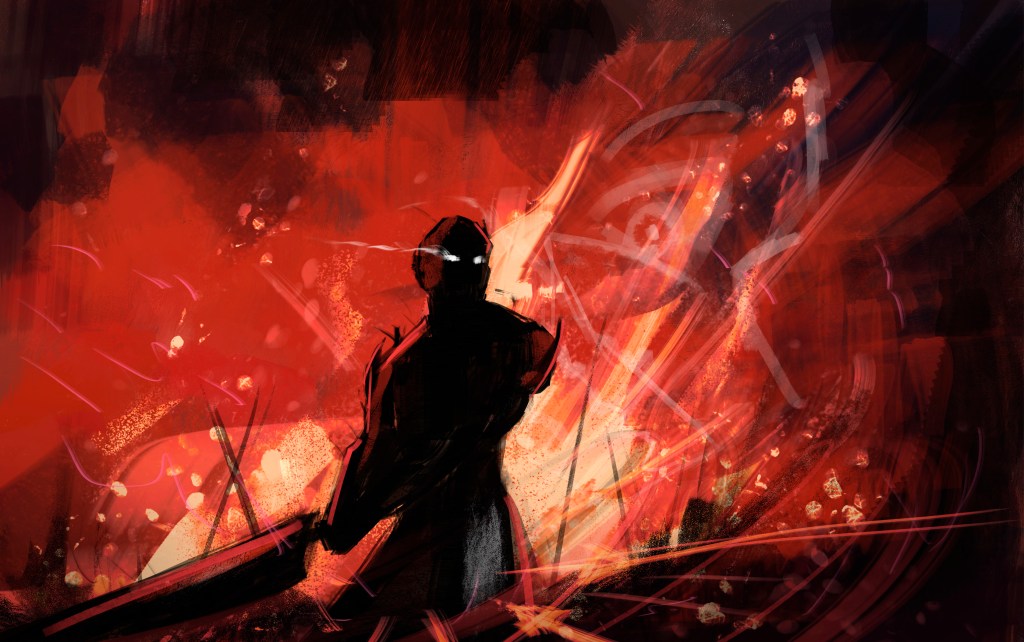
Art from Christmas Eve and Other Stories by Trans-Siberian Orchestra (Artist: Greg Hildebrandt)
There has always been the romantic idea of New York at Christmastime. The lights and decorations on storefronts, the tree and trimmings at Rockefeller Center, the spectacular show taking place at Radio City, the quiet reflection in a snowy Central Park, all paint the picture of a metropolis awash with majesty and joy and holiday spirit. But tonight, with mere hours before Christmas arrives, New York offers none of those things. Not to the two characters who are unwillingly about to be entangled in their search for the magic that Christmas Eve promises, as they chance upon a Manhattan hotel.
This year, the city is being pelted with snow once again; the kind of cold and bitter snow that steals the world from before one’s very eyes and steals the warmth from their very soul. Scatterings of office and storefront lights struggle to shine in the darkness, incidental beacons making vain attempts to guide passersby to their intended destinations. The destiny of man is to always be overtaken by nature, and no amount of flowing current can vanquish the might of mother nature. The snow consumes everything.
Everything except a Manhattan hotel. A Manhattan hotel which stands alone, parting the snow before it with the warm glow of a home for wayward travelers. The building looks to be well over a hundred, but aged gracefully, with intricately crafted wooden doors keeping their strength and beauty, and glass windows only slightly filtering the golden light of old lamps inside.
The unlikely duo are painfully aware of the cold. Walking in opposite directions from both ends of the block, they feel the fingers of the frost on every bit of the minimal skin exposed from thick hats, thicker coats, heavy scarves, and hands in gloves or shoved in pockets. The frost crawls its way down their spines as the wind sends visible waves of drifting snow down the city streets. They both wish for a warm drink and a fire to dry themselves out next to at the exact moment they spot the glow of the hotel. Unsure of their ultimate destination, and not two people who would ignore what seems to be a gift from the universe, they walk in together.
“Bitter cold tonight,” the man, in his thirties, comments in an attempt to make conversation. The lines on his face show a bit of age, and even more stress. He reveals the start of grey hair as he pulls his knit hat off, and the girl can see in his eyes that there was something to have aged him past his years this severely. He hasn’t shaved in two days, scratching his stubble before rubbing his forearm through a white sweater. The nervous habit corresponds with the location of the unit tattoo from his service overseas.
“I guess so,” the girl, just over eighteen, replies in a small voice. Her hair is a shade of blonde that, when colored by the glow of the lamps, turns into almost golden fire. The perceived heat in her hair is at odds with the icy blue of her eyes. Her eyes fall on the bartender, who is currently serving hot chocolate to a couple. The man follows her gaze to the same spot. The duo turn their attention back towards each other, nod in unison, hang their coats on the rack by the door, and walk into the entry hall of the hotel, and over towards the bar.
From deeper inside the bar comes the sound of a jazz sextet. The pair identify the different Christmas carols that the players are weaving together with their own flourishes. The notes and melodies sparkle out of the rhythm like fireflies on a summer night, a brief moment of prominence before melting back into song as a whole. The sound entices one to come forward and follow it, drawing the eyes closed without any provocation, promising dreams of trees, and presents, and sleigh rides, and holiday meals with family.
The pair finally step up to the bar, and the man raises the attention of the bartender. The bartender has a distinguished mustache, sculpted to recall older days, in a white shirt with a black waistcoat and tie, appearing almost outdated, if it weren’t for the rest of the hotel.
“Ahh, welcome! It’s a cold night out tonight!” The bartender greets with pleasant cheer. The man scoffs under his breath, unsure as to why this bartender could be so chipper on such a miserable night. He clears his throat to disguise the noise of disapproval.
“Yes, extremely. I’m glad you’re still open, not many other places are,” the man notes, leaning on the bar. The bar is a dark wood, polished and without damage while still radiating age and all the requisite characters who have stepped up to it over the years, less antique and more ancient in a way. The bar is trimmed in gold, as are the shelves behind the bartender stocked with various liquors, many of which are in bottles that the man cannot identify.
“This place is always open for those who need it.” The voice belongs to a woman in a white dress with gold trim who joins the two at the bar. Her hair is raven black, but her eyes are a pleasant green. She’s wearing a pendant with the image of a snow globe containing a rose. The girl looks at the woman in awe, as if she stepped from a myth to stand right next to the pair. The man’s reflex would usually be to make a playful advance, but this woman’s presence stops him cold without him saying a word. Somehow he knows that she would see through anything he said.
“Well, I’m not one to look a gift horse in the mouth,” the man says while his new companion stays silent.
“It’s such a dreadfully cold night out tonight. It would have been a tragedy had you two frozen to death,” the woman continues, her mannerisms making her sound like a ghost speaking from a much earlier time.
“Yeah, real tragedy,” the man replies gruffly, dismissive of any value that anyone else would put on him. He softens his scowl when he remembers that there is another experiencing this peculiar hotel with him, one whose loss would, in fact, be a tragedy.
“What is this place?” The girl finally breaks her silence, feeling the comfort of the hotel enough to speak to the woman. The woman, in turn, gives her a charming smile.
“This is a place where people tend to find what they need. And you two needed a place to warm up on a cold winter’s night.” The woman steps away from the bar, cocking her ear towards the musicians. “Well, they’re playing my song. Have a pleasant night.” And with that, she melts away into the crowd as the bartender steps to the unlikely pair with two mugs of hot chocolate. The duo shares another look of confusion.
“I put a little peppermint schnapps in yours, sir. You look like you could use it,” the bartender informs them. They both take a sip, exhaling in relief upon doing so. The hot chocolate expels the remnants of the cold from before, with the richest taste either of them had felt before.
“How much do I owe you?” The man inquires, taking a look at his companion, “For mine and hers?”
“Not a dime, sir. It is Christmas Eve after all,” the bartender replies with a wink before moving away to help one of the people who had been watching the musicians play. The pair take their drinks and walk over to the small table and a couch with a view of the street.
“So, I guess we’re sticking together tonight?” The man inquires.
“There’s something about the hotel that strikes me as off,” the girl notes her observations. Looking around, the place appears as though it would be outdated. Appears. Despite the obvious age of the light fixtures, the bar, the decorations, and even the patrons, nothing feels out of place. Except the man and the girl.
“Yeah,” the man agrees, “Something’s setting me on edge.” He looks out the window, but the snowstorm has only grown more intense, blotting out the view of anything on the street. Even passersby, if there are any, are invisible from inside the hotel. Just driving snow.
“Do you think it’ll let up?” The girl inquires, also staring at the snow.
“Well, if it doesn’t, I hope they have vacancy enough for a room.” He pauses a moment and looks at her. “Two rooms.”
“I don’t have the money for a room,” she states.
“I know, but I do.”
“Are you sure?” She stares at him quizzically, but his mind has already taken him back several years, to Afghanistan. He was one of several soldiers who attended a funeral for villagers killed in an attack on Christmas Day. One of the fallen was a young girl the man had gotten to know the previous few months.
“Yes,” he answers brusquely. The girl, having been running for quite some time, broadcasts the shock with her eyes. Nobody had ever been this kind when she set out on a quest to find her birth father. The two look towards the snow once more, sipping their drinks in silence as the quiet of the snow in their minds overtakes the musicians still bending and twisting and wrapping Christmas classics together in novel ways. The man takes another sip to find his mug is empty, having lost track of time. He sets his mug down alongside the girl’s as he picks up a hint of the band playing ‘It Came Upon A Midnight Clear.’ He lets out a small smile at one of his father’s favorite carols.
“Come on,” he urges her, “Let’s check out the band.” They both stand and start walking across the foyer. “So, where are you from originally?”
“Cleveland,” the girl answers, “Which is as boring as everybody says it is.” The man laughs, a deep, honest laugh, which elicits a look of confusion from the girl.
“You sound just like my younger sister! I’m from Cleveland too, so I know what you mean.” The two share a laugh at the coincidence before reaching the band. The band is a six-piece jazz band: a guitarist, pianist, bassist, drummer, saxophonist, and a trumpeter. The trumpeter also sings the occasional song, but the pianist handles most of the vocals, when the band bothers to use them at all.
“Now, I’m going to tell you about those three kings. And what really happened that night!” The pianist laughs a laugh that fills the room as he begins to play an old school blues groove. He is a grizzled old man, with grey hair, but a fire in his soul and deftness in his hands. His voice strikes the two most of all, simultaneously the gravely tones of a blues singer in smoky bars from days gone past, while somehow also possessing the strength and clarity of a classical singer in a concert hall.
“He’s really good!” The girl whispers, so as not to break the spell. The man nods, and a smile creeps farther onto his face. The girl marvels at the crowd around them. The people are dressed in their finery, as if going to a night at the opera. She even spies a few top hats and monocles, which causes her a slight giggle to herself. Everyone else’s eyes and ears are focused on the band. When the song ends, the man finally turns to respond.
“He’s incredible. He reminds me of this old jazz player I heard about in New Orleans. The older guys I saw play talked about this old man when they were starting out,” the man says.
“Now, that was our last one for a little while, but in two hours, we’ll be back, this time in the main ballroom!” The pianist informs the crowd with the cheer of the season. The people begin to break up and travel their separate ways, many of them going to the old theater connected to the hotel. The man and the girl share another look when they hear the prospect of an old Christmas movie being played, with a live orchestra providing the accompaniment.
“It would seem that we’ve got a film to catch!” The girl states, causing the man to smile.
“So, if you’re from Cleveland, why are you out here in New York?” The man finally asks the question that flitted around the back of his mind all night. The girl sighs, and her cheer evaporates the way snow does when it lands on warm ground.
“I was looking for my birth father. He left my mom soon after I was born,” the girl recounts her reasoning, “I followed his trail for six months, and that led me here. I found out he died in an accident years ago.”
“And you can’t make your way home?” the man inquires.
“Don’t want to.” In her eyes, the man can see an all too familiar pain. “My mother moved on like nothing ever happened, and I will never be enough for my step-father.” Now it’s the man’s turn to sigh.
“Look, as the resident expert on difficult relationships with father figures, I think you’re looking at it wrong. Fathers and children don’t always see eye to eye, but a lot of times, there is love there. Sometimes, dads are bad at showing it well, and kids are bad at understanding that.” The man sighs, reluctant to reveal his source of such wisdom, “And before you say anything, I know it’s a cliché.” The girl goes to respond, but the man raises his hand to silence her. “You’re going to say I’m wrong. I know, I used to be just like that when I was your age. So instead of digging in, don’t say anything. Just, think it over. We’ll talk about it when you’re ready. Trust me on this.”
The girl ponders his words a moment, and looks at him, willing to try it. Then the man taps her shoulder and points at the doors to the theatre across the foyer of the hotel, which are now open. Her smile is returned in an instant, and she grabs his sleeve and practically yanks him off his feet as she makes a beeline for the doors.
The theatre is grand, and old, with a foyer of its own with rich red carpeting, ornately engraved golden walls, and a chandelier that captures the flashes of snowflakes tumbling to the ground in the lights of the city outside. In the corner is a Christmas tree, bedecked with tinsel and garland and ornaments of every color, topped with a star that the man swears is actually glowing. The girl tugs at his sleeve, as the crowd that almost drifts into existence around them shuffles their way into the theatre itself, in top hats and coats or elegant dresses wrapped with furs. The man finds himself carried inside by the crowd, the girl practically dragging him to their seats, and is given a program for the night’s entertainment: a film, one which the man had never heard of before. He takes his seat, the lights fall, and the curtain draws open, the gates to a fantastical world.
The movie begins in 1914, on Christmas Eve, with the sounds of artillery shells being fired across No Man’s Land. The British soldiers huddle against the walls of the trenches, begging to be spared from the cannon fire. After what seems to be an eternity, the guns fall silent on the night that angels sing. Across the muddy, cratered mess of barbed wire and fallen men comes the sound of German voices, not shouting war cries, but singing carols of the season. Throughout the night, both sides sang to one another, and ventured out to greet their brothers on the opposing side upon morning light.
Ten years later, one of the British soldiers travels to Germany in an attempt to find some of the soldiers he met with during the truce. After searching across the country, he meets a man in a café in Berlin who was there on the same battlefields as he was. The two men wept as they recalled the cruelty of the war, and how the truce on Christmas Day was a bright spot within the terrors they endured. The German revealed that his remaining family had passed during the influenza outbreak after the war was over, and he had nobody to spend Christmas with. The British soldier offered the German an invite to his family’s estate outside of London, which was tearfully accepted. The two headed to the German’s apartment and packed his things before purchasing tickets for travel to London.
On the train, the pair spoke of their dreams as children, and how those dreams were derailed by the war. They swapped stories of childhood romances and mischief, spoke of their favorite Christmas traditions, and told each other of how they both fared after the war. They talked about going to America to visit and experience those wild parties in New York City, and where else in the world they wished to see without carrying a rifle. They bonded over their shared experiences, and the desire for their eventual children to never see a conflict like the one they had survived. By the time they arrived in London, they were fast friends.
The German was warmly welcomed by the British soldier’s family, barring the father. Being a proud British soldier once before, the father held a resentment in his heart for the Germans. The soldier asked his father to be polite to his friend, for his father knew not what they suffered on the battlefields of northern France. The father asked his son how he could treat their enemy with such civility.
“Father,” the son said, “We are both stubborn men, prepared to stand against a tide taller than the clock tower at the Palace of Westminster. You taught me to have pride in my nation, pride in my uniform, and pride in my family. But on those fields, that pride never mattered. My nation sent me in a uniform that was quickly stained with mud and blood, to fight against men with no reason to fight against me. We were all brothers on those bloody fields, and we owe it to ourselves, and to those who are yet to come, to keep alive the spark of that Christmas morning where we laid down our guns and embraced our fellow man.”
“My son,” the father said, “How could you consider a man like that your brother? How could he be family when he and everyone like him slaughtered our countrymen in droves?”
“Father,” the soldier replied, “We slaughtered them in droves. We spoke on the train from Berlin to London, sharing our stories from beginning to now, in their entirety. He and I both fancied girls, both caused mischief, both love our countries while we wish they never go to war again. We both laugh, we both cry, we both dream. Any man who does these things, and wishes only for peace on earth and goodwill towards his fellow man is my brother. And it breaks my heart to hear that you, my father, would not accept that your son could love someone the way you taught him to. If loving this man as my brother means that you no longer love me as your son, then I will accept it. But, if you can see what I have seen, then I merely ask you to give him a chance.” By the end of his speech, the father began to tear up.
“My son, there is nothing that you could ever do that would stop me from loving you. You are brilliant and wise, and this old fool only wants you to be safe from now on. If only the fathers of your generation were better men, then our sons would not have had to bleed and die for nothing.” The soldier, now crying as well, embraced his father, and the two men returned to the table. As the meal wore on, the German happily told tales of his childhood and his family, and the father listened and began to see why his son was so quick to invite this former enemy to the table.
The film ends by drawing back from the dinner table, aglow with the warmth and love of Christmastime as the night continues to wear on. The man slumps back in his seat, clapping his hands in appreciation for the film, and the live orchestra that helped the action on screen resonate within his heart. He wipes away a tear as he stands up from his seat, and files out silently, with the girl in tow. They return to the foyer of the hotel, and stare at each other.
“I had never heard of that movie before,” the girl states, “I want to see it again.”
“Neither had I, it was really good,” the man agrees, wiping away another tear. The girl doesn’t fail to notice it.
“Are you crying?”
“Yes. That reminded me of my relationship with my father. That’s why I’m in New York, alone, on Christmas Eve.”
“I won’t pry,” the girl assures him, but he shakes his head and looks at her.
“No, no, it’s okay,” he assures her, “I think I owe it to you. My family has been a proud military family stretching back for ages. My many-times-great-grandfather was in the British army during World War I, and did engage in the truce on Christmas Day in 1914. After the war was over, he moved to America and started a family. Since then, every man in my family has served their country. My father was very proud of the tradition, and so I joined up. I was stationed in Afghanistan.” He slides up the sleeve of his sweater to reveal his unit tattoo. “I’ve always kept this as a reminder of my time there.”
“Did something happen?”
“My father served during the Bosnian war, when I was growing up. He went with NATO forces to stop the fighting and was present in both Paris and Dayton during the peace talks. While there, he heard the story of the cellist who played during the fighting. He actually met the man sometime after and talked with him about his experiences. My father recounted the story to me before I joined up. How admirable it was that one man could find a way to bring beauty in such a horrid time. My dad was a believer in the duty of the strong to look out for the weak, and that conflict was inevitable and it was our job to keep it under control.”
“That doesn’t seem like such a bad way to look at things,” the girl comments, but the man shakes his head.
“He also was a career military man, and it ended up hardening him, and he stopped seeing the tragedy of every death. His ideas about things persisted until I was in a firefight in Afghanistan on Christmas Day. We had been helping keep a village safe, as they were giving us information on terrorist operations in the area. There was an attack on Christmas morning, and we went out to help repel it, but the fighting lasted for hours. When we finally drove them off, fourteen people were dead, including a young girl I had befriended. She was learning English and I had been helping her, giving her some of my old books when I was done with them. I went for the funeral with some of the guys in my unit. It was only later that we found out that the reason the village was a target was because we were involved there. I rotated home and left the service. I was home for Christmas the year after, and my dad and I had a conversation about it. It didn’t go well, and I stormed out. Haven’t been home or spoken to anyone in years, been drifting ever since.”
The girl takes in the story with a reverent silence, before offering a hug. The man accepts without hesitation, tearing up once more at the painful memories dug up. The girl finally pulls away to look him in his eyes.
“You were absolutely right, and I know what you meant earlier. Fathers and children don’t always see eye to eye, but a lot of times, there is love there. Sometimes, dads are bad at showing it well, and kids are bad at understanding that.” The girl offers a sly grin, and the man smiles and chuckles at having his own words thrown back at him by someone roughly half his age.
“You’re all right kid,” he comments, “Guess you do listen.”
“It’s not too late,” she reminds him, “For both of us.”
“You mean to patch things up?”
“Yeah.”
“You’re right,” the man replies, looking out the window at the front of the hotel. The snow has showed no signs of slowing down. “I just don’t think we can make it happen tonight. Any flight is no doubt cancelled, and the car rental places are all out, and probably closed at this hour.” The strains of the band perk both their ears, and they look towards the source.
“There’s always music to listen to while we think of a plan.”
“Shall we?” The man inquires.
“We shall!” The girl agrees. They follow the music deeper into the hotel to find a ballroom out of a fairytale. The two reach beautiful wooden doors propped open, emblazoned with a red rose inside of a snow globe trimmed in gold, the same symbol on the woman’s necklace from earlier. They marvel at the ballroom itself, with a distinctive pattern of the hardwood floors, the red and white curtains that are trimmed in gold, the location of the band and the golden glow characteristic of the hotel all look as though they were stolen straight from the pages of a fairytale. He looks back to the musicians and notices that the strings on the bandstand are accompanied by the band from the bar. The dancing of the pianist’s fingers across the ivory keys mirror the movements of the dancers across the stately pattern of the ballroom, as if the dancers and the musicians were in a dance of their own. No longer relegated to old Christmas medleys, the band plays grand waltzes and soaring melodies that add to the majesty and magic of the evening.
“I’m not much of a dancer,” the man admits.
“Neither am I,” the girl agrees. The two quietly listen to the music for awhile, gently swaying to the songs while dreaming of what Christmas morning could be if they could find a way home tonight. They watch the couples across the ballroom, a timeless scene if it weren’t for the electric guitar and drum set up on the bandstand, along with the pianist, the horns, and the strings.
“This isn’t such a bad sight to be stuck with on Christmas Eve,” the man comments.
“No, but I wish we could find a way to get home,” the girl states. A tap on the man’s shoulder breaks his trance. The woman from earlier, in her elegant dress, is standing there with a warm smile.
“I think I can help with that,” the woman speaks, causing the girl to whip around and stare in awe once more.
“And how can you do that?” the man is incredulous.
“Well, you seem to have forgotten about the trains in your earlier dismissal of the roads and skies as avenues of travel.” Her comments take the man aback.
“How did you?” he can only manage to ask half the question. The woman smiles a smile that tells him she won’t give up how she has that information.
“I hate to break it to you, but I don’t think that I’d make it to the train station without getting lost in that,” the girl gestures to the snowstorm outside. The woman laughs.
“There’s a platform under the hotel, it was built when the hotel was constructed. Allowed certain people to get in and out when they needed to.”
“Yeah, I’ll bet it’s still in use,” the man snorts incredulously.
“It is when it needs to be,” the woman responds while handing the pair two train tickets bound for Cleveland. “Like I said, this place is there for those to find that which they need. You better grab your coats. I’ll walk you to the stairwell to the platform.” The three walk over to the coat rack and the travelers collect their things.
“You know, I don’t recall ever seeing a map with this train station on it. Where exactly in the city is the hotel?” The man inquires.
“In exactly the right place,” the woman answers, causing the girl to grin at the man’s exasperated response. They walk down a long hallway, lit with the same warm lights that gives the hotel its dreamlike glow. The man cannot help but smile again at the magic within this wonderful place. They arrive at a doorway holding a staircase downward.
“And here is where I must leave you, but not without parting gifts.” The woman hands the girl a necklace exactly like the one she wears, with the image of the rose inside the snow globe, in all its beautiful color. The girl immediately puts it on with a glowing grin while the woman places a coin with the same image into the man’s hand, like one of the challenge coins he collected during his service.
“Farewell.” The woman bids them before she heads off to rejoin the party. The man looks at the girl, and nods at their tickets.
“So, did you find what you were looking for?” He asks her.
“No, but I think I found what I needed to. What about you?”
“Yeah, me too kid. C’mon, we’ve got a train to catch. The pair descend down the stairs to a resplendent station with old lamps and intricate tiling in archways across the ceilings that still don’t give up where in the city they are. But the light down the tunnel and clunking of wheels on rails lets them know that the train is coming, and they’re one step closer to home.
And so it is, on this night of nights, that the magic of Christmas is found by those who are willing to open their hearts and listen to the lessons it tries to teach us. For despite the bitter cold that threatens to harden our very souls, there is the love we have for one another, in all its forms, that will let us light the way home. We have to simply open our hearts and let the magic in.







Leave a comment