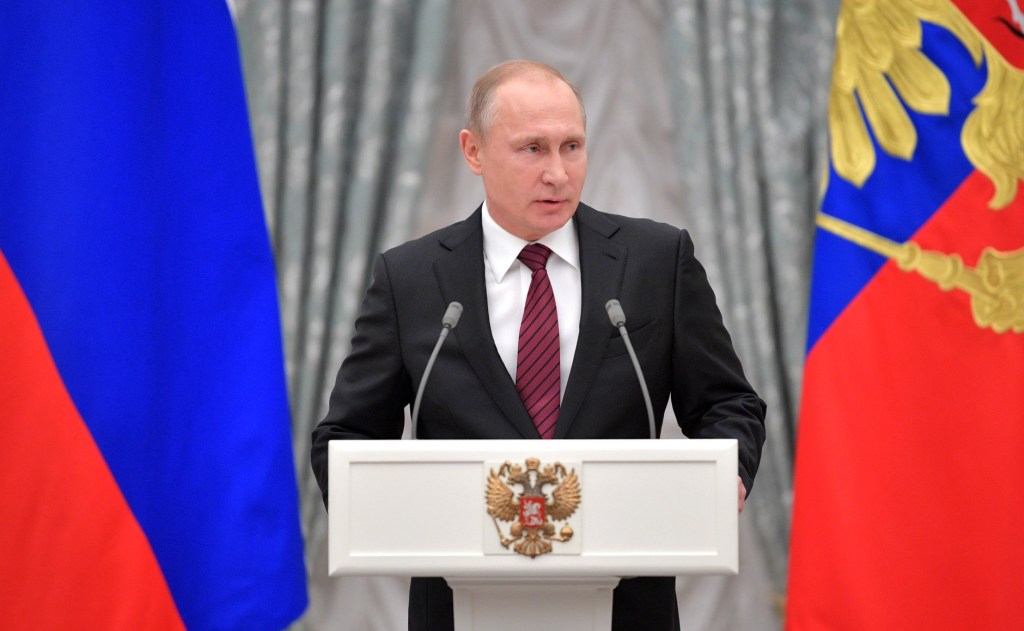
Vladimir Putin (Credit: Wikimedia Commons)
Russia is a mafia state, led by a don who fancies himself a tsar.
President of the Russian Federation is a rather quaint title for a man who considers himself “Vladimir Vladimirovich Putin, Emperor of all Russia.” In the wake of the Soviet Union’s collapse, Russia was poised to become an economic powerhouse and a large player in the Europe it either thoroughly oppressed or detested throughout most of the 20th century. Had it only played its cards right. In the days when the shattered remnants of the once mighty Soviet military were selling off their equipment in bulk to the likes of Nicholas Cage’s character from Lord of War, Russia was unable to pose an existential threat to the continent and had put its imperialist dreams of conquering its neighbors to bed. It was only when Russia’s fledgling democracy would be smothered in its cradle by Boris Yeltsin’s bid for reelection in 1996 that the dreams of empire would be reawakened and become Eastern Europe’s recurrent nightmare. And Vladimir Putin’s ascension to the highest authority in Russia marked himself as angling to be the first of the new tsars.
Make no mistake, Putin is a mafia don rather than a leader endowed with the divine right of kings. While the Theme from the Godfather can easily share some similarities with Russian folk music – after all, the mandolin and balalaika are virtually cousins – the difference in policy bears a much more frightening resemblance.
Much like Don Corleone, Vladimir Putin runs his nation based on a few principles: intimidation, fear, and absolute loyalty to the boss. When an underling’s ego outstretches the leash held by the top of the pyramid, they are disposed of swiftly. Provided they operate within the parameters set by their leader, they are able to enrich themselves to their heart’s delight, so long as they continue giving the boss his taste.
Unlike Don Corleone, Putin did not build his criminal empire on doing favors for those in the neighborhood and drawing lines which could not be crossed. He built his on force, loyalty, and enriching himself above all else. Putin dreams of the Soviet Union so far as that he wishes for its economic and military strength to make Russia feared and respected on the world stage. The Soviet Union’s stated ideas of equality don’t matter. Putin dreams of turning Russia into the world’s most powerful empire with himself sitting the throne.
At the Expense of All Others
If there is one thing Vladimir Putin can claim credit for, it is stopping the societal freefall of the 1990s in Russia. In the wake of the end of the Cold War and the dissolution of the Soviet Union, Russia needed strong leadership. To ensure long term democratic and economic success, it needed leadership with the willingness and know-how to cultivate a market economy with a population which had little idea of the concept, and to safeguard their freedom from overwhelming influence. Boris Yeltsin managed neither. Vladimir Putin opted for the former.
Boris Yeltsin was facing a dodgy election in 1996, as he was being seriously challenged by a communist. The 1996 election was the first free election Russia ever held. It was proof that the democratic process could work in the world’s longest standing autocracy. It also meant it was an election Yeltsin could lose. So, he traded his powers of regulation and oversight to guarantee his victory.
Under the Soviet system, the state controlled all of the major corporations. When the Soviet Union dissolved, and the economy shifted from a planned economy to a free market, the state parceled off its various corporations. The Soviet Union was in dire economic straits. The final Premier of the Soviet Union, Mikhail Gorbachev, once famously spoke about how the Soviet Union was brought down because of the expenses of cleaning up the 1986 Chernobyl incident. It would be compounded by the cost of the Soviet War in Afghanistan from 1979-1989. Russia had debts, and a population to feed and not the money to do so. The shift to capitalism was seen as a great hope to energize the Russian economy, but they didn’t have a cultural understanding about how to do business.
When the USSR dissolved, privatization was being practiced by a population which didn’t understand it and laid the groundwork for the Russia of today. Thanks to the chaotic, confusing, and quick method by which the new free market economy developed, a group of smart, well-connected individuals were able to secure the majority of the previously state-owned institutions. They had the connections and knowledge to take their respective industries and ride them to riches. This created an instant oligarchy with immense power over manufacturing, media, and finance lying in the hands of a few individuals. These became powerbrokers in the new Russia. Yeltsin ostensibly tried to hold them at bay, but the threat of losing his presidency was too much to bear.
By 1996, Yeltsin’s government was struggling. After putting down a coup attempt in 1993, and securing more power in state hands, Yeltsin was still struggling to keep food on the table. The parliamentary elections of 1995 had gone smoothly, and the regional elections throughout early 1996 proved that Russia was open to democratic ideals and that the candidates winning across the nation were not the hand-picked representatives from Moscow from the Soviet era.
However, the poor state of Russia’s economy left the government unable to collect taxes or pay wages. Inflation still ran rampant. Russia had gotten a crash course in capitalism, and it crashed out hard. Yeltsin had little choice but to bow to big business. His newfound allies in the oligarchs spent all their resources ensuring he won the election. In return, the remaining state industries changed hands and made the new aristocracy of Russia even more untouchable.
This chaos would provide Vladimir Putin with the perfect storm through which to consolidate even more power. Putin secured his power on the backs of the oligarchs. He continued allowing them to get rich if they would use their considerable influence to keep him in power. He used their unpopularity and his own image as a strongman to purge the ones who stood against him. It worked. Putin’s reforms stabilized the Russian economy, and the export of raw natural resources allowed the nation to rebound. Putin played hardball negotiations with much of Europe while providing them with resources and worked to reform the military into a strong fighting force. Most of these changes were only superficial, providing cover for Putin and his cronies to grow richer while the average quality of life for Russian citizens remained the same: barely scraping by in the ruins shadowed by the grave of the mighty Soviet empire.
As Putin centralized more power around himself and the Russian Presidency, he began leveraging the power of the state to get rid of oligarchs and other popular figures which posed a threat to his position. Today’s Russian oligarchy is made up of those loyal to Putin, who will do his bidding and take his punches. They became the capos for the boss of the world’s most powerful mafia family. With any capo who shows disloyalty or weakness, the boss will not hesitate to solve the problem permanently. Their positions and influence only exist because the boss has granted them. Their ability to make money and enrich themselves only lasts as long as Putin’s protection does.
Putin’s immense control over the economy and influence over the oligarchs allow him to hide the fact that he is probably one of the wealthiest men in the world. His control over the security services allows him to dispose of any rivals, critics, and other threats, a power he exercises frequently. However, the biggest trick in Putin’s repertoire is his control over the media. Managing the flow of information is paramount to Putin’s continued existence.
Journalistic freedom in Russia does not exist. The media does not exist to report on the happenings of the government, they exist to legitimize and spread the official accounts which may, but more often do not, bear a resemblance to objective facts. They may still print some truths, but they are careful not to cross lines which would put them in the crosshairs. While some independent outlets still exist, most were shut down since Russia’s illegal invasion of Ukraine began. Famously, TV Rain was the last independent news station left. It was shut down shortly after the invasion of Ukraine in 2022 when Russian security forces raided the newsroom. Their final broadcast? The footage of Swan Lake which was played in the USSR when the government was in crisis. Usually used when the leader of the nation died, as it was with Leonid Brezhnev in 1982, Yuri Andropov in 1984, and Konstantin Chernenko in 1985, the footage of Swan Lake was also used during the attempted coup of August 1991. Since then, it has become a symbol of protest.
Naturally, it was a fitting swan song for the last independent voice in Russia.
The complete control over the media allows Putin to normalize concerning or alarming events and actions, or even rewrite history. His word is gospel across Russia. To the Russian people, the government is good, the enemy du jour is bad, and politics aren’t really something they tend to pay attention to. Putin is strong and protects Russia. At least that’s what they’ll say aloud. Opinions are more mixed in the privacy of their own minds. Many know Putin is constantly lying to project the image of a grand country which is in actuality falling apart at all avenues. However, they dare not speak up as they have no choice. Political dissent is crushed without mercy. The lucky ones see jail time, while the less fortunate tend to suffer more lasting physical harm. Or tragically dying from multiple self-inflicted gunshot wounds to the back of the head, judicious quantities of polonium which spilled into their tea, or mysterious falls from open windows. Protests are rapidly squashed with internal security agencies judiciously applying force. All roads in Russia lead to Putin, and all direction flows down from him.
The law offers no constraints either. The Russian constitution established in the 1990s would put a restriction on the Presidency: no more than two consecutive terms, without limiting the number of terms in general. Putin exploited this loophole by running for election in 2008 as Prime Minister with Dmitry Medvedev running for President. The two would swap jobs in the 2012 elections, with Putin amending the Russian constitution afterwards to remove any term limits on the Russian presidency whatsoever. In addition to the jailing of political opposition, the absolute control over the media, and voter intimidation, Putin would maintain an iron grip over Russia for the entirety of his presidency.
Putin’s strength lies in how he portrays himself.
The Perception of Power
The 2019 HBO miniseries Chernobyl about the eponymous nuclear disaster which took place in 1986 in modern-day Ukraine contained a line spoken by Mikhail Gorbachev. “Our power comes from the perception of our power.”
The Cold War was a battle of perceptions. The USSR regularly held military parades through Red Square in Moscow to show off the strength of its fighting forces. The Victory Day parade was held on May 9th, to commemorate the end of World War II in Europe. This parade was only held on major jubilee days. The more common parade in the Soviet era was held annually on November 7th to commemorate the October Revolution of 19171 in which the Bolsheviks overthrew the Provisional Government which overthrew the Romanov Dynasty. The Bolsheviks would build the Soviet Union over the next several years during the Russian Civil War.
With the fall of the Soviet Union in 1991, the October Revolution parades ceased to be major celebrations. Instead, the Victory Day parades took their place as the preeminent demonstration of the Russian military. The Victory Day parades have been held annually since 1995. In Putin’s Russia, showing the military’s might is an important part of projecting strength across the world. He is synonymous with Russia. He is strong and therefore must also demonstrate that Russia is strong.
Of course, in the wake of the disastrous and costly invasion of Ukraine, it should come as no surprise that the 2023 edition was incredibly stripped back. There was only a single tank pulled from a museum and fewer soldiers with no aircraft for a flyover. Despite the justifications over security and protecting the troops needed for the war effort from Ukrainian terrorist attacks, the lack of an impressive parade undoubtedly bothered Putin and, to again quote Chernobyl, “humiliated a nation obsessed with not being humiliated.”
In contrast to the state-mandated atheism of the Soviet era, Putin’s Russia has embraced its religious roots to a frightening and frankly strange degree. The Main Cathedral of the Russian Armed Forces was dedicated in 2020 to commemorate the 75th anniversary of the end of WWII – known in Russia as the “Great Patriotic War” – as not only a commemoration of Russian military history, but as a monument to the victories gained under the Soviet system which repressed the very religious organization now operating the new Cathedral. Bishops blessing battlefield equipment used to be a regular occurrence. It was banned in 2019 by the guidelines of the Russian Orthodox Church. Regardless, the image of Russian Priests blessing a nuclear missile is still an absurd sight. It also marks a return to the days of the tsars.
In the Russian Empire, the clergy were extremely important figures. The last of the Romanovs, Tsar Nicholas II, was a very religious man. His son, Alexei, was tortured by hemophilia and the eccentric provincial holy man named Grigori Rasputin seemed to be the only one who could keep Alexei safe by channeling God’s divine might. Rasputin aside, the religious leaders were important for the tsars of the Romanov dynasty – which stretched back 300 years – to maintain control over the vast Russian Empire. Thus, their elevation back to societal importance in the modern day allows Putin to draw those parallels with the regime he idolizes. Even without explicitly declaring himself as chosen by God to lead Russia, Putin can still imply a greater importance to his position as President of the Russian Federation.
And he will take any chance to show himself as being greater than others. This doesn’t end at the societal level either. Putin is obsessed with the idea of portraying himself as extremely tough and masculine. The most infamous of which are the pictures of Putin shirtless while riding horses, engaging in sports, or performing other such “manly” activities. These images were widely circulated in the 2000s and early 2010s. While the internet’s fondness for Putin’s incredibly masculine self-portrayal is typically of humorous nature, those images still served to subliminally achieve his goal and cement his reputation as that of a tough guy.
Putin has cultivated his reputation as a man hard to rattle, hard to get an advantage on, and greater than his peers. He has used various psychological tricks to reinforce that image, through creating distance or intimidating others. Putin doesn’t publicly speak English or other languages very often. Despite having shown a fluency in German thanks to his KGB days in East Germany, and a commanding grasp of English in a few circumstances or privately with world leaders, Putin’s refusal to speak anything other than his native Russian is one of many power moves he uses. By forcing others to play on his turf, he does whatever he can to gain a psychological advantage. Former German Chancellor Angela Merkel recalls a time when Putin used his dog to frighten her during a meeting. Other tactics include keeping other world leaders waiting or publicly undercutting them.
Between Putin linking himself to the military and linking both himself and the military to the clergy, the idea is that Putin is strong and so is Russia. The image to the world is that Russia is untouchable and it is a great indignity and utterly unfair that anyone would dare question or act against the Motherland. Everything he does on the international stage is to assure the world and the domestic audience that he is a powerful man and deserves concessions.
After all, who would dare to challenge such a strong man when he decides to assault his neighbors?
War Against Neighbors
Since the fall of the Soviet Union, Putin has lamented that Russia does not control many of the territories which formerly took their marching orders from Moscow. The ongoing war in Ukraine is not the first of the post-Soviet conflicts Russia has perpetrated. The common thread is that all of them trade blood for small-term gains and only occur to make others suffer.
Russia’s legacy of post-Soviet conflicts begins during Boris Yeltsin’s tenure. The Chechen Republic of Ichkeria, more commonly known as Chechnya, was a territory populated by the Chechen, Ingush, and other northern Caucasian peoples until Stalin had them forcibly removed and repopulated by ethnic Russians. Nikita Khrushchev, Stalin’s successor as leader of the Soviet Union allowed them to return and restored the constituent republic in 1957. When the Soviet Union dissolved in 1991, Chechnya renewed its old struggle for independence which stretched back for hundreds of years.
Yeltsin handled events with a heavier hand than Mikhail Gorbachev. When Gorbachev presided over the end of communism in the Eastern Bloc, he refused to use force to keep the Soviet Union together and the USSR’s allies from toppling their communist governments. When Chechnya reasserted its independence in 1991, Yeltsin ordered Russian troops to restore order. They retreated when met at the airport by Chechen fighters. Over the next three years, internal power struggles would cause conflict across Chechnya, and in December of 1994, Russian ground forces finally entered the fray when they moved towards the Chechen capital of Grozny.
Grozny became the epicenter for the brutality of the war, with the city seeing weeks of artillery and aerial bombardment and brutal street fighting. The war would eventually end On August 31st, 1996, once the Russian military stopped gaining ground, and the public became upset at the cost of the war in manpower, coupled with resistance from within the military at being sent against other Russian citizens. Chechnya had gained de facto independence for the moment. They were still under the control of the Russian Federation but were given a greater degree of autonomy than the rest of Russia. The estimated civilian casualties range from 100,000 to 130,000, with roughly 3,000 Chechen militants dead and about 9,000 Russian soldiers killed with another 52,000 wounded.
Between 1996 and 1999, Vladimir Putin would become Prime Minister of Russia. Through clever wheeling and dealing and putting his skills as a former KGB officer to good work, Putin ascended from a mid-level civil servant in Saint Petersburg to the second most powerful man in Russia. With Boris Yeltsin’s health failing, Putin would call the shots more often than not. Putin disliked not having control over Russia’s neighbors, which meant his inability to control his own country was absolutely unacceptable. Add to that his dramatic unpopularity in the face of hard times for Russia, and he needed a large win to be accepted by the Russian people.
The 1999 apartment bombings were a series of bombings in Russia, ostensibly committed by Chechnyan terrorists. However, there is enough evidence to raise the possibility of these events being committed by the FSB (Russia’s internal security forces) as a false flag to justify the Second Chechen War, which kicked off in August 1999 and officially lasted until 2009. Putin’s cold-blooded willingness to sacrifice his own citizens to justify the devastating use of military force is the perfect summary of his time in power. With his immediate blaming of the Chechens, and strong declarations that he would safeguard the innocent people of Russia, Putin’s popularity soared. Yeltsin would remain President for the beginning of the war, but within a few months, Putin would take his place and thus, the responsibility for the next decade of conflict. Russia would take control of Grozny and most of Chechnya in a few short months, mostly by flattening Grozny with artillery and aerial bombardment once more. It would be a chilling precursor to Russian tactics in Ukraine. Putin installed a pliable leader and brought Chechnya to heel for the most part, though sporadic resistance would occur until 2009.
The number of civilian casualties for the Second Chechen War has been estimated anywhere between 25,000 and 300,000 while the number of Russian military casualties is estimated between 8,000 and 40,000. Due to the brutality of the fighting, it is impossible to pin down the number very accurately. There are no solid estimates for the numbers of Chechen fighters killed in the second war alone.
Use of a heavy hand would be the general policy of Putin’s government, no matter who got squashed underneath it. In October 2002, Moscow’s Dubrovka Theatre would see Chechen militants take 912 hostages. They would release close to 200 people on the first day, mostly people with medical conditions, pregnant women, foreign nationals, children, and Muslims. After three days, Russian security services used a chemical agent to incapacitate the militants before taking the building and freeing the hostages. All 40 militants died. 132 hostages were also killed in the rescue effort, mostly due to the sleeping gas. The chemical agent was unknown, the government remained shady on details, there was no investigation, and many say no justice for the victims.
The majority of Putin’s regional desires are based on ethnic grounds. He is a Russian supremacist at heart. He wants to reunite the ethnically Russian areas: Russia, Belarus, and Ukraine. The territories and resources of the former Soviet territories also provide a prideful reason for Putin to reassert control. However, with almost all of the former Eastern Bloc nations joining NATO shortly after the end of the Cold War, as well as the Baltic States of Estonia, Lativa, and Lithuania, Putin was being surrounded by a military alliance dedicated to deterring Russian aggression. Important to note that the language Russia uses about other sovereign nations joining NATO of their own volition is meant to imply that Russia has the right to determine the course of sovereign nations which do not belong to Russia. Any such talk of sovereign nations joining a strictly defensive alliance is designed to justify Russia’s actions. Their neighbors would not ask to join a protective alliance if they did not feel threatened by Russia’s imperial ambitions.
The current war in Ukraine wasn’t the first time Russia would start a war with a neighbor and former territory to violate their national sovereignty. In 2008, the Republic of Georgia would be wracked with civil conflict when Russian troops without insignia would support separatist forces in Abkhazia and South Ossetia, which would “officially” declare their independence despite no other nation recognizing them as such. Georgia as a nation does not wish to give up territory, however nations with active border disputes cannot be allowed to join NATO and the instability makes joining the European Union more difficult. Therefore, despite over fifteen years of a frozen conflict in Georgia, Putin has been able to keep his border in the Caucasus ‘secure.’
Amongst the former Soviet Republics, Ukraine is the most important for Putin to control. The largest of the former Soviet territories outside Russia itself, Ukraine is the historic seat of the Russian peoples. Ukraine has not only tremendous natural resources in its oil and natural gas resources, its access to a warm water port (which is the defining trait of Russian territorial ambitions stretching back centuries), but it is also known as the ‘breadbasket of Europe’ due to its agricultural output. Putin’s desire to bring Ukraine under the heel of Moscow once more is as much pragmatic as it is prideful.
The Euromaidan protests were the beginning of the current crisis in Ukraine. In 2013, the pro-Russia President of Ukraine, Viktor Yanukovych, refused to continue the process of Ukraine joining the European Union. Massive protests erupted in the capital city of Kyiv, centered at Independence Square, known in Ukrainian as Maidan Nezalezhnosti. Pressure turned the protests into a revolution, and Yanukovych fled Ukraine for Russia in 2014. In response, Putin illegally annexed the Crimean Peninsula, and the Donetsk and Luhansk regions. This created a border crisis, again preventing Ukraine from joining NATO or the EU. The war would be escalated in 2022 when Putin launched the full invasion of Ukraine which started the fighting still raging as of the writing of this article. Before 2022, it is estimated that that 3,404 civilians were killed, with about 4,500 Ukrainian military forces were killed and 7,000 pro-Russian or Russian forces were killed. After the 2022 escalation and as of December 31st, 2024, it is estimated 12,456 civilians killed and 28,382 injured, 700,000 Russian forces killed, and 80,000 Ukrainians killed with 400,000 wounded. These numbers continue to rise as the war drags on.
However, regaining access to Ukraine’s resources doesn’t mean Putin’s Russia would be able to effectively administrate them. Russia’s current economic situation is thanks to Putin’s insistence on waging war and alienating his nation from their neighbors and the second largest economic powerhouse on the planet: the European Union. A Russia with strong ties to the EU could have industrialized and taken advantage of its own natural resources to spur a great society, instead the nation has become a paper tiger subsisting on selling raw oil and the appearance of strength from a military currently on day 1,085 of a “three-day special operation” in Ukraine. Once Russia’s status as an economic fraud was revealed, and sanctions were slapped against the country by the United States and most of Europe, the Russian economy cratered and the nation’s financial prospects in the future look incredibly bleak.
General Incompetence
The flip side of Putin’s portrayal of Russian military power was institutional rot and incompetence. Such problems would plague the Russian military’s efforts in almost all of their endeavors. This would be indicative of the widespread corruption across the nation. The oligarchy continues to get richer and richer, while the Russian military starves amidst a war they never asked for. Putin’s inner circle continues to buy new mansions and property in the great global capitals while the majority of the nation’s cities and towns crumble and rot. The institutional decay across Russia had been displayed time and again by the country’s military.
In August 2000, the Russian submarine Kursk sank in one of the worst submarine disasters in military history. The Kursk was part of the largest Russian naval exercises since the dissolution of the Soviet Union. She was the pride of the Russian submarine fleet, and a symbol of the resurgence of a new and powerful Russia in the wake of the economic turmoil of the 1990s. The submarine suffered a mishap with dummy torpedoes which exploded and flooded many of its watertight compartments, causing it to sink. Its emergency buoy was purposefully deactivated, and welded to the top of the boat, which meant that the Russian navy vessels all around the sunk sub were completely unaware. NATO and other western nations detected the seismic event of the explosion and offered to help immediately. Vladimir Putin refused these requests for five days, while he remained on his holiday in Sochi instead of returning to Moscow to deal with the crisis. Only once the submariners were almost surely dead did outside help arrive, and it would be another two days before they could actually make their way inside the submarine to find no survivors. At a press conference to discuss the events, Nadezhda Tylik, the mother of Lt. Sergei Tylik, was forcibly sedated against her will and dragged from the event when confronting the President. The incident would be studied and dissected by navies across the world.
President Putin’s rather blunt response when asked about the Kursk: “It sank.”
This didn’t stop the military from providing “conclusive” claims with no basis such as the United States had a submarine which collided with the Kursk. Several high ranking military officers were shuffled, including the Minister of Defense and the commander of the Northern Fleet’s submarines. Overall, however, little within Russian military culture changed. Their only aircraft carrier, the Admiral Kuznetsov, is more often in drydock than it is sailing, typically travels with tugboats for when (not if) its engines break down, and has a nasty habit of catching on fire. The second largest military in the world should have a flagship which spends more time at sea than it does in a hastily-constructed floating drydock which itself has a tendency to sink.
Time has not made the failures of the Russian military any easier. At the onset of the 2022 war with Ukraine, Russian forces were using unsecured cellphones to plan tactical troop movements, which were intercepted by the Ukrainian forces, resulting in massive casualties for the Russians. The problem became so severe that the Russian parliament authorized disciplinary actions last year for troops using cellphones in combat zones. Russian ground forces also operated supply convoys a mile long without adequate fuel or protection, so they would sit on roads, unsecured, while waiting fuel. They made easy targets for the Ukrainians.
The Russian military is not well-trained, nor is it well-equipped. Their nuclear forces may be woefully inept despite Russia’s claims. Russia was dramatically unprepared to fight an enemy with vastly inferior resources and technology, which has turned the war in Ukraine into a brutal war of attrition rather than the quick and decisive victory for Russia which was expected. While this is a blessing of sorts for Ukraine, it also comes with backing Russia deeper into a corner. Russia’s increased rhetoric around the use of nuclear weapons and lowered thresholds betray Putin’s greatest fear: Russia looking as weak as it has actually become. The weakness of Russia is a direct indictment of Putin’s presidency, enriching himself and his cronies at the expense of the nation. This corruption is undoubtedly responsible for the failures in Ukraine, and the shuffling of executives in Putin’s government.
People only tolerate a strongman dictator so long as the dictator is actually strong.
Dark Reflections
The current President of the United States, Donald Trump, has often spoken favorably of Vladimir Putin. Especially throughout his first term, Trump openly idolized Putin as an example of a ‘strong leader.’ Trump has been open about his unconstitutional desire to stay in power after his current term expires, purging the government of those who aren’t loyal, purging the military, openly ignoring the courts and declaring he is the supreme power, executive incompetence causing economic instability, restricting media access, covering the crimes of allies, weakening America internationally so others can fill the void, and threats to invade and annex neighbors. All of these things draw similarities to actions Russia has taken under Putin.
Much of Trump’s stated plans for America would retrace Putin’s steps and destroy American dominance on the world stage while plunging the nation into chaos at home. The eradication of an independent and critical media, the corruption, degrading military capabilities on ideological grounds would all push America down a path to be as ineffective, corrupt, and economically troubled as Russia is. It is not hard to see how the age of American superiority will end up if this current path continues. Russia under Putin will be echoed in America without an immediate and dramatic course correction.
Putin’s Russia is a warning, one which America would be smart to heed.
- The Russian Empire used the old Julian Calendar, which was about two weeks behind the Gregorian Calendar in use across the rest of the Western World. The Soviet Union would switch to the Gregorian Calendar in 1918. This means that the October Revolution began in late October in Russia, but early November in the rest of Europe. ↩︎


 Ark of the Lost Angels
_02.jpg)
Leave a reply to Caleb Cheruiyot Cancel reply