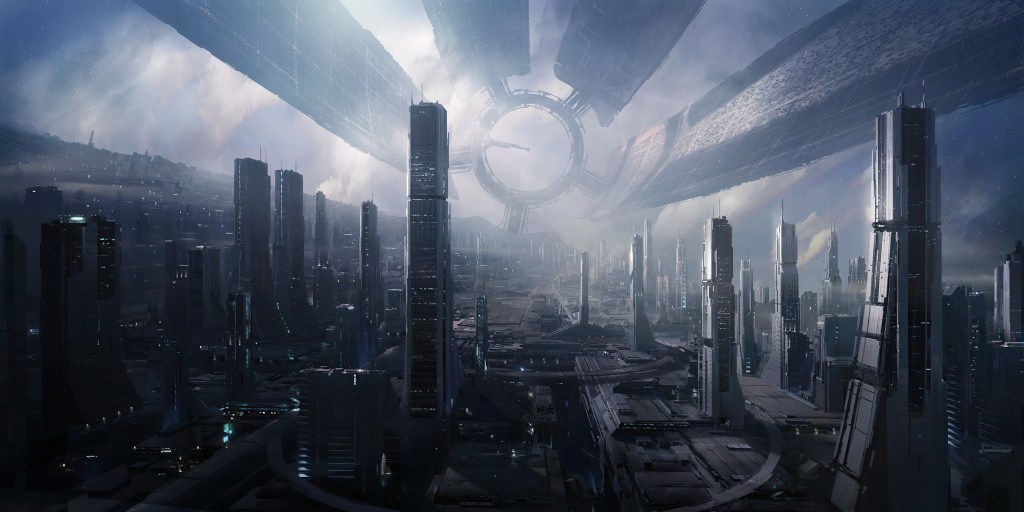
The Citadel, Mass Effect 2 (Credit: BioWare)
A case study in corporate and project mismanagement squandering a longstanding great reputation.
Fare Thee Well, BioWare.
A case study in corporate and project mismanagement squandering a longstanding great reputation.
2007 was a landmark year in gaming. Scores of genre-defining, industry paradigm shifting, all-time greats launched that year. The big two FPS series Call of Duty and Halo saw landmark entries, in that Call of Duty 4: Modern Warfare launched a new sub-franchise (the reboot of which concludes this week with the release of Modern Warfare 4) and Halo 3 ended a trilogy which had been running since 2001 and the release of the original Xbox. Assassin’s Creed introduced the world to the secretive orders of Assassins and Templars controlling world events from behind the scenes, Bioshock took us to the hellscape of Ayn Rand’s philosophies run amok in a science-fiction city under the sea gone terribly wrong, Mario explored a massive collection of stars in Super Mario Galaxy, Portal gave us a new type of 3D puzzle solving with dry quirky humor of a research facility also gone terribly wrong in the background, Nathan Drake proved to be a worthy successor to Indiana Jones in Uncharted, and so on and so forth. Another franchise put itself forward as a massive part of gaming culture in the late 2000s and early 2010s. BioWare released the first game in an iconic trilogy, by the name of Mass Effect.
BioWare had been around the gaming world for years by 2007, releasing beloved games such as Jade Empire, the original Baldur’s Gate, and the universally acclaimed Star Wars: Knights of the Old Republic I&II. But Mass Effect was their first wholly original outing in the new age of console gaming. The series was a space opera all their own in the next generation of consoles which captured the gaming world’s attention with their signature attention to detail, engaging characters, fascinating worlds, and branching storylines. A few years later, BioWare would follow it up with the first Dragon Age game, taking all their technical leaps and bounds from Mass Effect into a fantasy setting. In terms of action RPGs, BioWare ran the table back in the day.
BioWare announced it was shutting down on Wednesday of this week after thirty years in operation. How did that all go so wrong?
The short answer is: private equity ruins everything. The long answer is a complicated question which can be boiled down to bad project management over the course of decades coupled with idiotic directions from corporate overlords led to BioWare looking like a liability, allowing private equity to land the killing blow.
The Road Turned Bad
BioWare’s last undisputed success story was Dragon Age: Inquisition, which launched in 2014. It was the first BioWare project to use DICE’s Frostbite Engine. Frostbite was created by DICE to power their first-person shooter series, Battlefield. It was never meant to be used as an engine for other types of games, but because it was developed in-house, Electronic Arts (the parent company of both DICE and BioWare) mandated that all of their companies use Frostbite to make games, so that they didn’t have to pay licensing costs for other engines.
Now, Dragon Age and Mass Effect were previously developed by teams using the Unreal Engine. Unreal is an industry standard, familiar to many developers working in video games. With the change from Unreal to Frostbite, the development teams for both Dragon Age: Inquisition and Mass Effect: Andromeda had to learn new workflows, new tools, and the behavior of the new engine. Unreal is also more modular than Frostbite. Frostbite was designed first and foremost as an FPS engine, necessitating a lot of extra development work to create RPG systems like inventory and party management as well as animation in an engine that didn’t really want to do any of those things.
The developers spoke back in the day of the challenges in adapting an FPS engine to a third-person RPG environment, burdening the engine and the game builds with many workarounds and extra features Frostbite wasn’t designed to handle. As a result, graphical fidelity, gameplay, stability, and other factors were severely impacted, leading to the somewhat mixed reaction to Inquisition, and the very mixed reaction to Andromeda.
Then came Anthem. Anthem was BioWare’s first foray into a new IP since the original Dragon Age launched in 2009. Anthem was also rebooted from a story and gameplay perspective about eighteen months before launch after several years of little-to-no progress on building the game. The final result was basically dead on launch, with players complaining about the always online nature of the game, the necessity for co-op to advance, limited activities, uninspired story, lackluster gunplay, and so on and so forth. Basically, the only piece of Anthem that got praise was the flight system, which almost didn’t even make it into the final game. The game was a financial disaster, and a body blow to BioWare’s reputation. EA closed the servers for Anthem in January of this year.
Development delays, covid, and other factors led to the next BioWare game, Dragon Age: Veilguard, releasing in 2025, a full seven years after Anthem. Anthem was part of the reason, with Veilguard’s team being brought over to get Anthem over the finish line after development stalled out. The other part was that EA mandated that the singleplayer Veilguard become a live service multiplayer game. So BioWare used what they could to fit the new mold, throwing out all of the development work which had been previously done. Then EA told BioWare to switch it back. On top of all that, the release date kept shifting. For a major multi-year project like a Dragon Age game, the constant shifting of deadlines so the game was always ‘coming down the stretch’ dealt unimaginable damage to the development team’s ability to get the job done.
Mass Effect wasn’t spared from this ripple effect of bad management either. The N7 Program in the Mass Effect Universe is the Alliance’s top tier of soldier, and a very difficult program to get into. Commander Shepherd, the protagonist of the original Mass Effect trilogy, was one such soldier. As a result, November 7th (N7) became the unofficial Mass Effect day as decreed by the fandom before being adopted by BioWare as the official Mass Effect day. On November 7th, 2020, the next installment of the Mass Effect franchise was announced, to the delight of fans everywhere.
2017’s Mass Effect Andromeda was seen as a bit of a disappointment, due to an underbaked story, scaling back of the scope of the universe, some wonky mechanics, okay graphics for the time, open-ended obvious sequel hook, and for some fans, because it jettisoned the world players had grown familiar with (though with the multiple endings of Mass Effect 3, it would have been impossible to pick up right where the story left off at that definite conclusion). The lackluster response the game received led to EA or BioWare cancelling a direct sequel and any DLC, leaving Mass Effect adrift. The teaser for Mass Effect 5, confirming it was real, excited the fanbase and gave everyone real hope.
Then in 2025, Veilguard came out and got skewered in the court of public opinion and became very unprofitable. This came on the heels of EA being purchased by a private equity group which included a significant portion of ownership by a Saudi investment group. The concern over private equity owning a video game tentpole was proven to be correct with this recent set of layoffs and closures, and an announcement that EA would be pivoting the majority of its focus towards its sports and shooters. BioWare’s lackluster returns on investments with its RPGs just meant it didn’t fit with the ‘vision’ EA has.
With all of its output in the last ten years being seen as financial misfires, the sharpened axe fell for BioWare.
EA: The Devil at the Heart of it All
Some of BioWare’s failings can be attributed to the biggest problem facing the gaming industry these days: poor project management. Stories of every game developer having a lackluster title with all of the postmortem articles coming out talking about how there wasn’t a solid game roughly two years to eighteen months before the release date. Project management in large scale projects is everything when it comes to ensuring success. It means oversight over the work is being kept solid, blockers are dealt with efficiently, problems are solved, there are solid decisions being made throughout, and the totality of the project is being guided in such a way that time isn’t being wasted to achieve the final goal. BioWare struggled with this hard when it came to Anthem. However, good project management means nothing when the corporate overlords keep moving the goal posts and changing what sport the developers are playing.
EA is one of the worst gaming companies. Full stop.
Roll the clocks back to 2017. Mass Effect Andromeda came out to mixed reviews, but the Star Wars sequel trilogy was in full swing. Months ahead of the release of Episode VIII: The Last Jedi, EA was talking about their big Star War release. Battlefield developer DICE had been tapped a few years prior to create reboots of Pandemic’s Star Wars Battlefront games, which were universally beloved in the 2000s when they came out. Pandemic was one of the studios purchased by EA and shuttered shortly thereafter. Ahead of The Last Jedi’s release, DICE’s Star Wars Battlefront II was making its debut, and shortly after Mass Effect Andromeda’s launch, EA was doing the full court press to build excitement for Battlefront II.
When the game’s progression system was revealed, it was met with skepticism. Battlefront II was built around a loot-box style of progression, much to the consternation and frustration of gamers everywhere. Loot boxes are essentially a form of gambling, and EA loved them at the time because of how much money they can make. Tying in progression (as in: the ability to
Of course, when EA claimed the system was, “to give players a sense of pride and accomplishment,” it should come as no surprise that it became the most downvoted comment in Reddit history, spawned a meme which still occasionally pops back up to this day, and elicited an immense amount of community backlash.
This kind of microtransaction was not new to EA games. Mass Effect 3’s multiplayer, which came out upon the game’s release in March 2012, had the same progression style. New weapons, characters (which all had different abilities), upgrades, and equipment all came out in lootboxes. Each weapon had to be rolled ten times to fully upgrade them, and every character needed multiple awards to unlock all their customization options. The minorly saving grace with this is that Mass Effect 3 multiplayer was all cooperative against NPC enemies. Battlefront had player versus player combat as central to its gameplay loop. This meant new heroes, new weapons, and new abilities, as well as their upgrades, were all tied to randomized progression with the in-game currency used to obtain them being earned at a snail’s pace.
It’s this kind of anti-consumer, nonsensical decision that EA pushed on many of its franchises, and the kind of thinking which tanked BioWare as a company. EA believed that every game should see a massive return on investment, far outstripping what the market would actually dictate. It didn’t understand the secondhand love that many RPG fans would show in merch sales, tie-in media, etc. To EA, the games had to go gangbusters. They fundamentally didn’t understand what kind of company BioWare was. And BioWare isn’t the first company like this.
EA has had a reputation for decades in the gaming industry for purchasing studios, not understanding them, then absolutely gutting them when a release after corporate-inspired development hell doesn’t see record profits before ingloriously closing the studio shortly thereafter. EA also didn’t understand from a high level that a studio is often geared towards developing a specific style of game. To people who don’t understand the nuances of game development, the idea that a body of people can just be thrown at a given problem to make any kind of game is ludicrous. Different development teams specialize in different mechanics, game styles, genres, tools, workflows, etc.
With that being said, BioWare had its own set of problems, without EA’s involvement. A few paragraphs up, I wrote about the necessity for solid project management, and it was sadly lacking at BioWare. Games are often ‘in development’ for so long with no actual progress that by the time they have to start putting the shoulder to the wheel, there must be a clear direction, goals, and significant progress already down as part of the final game. However, EA contributed to that lack of solid project management with their way of running BioWare as overall owner trickling down. Corporate-style management and cost-cutting directives will interfere with any company’s internal processes after a long enough period of time.
EA killed BioWare slowly over the course of nineteen years. The gaming world is worse off for it.
Keelah Se’lai
The immediate announcement of BioWare’s closure led to a massive uproar within the gaming community, with the Mass Effect community feeling the sting most of all. In the immediate aftermath, a petition for EA to either not close BioWare or sell the company’s IPs to those who would do something with them reached over 75,000 signatures. The efforts were supported by Jennifer Hale and Mark Meer, both of whom served as voice actors for Commander Shepherd for all three installments in the Mass Effect trilogy (due to Shepherd being a customizable character). There was supposedly an effort from employees to purchase the company and its properties from EA which were dismissed out of hand. Avi Lewis, a member of Parliament in BioWare’s home nation of Canada wants to provide government support for the studio to remain in operation, out from under EA’s umbrella. At this juncture, all of these avenues lead to dead ends.
BioWare, for the moment, remains dead. Former studio boss and Mass Effect creative director, Casey Hudson, said he’ll “forever be grateful” for his time at the studio. And the sentiment has been shared by many former BioWare developers and employees, both who were laid off with this studio closure and who had left the company in years previous. Fans are in both mourning, and furious at EA, echoing sentiments shared by industry legend Warren Spector. Much of the criticism of EA’s handling of the studio is directed towards the profit-first motivation EA brought to the table. The way EA viewed BioWare’s projects by the end seemed to be that they were “prestige projects” and not reliable sources of income. The recurring shooter and sports games drive recurring profits for the company. While games in BioWare’s wheelhouse may be true in a sense of not providing massive boosts to quarterly or yearly profits, they serve a different purpose. Grand Theft Auto VI, for example, is projected to be one of the best selling games of all time. This is a game which is coming out thirteen years after its predecessor (albeit, Rockstar did release Red Dead Redemption 2 roughly midway between GTA releases) and has built phenomenal amounts of hype. However, Rockstar has built itself to be a juggernaut within the industry by carefully crafting incredible experiences where each release is an event. Without the mandates from a less-responsible corporate owner (like EA), Rockstar is able to craft games which can make up for the lack of massive revenue year by year with a reputation for high quality, replayability, and fun. While Anthem may have been a BioWare misfire of its own making, its other failures around it (namely Mass Effect Andromeda and Dragon Age Veilguard) cemented Anthem as part of a string of failures rather than the one-off mistake it would have been in the name of a studio trying something new. Trying new things for gaming studios is how the industry evolves, so while Anthem might have been a failure without any interference with EA, it wouldn’t have been the body blow to BioWare’s reputation the way it was sandwiched between Andromeda and Veilguard.
BioWare was a groundbreaking studio in many ways, creating fun, accessible RPGs with incredible writing, deep characters, fun action pieces, even if there were some troubles. It was one of the first studios to push queer representation in mainstream video games, for example. If the information which has come out in the days since the closure’s announcement regarding the now-cancelled Mass Effect Universe are any indication, the fifth entry into the Mass Effect franchise would have been another groundbreaking revolution for the franchise.
A trailer for the game leaked within a day of the announcement. Prominent video game journalist Jason Schrier confirmed it was real. The choices of the game were supposedly in line with Baldur’s Gate 3 and Cyberpunk 2077. The team even found a way to work around the controversial ending of Mass Effect 3 to respect what had come before without having to create an entirely new game for each of the endings to the original trilogy. There was apparently an immense amount of choices available to the player. If the quality of writing for Veilguard’s final chapter was any indication, the Mass Effect team had a bona fide hit in the works if they could have gotten it out the door.
BioWare’s failures can be traced back to much of EA’s mismanagement. Maybe not in totality, but a majority of its struggles over the last several years can be traced back to corporate mismanagement at higher levels. Whatever the reason, there are a lot of people mourning the loss of a developer which created so many iconic and beloved games over its thirty year history.
Farewell, BioWare.







Leave a Reply