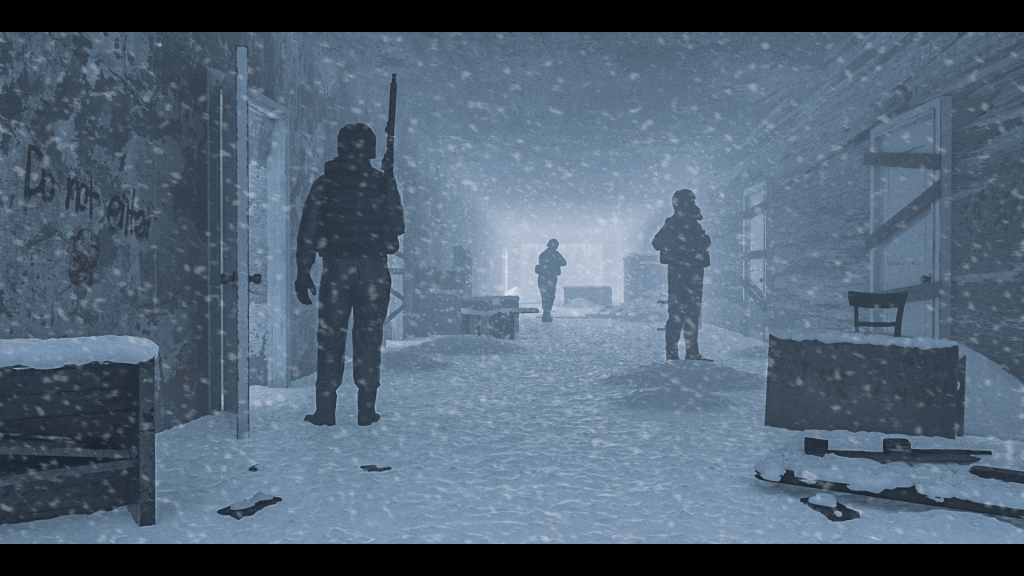
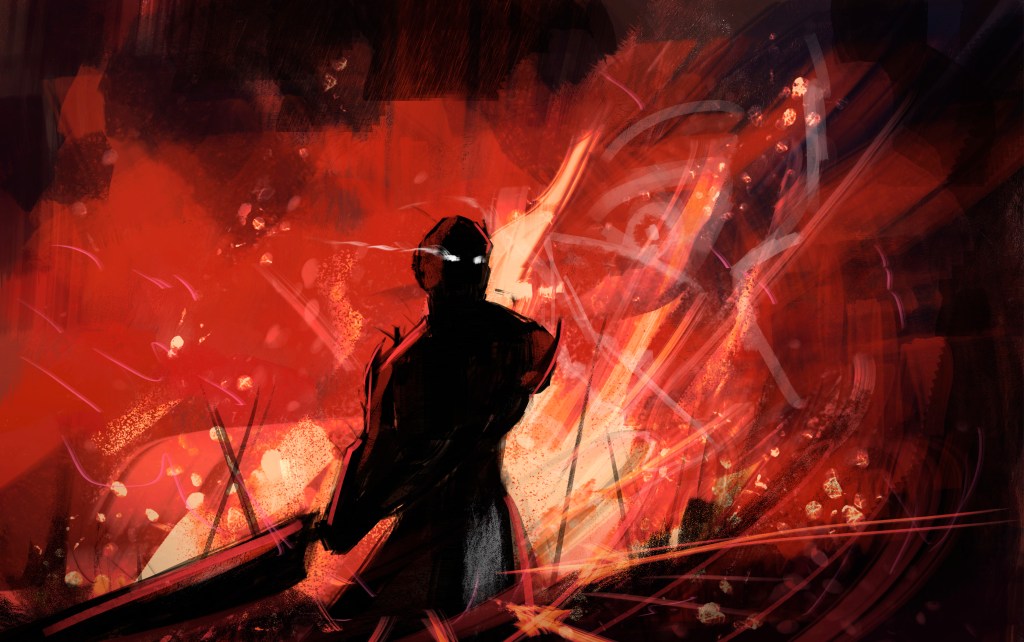
Do Not Enter (Credit: gunSlingeer on DeviantArt)
It was 1963, and the world was on the knife’s edge. President Lyndon B. Johnson had barely had a moment to breathe. The United States had been rocked by the crisis five days earlier when President John F. Kennedy was assassinated in Dallas. Johnson had never intended to become President under such circumstance, and when faced with the crisis of reassuring a shocked and grieving nation amidst a cloud of uncertainty and fear, his mettle was tested almost immediately. Overseeing the final White House preparations for a muted Thanksgiving, President Johnson helped solve a crisis halfway across the world which remained secret until now.
Thanks to interviews given by former White House staffers and military officers, declassified documents, Freedom of Information Requests, and a treasure trove of records mistakenly released to the public following the dissolution of the Soviet Union in 1991, we have assembled an account of the world’s most troubling events in late 1963.
It was late on November 27th. President Johnson had just given his “Let Us Continue” speech to a joint session of the 88th United States Congress. Returning to the White House while coming down from the minor high of his first speech to the nation’s legislature amidst the extreme lows of the previous week, Johnson was exhausted. He was looking forward to a quiet Thanksgiving, however, his world would be thrown off its axis by events even more intense than his predecessor’s assassination. While the President was in the House Chamber giving his historic address, a message from the Kremlin arrived on the Moscow-Washington Hotline. Official records have the first recorded usage of the hotline during the Six Day War in 1967, because the events following that message were buried by both governments.
Within an hour of his return from the Capitol, President Johnson received a phone call directly from the Kremlin. Only four people in the world heard that phone call: President Johnson, Soviet General Secretary Nikita Khruschev, and their translators. Nothing in the National Archives has turned up with any record of that conversation from the American side, however, documents which were mistakenly released in 1992, in the immediate aftermath of the Soviet Union’s collapse reveal that the call lasted almost two hours in length and was predicated on one factor which would have turned the world on its head.
The Soviets were asking for help.
Both leaders agreed that to keep the world stability intact that the two great enemies cooperating must remain the utmost secret. While the revelation of a sensitive joint venture might have taken massive strides toward ending the Cold War far earlier than it did in reality, it became clear in the research of this article that answering the questions which would have been asked in light of this historic secret cooperation would have plunged the world even deeper into chaos.
To understand the crisis happening behind the Iron Curtain, we first need to roll the clocks back another eighteen years. Following Adolf Hitler’s attempts to conquer Europe, the United States and the Soviet Union were acquiring as much of the Nazis’ scientific capabilities as possible. Operation Paperclip and its Soviet counterpart saw the systemic recruitment of prominent Nazi scientists whose work had value to the two new superpowers in an attempt to get an edge over each other. In addition to personnel, entire facilities were disassembled and brought back to the respective nations alongside whole libraries filled with all sorts of scientific research garnered through the Nazis’ horrific methods.
Where the United States used the core of the Nazis’ V2 rocket program to give NASA’s rocketry its own jump start, other Nazi scientists and engineers found themselves working in Groom Lake, Nevada on advanced aircraft prototypes. They quickly were put to work in the early 1950s on reverse engineering an unmanned UFO which crashed at Roswell, which formed the nucleus of America’s advanced scientific research units. Conspiracy theories surrounding UFOs which crash landed in Roswell, New Mexico were all the rage for years, and many people did not believe the government’s denials of alien life. While the craft itself was unmanned, its very existence overturned the belief that humans were alone in the universe.
America saw this as an opportunity. The wreckage of this gift from the heavens was transported to Area 51 so that American scientists could reverse engineer its components to gain some advantage over the Soviet Union. President Johnson was reportedly shocked by the revelations. In a once-classified memo detailing a conversation between the President and a staff aide to the National Security Council, Johnson was said to have remarked, “I see the proof in front of me and still do not believe it.”
The Soviets operated much on the same principles.
A report from a KGB Colonel by the name of Yuri Baranov outlined an inexplicable event. Baranov was in charge of a group within the Eighteenth Chief Directorate responsible for investigating events which threatened the secret weapons research being conducted within the borders of the USSR. Four pages from his report were accidentally released to the public in 1993, but weren’t translated into English until 2019. These pages were the first piece of this unbelievable puzzle.
These pages described in detail a conversation one of Baranov’s subordinates had with a scientist who had been working on a research project in the Ural Mountains. On November 26th, 1963, an entire town which laid in the shadow of Mount Yamantau mysteriously vanished. The town’s name remains shrouded in mystery but it is know that it was located near a facility conducting sensitive research for the Soviet Ministry of Defense.
A memo from Baranov himself was found after he had been called into a meeting with Khruschev. It read, ‘After call with LBJ, adversaries sending help.’ A former military official who declined to be named went on the record in 2003, shortly before his passing, in a never published interview which corroborated Baranov’s note.
Within the White House late that cold November night, President Johnson was faced with a choice which changed world history with anyone realizing. Under the highest levels of secrecy, the President immediately authorized a specialized detachment of United States Army Special Forces with ties to the CIA to travel to the Soviet Union and assist the KGB Spetsnaz in containing the situation.
But what was that situation?
On June 30th, 1908, there was an explosion in a remote part of Siberia, near the Podkamennaya Tunguska river. The world knew, through scientific measurements that something hit the Earth, creating one of the most powerful explosions ever recorded by mankind. However, nobody knew what it was.
Soviet mineralogist Leonid Kulik visited the central blast site of the Tunguska Event on his second expedition to the area in 1927. The official records of the event state a miraculous conclusion: that there was no crater, but a massive area where the trees had been flattened except at the central blast zone, in which the trees were upright but scorched and devoid of branches. Over the next several years, further scientific expeditions were carried out to this site to study what might have done this.
Or so the Soviet government reported.
In actuality, there was a crater at ground zero, though trees being flattened, scorched, and stripped of branches were true. It was just that the impact of an extraterrestrial spacecraft was to blame for this tremendous event. The report, with photographic proof, made it all the way to Soviet General Secretary Joseph Stalin’s desk. On his orders, the impact zone became a secure military site, and all further ‘expeditions’ were really missions to study the craft and transport it to a more secure location. However, Stalin expressly forbade attempting to reverse engineer this craft, and it became one of the Soviet Union’s most tightly held secrets, coming to rest in an off-the-books research facility outside of Voronezh.
Then the war came.
Upon the launch of Operation Barbarossa, which saw Nazi Germany execute a massive invasion of the Soviet Union, Stalin ordered the Tunguska craft to be moved to a secure facility in the Ural Mountains, far from the fighting. Many of Stalin’s moves with this craft used other, larger decisions as cover. The craft was moved during the mass wave of relocating factories to beyond the Urals, out of range of the Nazis. A construction crew built a containment and research facility in the shadow of Mount Yamantau. The mountain’s name, ominously meaning ‘wicked mountain’ in the tongue of the local Bashkir people, would only serve as a premonition of what came next.
A journal from an aide to NKVD head Lavrentiy Beria was included in the documents released in 1992. The aide was eventually imprisoned for crimes against the state and executed shortly before Stalin’s death in 1953. There were many entries of interest to historians, especially about the leadup to the war itself. But it revealed a bit about the efforts to keep the Tunguska craft secret as well. Stalin’s paranoia meant that he ordered the death of many of the scientists who had uncovered the Tunguska craft. They were swept up in the Great Purge of 1938. Many who survived the purges would perish during the war, such as Leonid Kulik, who died after being taken prisoner by the Germans during the battle of Stalingrad.
Stalin’s paranoia over the power the Tunguska craft would not be shared by his successor. During the power struggles which occurred following Stalin’s death in March of 1953, Khruschev came to learn of the craft’s existence. He ordered that the ‘Tunguska Podarok’ or ‘Gift’ be utilized to its full extent. With the American detonation of the Ivy Mike thermonuclear weapon the year prior, Khruschev wanted to have a backup plan in case the Soviets’ efforts at creating their own hydrogen bomb failed. In Khruschev’s mind, if there was a weapon he could shepherd the development of in short order, it would solidify his position as the next leader of the Soviet Union, ousting Beria and Georgy Malenkov.
The Americans were not the only ones toying with things they did not understand in the pursuit of dominance over their great geopolitical rival. Once Khruschev solidified power, he began diverting immense resources to study the Tunguska Gift. After ten years of study and experimentation, they had a breakthrough.
That breakthrough is why Khruschev called Johnson.
White House phone and visitor logs released through a Freedom of Information Request pertaining to the aftermath of Kennedy’s assassination revealed that Yuri Baranov visited the White House, accompanying Soviet ambassador Anatoly Dobrynin following phone calls with the American Embassy in Moscow. A copy of the President’s schedule for December 3rd revealed the purpose of the meeting. Baranov was in Washington to brief the President on information he had presented to the Presidium of the Soviet Union three days earlier pertaining to the Urals incident. Following this meeting, the President signed a now declassified executive order. Though heavily redacted, the sentence, “All scientific resources at the disposal of the United States to [REDACTED] will be provided to Colonel Baranov for the duration of the crisis.” Though a lengthy clause was redacted, the choice of the word “crisis” gave away the event’s serious nature.
This is where the other central player of the drama behind the Iron Curtain first shows up in the narrative. Doctor Gerald Stipe. Stipe was a physicist who studied at the University of California, Berkeley, under J. Robert Oppenheimer in the years before the war broke out. Choosing a different path, Stipe was never part of the Manhattan Program, but contributed to American scientific research endeavors, joining the Advanced Research Projects Agency (ARPA) upon its founding in 1958. Stipe was brilliant, easy to work with, and had a knack for project management. His skillset pushed him away from the science he so desperately loved.
Stipe traveled to the Soviet Union, landing in Moscow on December 5th, where he met with researchers at both the Kurchatov Institute and the Keldysh Institute of Applied Mathematics. According to Stipe’s diaries and the writings of acclaimed Soviet scientist Anatoly Nevskiy, the incident involved some sort of mass displacement brought on by attempts to reverse engineer the craft’s power source. With nuclear energy on the rise in both superpowers, finding something without the resource requirements or the risk would have all but guaranteed Soviet dominance in the world energy race.
KGB records on Stipe’s first day detail discussions about a gateway opening up, as well as Stipe’s excitement at the challenges of the program. December 7th saw a detachment of the KGB Vympel home security units travel with Mystic Group, a specially assembled group of Army Green Berets who had arrived two days earlier. Baranov had been placed in charge of containing the unit, and coordinated with US Army Major Jesse Harling, who was placed in command of Mystic Group. Soviet documents from the site show a cooperation shown by US and Soviet forces not even practiced during the Second World War.
The reports from scientists on both sides of the Atlantic revealed the fully dramatic picture of what situation they were containing. It was theorized that both the Roswell and Tunguska crafts came from the same space-faring civilization, as many of the scientists Stipe brought with him from Area 51 remarked upon the similarities. Notes from a working session on December 9th reveal that the combined scientists theorized that the town was somehow displaced when what they believed to be the faster-than-light components of the spacecraft’s systems activated without the other systems working in sequence. Instead of displacing the craft, it affected the town instead.
An after-action report regarding a firefight with what an American Sergeant called “Shadows” revealed the existence of some sort of doorway. For three days, the soldiers held the line, becoming bonded as brothers in arms against whatever these shadows were. They fired bullets which matched the characteristics of rounds used by both the Americans and Soviets, and the soldiers who got hit did not see any unusual effects from being hit.
A breakthrough came on December 13th, which prompted the panic to set in. Stipe and Baranov claim to have spoken to other versions of themselves who predicted the events of the following two days with pinpoint accuracy. On the 15th, their credibility established, the doubles of Stipe and Baranov begged their normal versions to destroy the craft which would close the gateway and, as Baranov recalls, “put an end to [their] nightmare.”
Journal entries from one of the junior scientists spoke about how unnerved both Stipe and Baranov were and barely slept. An official report from a Soviet Captain spoke about how the gateway began growing angrier, as if it were threatening to expand and ‘consume’ more of the world around it. The attacks by the Shadows grew more intense. A casualty report on December 23rd lists Yuri Baranov amongst the dead. A record of disciplinary action on December 24th notes that three Soviet soldiers worked with two Americans to gain access to explosives and perform some other action, but this section of the report was redacted.
White House visitor logs have Doctor Stipe visiting the White House on December 29th. The roster of soldiers deployed as part of Mystic Group was never made public knowledge. Doctor Nevskiy spoke publicly about humanity glimpsing the face of forces it was never meant to know existed after the USSR’s dissolution, and supposedly wrote a book detailing the events of that November and December. However, the manuscript was never found after Nevskiy’s death in March of 1994 from age and liver failure thanks to many decades of heavy drinking.
Colonel Baranov was given a funeral with full military honors. Members of the American military were reportedly in attendance, but there are no records of their names. KGB records indicate a group of American soldiers and scientists who routinely traveled to the Soviet Union even at the height of Cold War tensions, but sadly, no record of their identities can be found either. Baranov’s deputy, a man named Ivan Kirilenko, showed up on White House visitor logs thirty-four times between 1964 and 1982. Similarly, KGB records show Gerald Stipe flying into Moscow to meet with senior officials at the Kremlin two dozen times between 1964 and 1987. Neither Soviet nor American authorities ever raised any issues at these specific individuals traveling between countries.
Doctor Stipe died in 1992. He never wrote about his time in the Soviet Union, and seldom gave interviews. After his death, a journal which he had kept since his time as a student at UC Berkeley went missing from his effects. Who took the journal and why have never been uncovered.
President Lyndon B. Johnson would oversee the passing of legislation aimed to bring civil rights to the nation and expand social welfare. He escalated the War in Vietnam during the rest of his tenure as President before opting to step aside in the 1968 Presidential election. First Secretary Khruschev would be ousted by his government before the end of the following year. Neither man spoke about the incident before they died.
When called for comment, the Russian Ministry Defense denied any knowledge of the events, despite the area in question around Mount Yamantau remaining an exclusion zone. The United States Department of Defense remained similarly closed lipped. The only clue we received during the course of our inquiries was a name.
“Operation: Shattered Veil.”



Leave a Reply