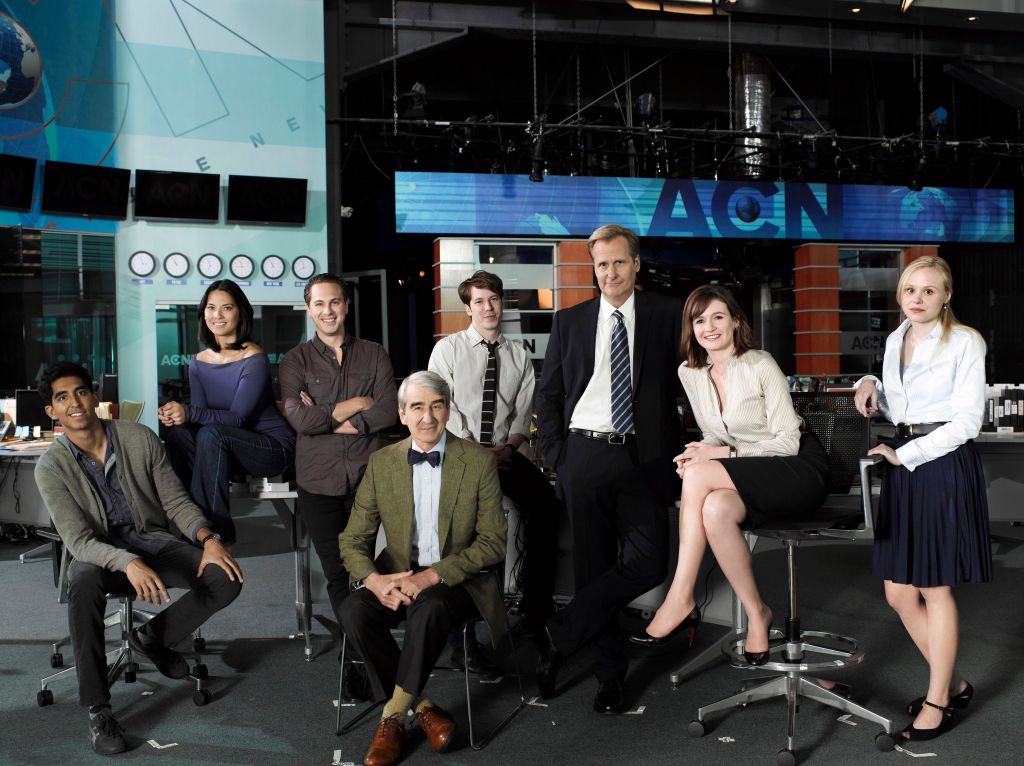
The cast of The Newsroom (Credit: HBO)
No discussion of the greatest television shows of the 21st century would be complete without The West Wing. Series creator and writer (for the first four seasons) Aaron Sorkin has been a Hollywood powerhouse for decades. Aaron Sorkin is somewhat of a divisive writer for television and film. Despite this, he has written films and television shows which have all captivated audiences, known for their fast-paced, witty dialogue and in many instances, idealistic tone.
Most of Aaron Sorkin’s television shows start the same way: an important character says something they shouldn’t say on television, and the pilot episode deals with the fallout of such a decision. In The West Wing, White House Deputy Chief of Staff Josh Lyman (played by Bradley Whitford) went on a tirade against members of the Christian right, claiming that “the God [Mary Marsh] pray[s] to is to busy being indicted for tax fraud.” In The Newsroom, Atlantis Cable News anchor Will McAvoy (played by Jeff Daniels) gives an impassioned rant while at a panel for media personalities at Northwestern University explaining why America isn’t the greatest country in the world anymore. In Studio 60 on the Sunset Strip, the executive producer of a weekly sketch comedy show goes on a rant about the state of television which embarrasses the network and causes his firing. The biggest connecting tissue of these show is that they follow what happens outside of the public eye. Many moments on The West Wing took place in the leadup to large events such as the State of the Union, but the actual events were seldom depicted, or were confined to background footage during other scenes.
Sorkin reuses plotlines, character archetypes, lines of dialogue, and other things which give his shows a sense of continuity. It also makes things feel very familiar, sometime almost predictable. There is a connecting set of DNA throughout Sorkin’s shows, but the two that best exemplify it are The West Wing and the Newsroom. Both of these shows see a group of idealistic, dedicated people try to navigate a variety of situations related to their industry as best they can. In that way, there’s something almost comfortable about Sorkin’s writing. Clever, witty, idealistic, and somehow both timely and timeless all at the same time. While every conversation is as unrealistically witty as could possibly be expected, every situation the characters find themselves in and every challenge they are faced with feel so very real.
Plotlines are ripped from the headlines, and try to examine things with a deep look even if Sorkin’s writing can get a little preachy or one-sided. Throughout an episode of say, The West Wing, the characters will be faced with a policy problem and often disagree about the best way to address it. The arguments (at least while Sorkin was writing the show) were never personal, and they helped to examine the policy issue at length. Characters’ positions also felt pretty consistent with who they were as people, making them feel a lot more three-dimensional and consistent.
Another of Sorkin’s hallmarks is that the main characters are all struggling for a common goal. Interpersonal drama is seldom a plot motivating factor, it’s always a group of bright and passionate people tackling the problem together. Even when one or several of them sprint headfirst into a wall or make the issue of the week worse, they solve it as best they can, and they solve it together. It’s a refreshing change of pace from other shows who want to crank up the drama by having a group of people who should be trying their best to work together all too willing to turn against each other because it creates cheap drama.
Sorkin’s critics believe he is overly preachy, smug, and writes all of his characters to espouse his personal viewpoints. The criticism of Sorkin’s plots is that they are liberal wet-dreams and wildly unrealistic. To a degree, that may be true. However, what in Hollywood isn’t unrealistic? It’s easier to count more that’s wrong than what’s right with some movies which make hundreds of millions of dollars at the box office. Yet they still become beloved classics, or fun popcorn flicks, or critical darlings.
A lot of the flak that Sorkin catches for the way he writes shows and movies is unfair. He is not trying to show a perfect reality, but write the worlds of journalism and politics and society the way they should be. Sorkin’s shows dare us to believe in a world where the political leadership of this nation, both in the majority and minority, act for the greater good of the public. He shows that journalists should have spines in calling lies what they are, and that there is no honor in running from telling the truth responsibly.
It’s also a wrong criticism that his characters are always the good guys, do everything right, and always win. The West Wing’s first season was predominantly characterized by the staff of the Bartlet White House being held back from doing anything substantial and when they did get a victory, it was a rather pyrrhic one. The second season saw the revelation of the President’s multiple sclerosis that was never disclosed when he was running for office. The final five episodes of Season 2 were about how White House Communications Director Toby Ziegler figures out the President may not be running for reelection, prompting President Barlet to come clean to the American people. A significant portion of the following season is about the President coming to grips with accepting his culpability at doing something wrong.
Most of the time in the show, the administration might get a couple of impactful bills or initiatives passed, but most of their victories were soured by what they had to give away in order to get the win. The most memorable storylines on the show were when characters were pushed past their normal morality, especially when the President revealed he had MS or had to give a controversial order for national security purposes (especially in the wake of 9/11 in the real world). It’s a refreshing take on Washington to see leaders willing to admit to their faults and mistakes and face the consequences for them. It’s an optimistic look at the world of politics which the nation sorely needs because the people working in the industry are honest and true, not because the whole of the industry is.
In a similar vein, the Newsroom gets criticism for being a depiction of the people who get the news right perfectly. The overarching plotline of the second season is about a major news story the staff airs only to find out they were completely wrong, the story they aired being an allegation that the military used chemical weapons on civilians during a secret rescue mission. It cost the audience’s trust in the network, which became a problem in the third season. The show was set a couple of years before it aired, which meant that it could depict major news stories with the perfect benefit of hindsight. The show’s first episode took place on the day of the BP Deepwater Horizon disaster in 2010, as the staff puts together the actual story and airs it as opposed to the less-informed version which aired on all the other major networks in real life.
The goal of the team as they reboot the flagship news show is to change the hearts and minds of people in America with impactful reporting. The show being set in the past means that they obviously didn’t do so. Their goal to change people’s minds fails hard. By setting the show in the recent past, Sorkin makes the point that people getting the news right in the best way are probably not going to change the country singlehandedly, but it’s a fight worth fighting anyways.
Sorkin shows an idealistic truth: many industries are filled with idealistic people trying to do their best. They often fail. They often don’t reach their lofty goals. But striving for them is still ultimately a worthy use of time and effort. Even if you fail. Especially if you fail. The message isn’t that there is some magical world where the bleeding heart liberals can give an impassioned speech, everybody rises and claps, and the credits roll into the sunset. It’s saying, in a Margaret Mead quote which Sorkin often uses, to “Never doubt that a small group of thoughtful, committed, citizens can change the world. Indeed, it is the only thing that ever has.”
The optimism seen throughout the West Wing is something which should be aspired to. To act, not for purely partisan reasons but to try and best serve the American people is something to which politics should aim for. The reality of hard decisions and difficult compromises, and the challenge of balancing the needs of the American people with the often less-than-ideal circumstances of the American political system is something the show excels at demonstrating. This optimism is exactly why the show drew so many people to politics.
The kind of optimism at the heart of Sorkin’s shows, especially The West Wing and The Newsroom is something the world needs far more of. In today’s day in age, it’s almost mandatory to be apathetic or cynical regarding society and its institutions. There’s this idea that the whole American Experiment is a failure and there isn’t anything redeeming about it. More that that, there’s this idea that everything is doomed to be awful all the time, so it is pointless to try to make it better and you’re a naïve idiot for wanting it to be so. It’s not unjustifiable to think so, but it also isn’t constructive. To take it a step further, being so apathetic and resigned to everything being a failure only enables the worst in society to line their own pockets and hold undue influence.
The real White House under the best of circumstances isn’t quite like the West Wing, but who is to say it can’t be? Who is to say that idealism is dead in an era of cold, self-serving “pragmatism?” A world where dreaming of a better society is something to be derided isn’t a fair world at all, nor is it a world that any great society should strive for. Will McAvoy’s tirade as to why America isn’t the greatest country in the world is followed up by a rousing call to action. America needing to recognize that it is not the greatest country in the world and understanding why people used to say it was and how it can be again is the heart of Sorkin’s ethos. The nation is better when the people in charge of its institutions believe in their power and capacity to do good.
Without the assent of the people, they are incapable of doing anything, so it is up to all of us to build that world, to elect those leaders, and be willing to listen to the truth even if it’s inconvenient or not desirable.









Leave a comment